49 works in this view — arrow keys or swipe to move between them.
Dance in Art
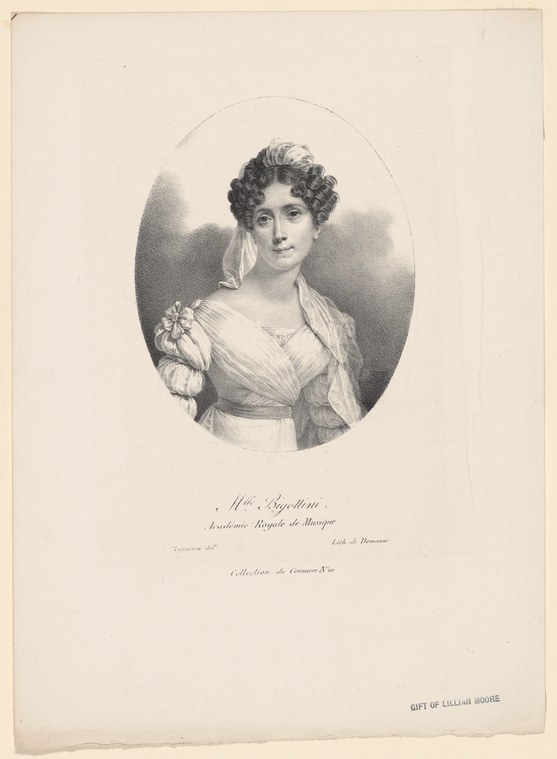
Mlle. Bigottini, Academie Royale de Musique
Unknown artist
- Collection:
- Prints depicting dance
- Source:
- New York Public Library
- Rights:
- Public domain — free to use, share and adapt.
- Recorded as:
- Public Domain
Bigottini was a significant performer in early Romantic ballet (she danced in *La Sylphide* and other important works), and this print is part of the visual archive by which dancers were known and circulated to the public. The image reveals the gendering and aestheticization of the dancer—she is presented as a society object rather than a working artist—which is itself a crucial historical fact about how women's dance labor was framed and valued.
What you are looking at
A three-quarter-length portrait of a young woman set within an oval frame, rendered in fine stippled engraving. She faces the viewer with a composed, neutral expression, her dark hair arranged in fashionable waves with a white ribbon or headpiece. She wears a high-waisted white gauze or muslin dress with long sleeves and a low neckline in the Regency style, and holds a small bouquet of flowers—a single bloom visible in her hand. The background is softly shaded with atmospheric effect, creating depth without narrative setting. The engraving is skillfully executed with delicate cross-hatching that models the face and fabric with considerable refinement. Below the portrait runs an inscription identifying her as a member of the Académie Royale de Musique, the Paris Opéra.
The dancing
The sitter holds herself upright and still, with no active dance posture visible. One arm rests naturally at her side holding flowers; the other is not visible. Her shoulders are relaxed and level. There is no evidence of the turned-out legs, lifted spine, or dynamic weight distribution characteristic of a dancer in motion or even in a posed performance attitude. The pose is that of a society portrait rather than a dance image.
The dance depicted
Mlle. Bigottini was a notable dancer at the Paris Opéra during the Romantic era, celebrated for roles in ballets of the 1820s–1830s. This is a formal society portrait rather than a documentation of dance itself. The image tells us that she was celebrated enough to warrant publication as a society portrait—a mark of professional standing—but conveys nothing about her technique, repertoire, or performance practice. No dance-specific iconography or movement is depicted.
How it was made
This is a line engraving, executed in fine stipple and cross-hatch rather than the bolder line work of earlier engraving traditions. The technique allows subtle modeling of faces and fabric, producing a refined portrait suitable for circulation as a society print. Such engravings were typically reproduced in albums and periodicals aimed at an educated urban audience interested in the theater and cultural life. The oval vignette format was fashionable for celebrity portraiture of the period.
About this work
This is a society portrait of a professional dancer at the Paris Opéra, not a dance image proper. Mlle. Bigottini is presented as a fashionable young woman of standing rather than as a performer captured in action or in stage costume. The work belongs in a gallery of dance imagery because it documents how dancers were publicly represented and celebrated in the early 19th century—not as workers or athletes, but as cultured, elegant members of the entertainment elite. The portrait preserves the likeness of a historically documented performer whose name appears in the records of Romantic-era ballet, offering evidence of the social position and visual culture surrounding the female dancer in this period.
How to look at it
Attend to the conventions of society portraiture: the restrained pose, the fashionable dress, the flowers as a mark of femininity and cultivation. Note that there is no attempt to capture the sitter in her professional role—no stage costume, no dynamic pose, no reference to the physicality of dance. This is precisely the point: the dancer is presented as a desirable object and cultured woman, not as a technical artist. The oval frame and refined technique signal her respectability and marketability to an urban audience.
The artist
The engraver is not named in the catalogue record. The inscription attributes the print to 'Lith & Darcourt', likely the lithographer or publisher. The style and finish suggest a professional atelier producing society portraits and theater celebrity prints for the Parisian market in the 1820s–1830s.
The period
The Romantic era (1820s–1840s) saw the flourishing of ballet as a major art form in Paris, centered on the Opéra. Female dancers achieved celebrity status and were subjects of popular prints, portraits, and critical discussion. The high-waisted Empire/Regency silhouette visible here dates the portrait to the 1820s–early 1830s, a period when Bigottini was active. Society portraiture of performers was an established commercial genre, circulated to fans and collectors, and this print is part of that infrastructure of fame and public image-making.
Where it lives
The work is held in the New York Public Library's collection of prints depicting dance. It is part of a substantial archive of theatrical and dance imagery, primarily European, from the 18th and 19th centuries. Such prints were produced for circulation and sale to the theater-going public and form an important visual record of the entertainment industry and celebrity culture of the period.
Questions about this work
Was Mlle. Bigottini a famous dancer?
Yes. She was a soloist at the Paris Opéra during the Romantic ballet era and is documented in the repertoire of major works of the 1820s–1830s. She represents the first generation of dancers to achieve widespread public celebrity and visual reproduction through prints and portraits. However, detailed accounts of her technique and career are limited.
Why is this a portrait and not a stage image?
Society portraits of performers were a separate commercial genre from stage imagery or dance documentation. They circulated to fans, theater subscribers, and collectors who wanted likenesses of admired performers in fashionable dress. This format elevated the dancer's status by presenting her as a society figure rather than confining her to a theatrical role.
What does the flower signify?
The bouquet is a standard attribute of feminine beauty and refinement in 19th-century portraiture. It signals elegance, youth, and desirability—qualities valued in both dancers and upper-class women. It has no direct connection to dance or performance.
More dance artwork





