49 works in this view — arrow keys or swipe to move between them.
Dance in Art
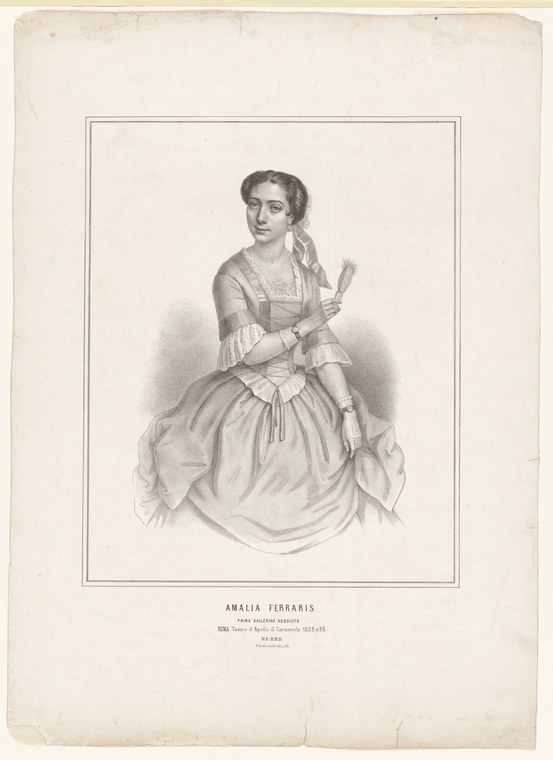
Amalia Ferraris: Prima ballerina assoluta. Roma, Teatro d'Apollo, il Carnevale 1855, e 56
Unknown artist
- Collection:
- Prints depicting dance
- Source:
- New York Public Library
- Rights:
- Public domain — free to use, share and adapt.
- Recorded as:
- Public Domain
Amalia Ferraris was one of the last great Italian prima ballerinas to dominate European stages during the Romantic ballet era; this portrait is contemporary documentation of her celebrity at a specific season. The work preserves not her dancing but the visual and social identity constructed around her fame—how a nineteenth-century prima ballerina was presented to the public and how her status was commodified and circulated through prints.
What you are looking at
A three-quarter-length portrait of a young woman seated in an elegant interior, posed with evident consciousness of her status as a prima ballerina. She wears a full mid-nineteenth-century dress of pale fabric—likely silk—with a fitted bodice and voluminous skirt gathered at the waist, the skirt's folds rendered with careful attention to light and shadow. A decorative belt cinches her waist. She holds a small fan or similar accessory in her right hand, raised near her shoulder in a graceful gesture. Her left arm rests across her lap. Her hair is styled in the fashion of the 1850s, pulled back smoothly with what appears to be a decorative element. The background is plain and neutral, keeping all attention on the sitter. The light falls from the left, modeling her face and figure with the soft but precise chiaroscuro of engraving.
The dancing
A single figure in a seated, three-quarter pose. The woman's posture is upright and composed, her shoulders squared, her head turned slightly toward the viewer. The raised right arm is extended in a graceful curve, the hand holding an object (fan or similar accessory) at shoulder height—a pose that suggests trained deportment and balletic carriage even in stillness. The line from shoulder to fingertips maintains the elegant elongation prized in Romantic-era ballet. Her seated position does not collapse but maintains the tension and lift of a trained dancer.
The dance depicted
This is a portrait of Amalia Ferraris, an Italian prima ballerina assoluta who performed at the Teatro d'Apollo in Rome during Carnival 1855–56. The inscription confirms her professional identity and the specific venue and season. The work documents her as a celebrated dancer at the height of the Romantic ballet era, when Italian ballerinas remained prominent on European stages despite the dominance of French and Danish schools. The portrait is not a dance scene but a representation of the dancer herself as a public figure—a convention that emphasizes her celebrity status and refined bearing rather than the movement itself.
How it was made
This is an engraving, identified from the linear hatching, tonal gradations built from parallel lines, and the characteristic line-work of the medium. The technique allows precise rendering of the sitter's features and the fabric's texture while creating a work suitable for reproduction and wide circulation. The style and printing method suggest this is a commercial or promotional engraving, likely published as a celebrity portrait—the kind distributed in theatrical programs, newspapers, or collected as prints by admirers. Such engravings served both to document performers and to build their public image.
About this work
This engraved portrait documents Amalia Ferraris, an Italian prima ballerina assoluta, in street dress during the 1855–56 Carnival season in Rome. It is a celebrity portrait in the formal tradition, emphasizing the dancer's refined and elevated social status rather than depicting her in performance. The work belongs to the visual culture of nineteenth-century theatrical celebrity, when engravings of celebrated dancers were produced and circulated to the public as luxury objects and mementos. Ferraris represented the persistence of Italian ballet excellence during the Romantic era, and this portrait is a record of her fame at a specific moment and place. The engraving's precision and elegance reflect both the medium's technical capacity and the sitter's elevated position as a prima ballerina assoluta—a rank that placed her at the pinnacle of the profession.
How to look at it
Attend to the dancer's upright carriage and the lifted, elongated line of her raised arm—these betray balletic training even in a seated, non-performance pose. The carefully arranged folds of her skirt and the attention to the fabric's volume and fall are not incidental details but part of the sitter's presentation as a woman of wealth and refined taste. The engraver has taken care to render her face with clarity and flattery, creating a portrait that serves as both a record and a promotional image. The neutral background directs all attention to the figure, making her the sole subject of interest.
The period
This portrait dates to the height of the Romantic ballet era, when the ballerina had become the principal focus of theatrical dance and a major celebrity. Amalia Ferraris (1826–1904) was an Italian dancer who achieved international fame, performing in Paris, London, and throughout Europe. By the 1850s, Italian dancers faced competition from the dominant French and Danish schools, but Ferraris remained celebrated for her technical prowess and dramatic presence. The 1855–56 Rome season would have been late in her performing career, yet she retained her status as prima ballerina assoluta—a rank granted to only the greatest dancers. The engraved portrait was a standard medium for documenting and promoting theatrical celebrities of the period; such prints were collected, displayed, and exchanged among theater-goers and were often sold in the theater lobby or through print publishers.
Where it lives
The work is held in the New York Public Library's collection of prints depicting dance. The inscription identifies it as a commercial engraving, likely published in Italy or distributed internationally; such prints were standard theatrical merchandise of the period.
Questions about this work
Who was Amalia Ferraris?
Amalia Ferraris (1826–1904) was an Italian prima ballerina assoluta—a rank reserved for the greatest dancers. She achieved international fame during the Romantic ballet era, performing in major European cities. By the 1850s, when this portrait was made, she was one of the last great Italian ballerinas to maintain prominence as the ballet world increasingly centered on French and Danish dancers and techniques.
What is a prima ballerina assoluta?
Prima ballerina assoluta is the highest rank in ballet, bestowed only on the most accomplished and celebrated dancers. It signifies supreme technical mastery, dramatic presence, and status within the profession. The rank was more common in the nineteenth century and is now rarely awarded.
Why is she dressed in street clothes rather than a ballet costume?
This is a celebrity portrait, not a dance scene. Such engravings documented performers as public figures and were sold or distributed as theatrical souvenirs and promotional materials. The formal dress emphasizes the sitter's refined taste and elevated social status, presenting her as a woman of consequence rather than only as a dancer.
What is the Theater d'Apollo in Rome?
The Teatro d'Apollo (also called Teatro Apollo) in Rome was a major theatrical venue in the nineteenth century. The inscription specifies that Ferraris performed there during Carnival 1855–56, one of the major social and theatrical seasons in Rome. Such seasonal playbills and star engagements were typical of the theatrical calendar across Italy and Europe.
More dance artwork





