49 works in this view — arrow keys or swipe to move between them.
Dance in Art
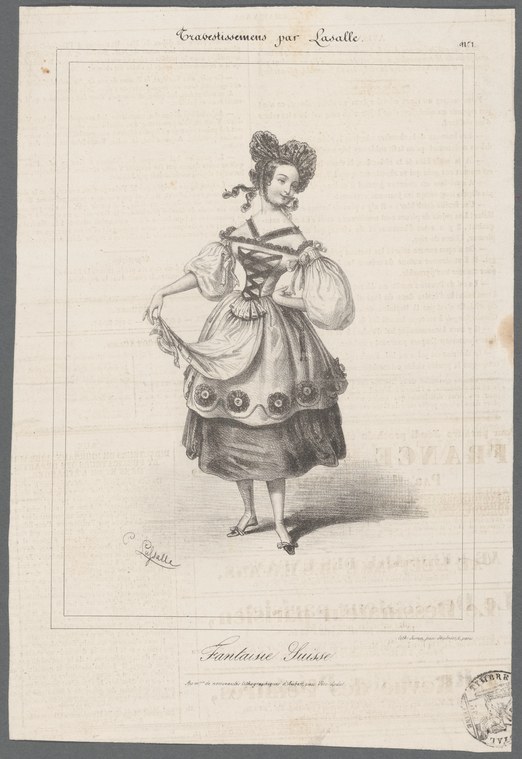
Fantaisie suisse
Unknown artist
- Collection:
- Prints depicting dance
- Source:
- New York Public Library
- Rights:
- Public domain — free to use, share and adapt.
- Recorded as:
- Public Domain
This work demonstrates how 19th-century European artists and publishers used lithography to circulate images of folk costume and regional dance identity to urban audiences, often conflating actual ethnographic practice with theatrical fantasy. The careful attention to costume detail—the scalloped hem, the geometric lacing, the hair styling—reveals what manufacturers, theaters, and audiences understood (or imagined) about Swiss folk dress, making it valuable evidence of how national identity and folk practice were constructed and consumed through visual media.
What you are looking at
A single female figure stands at center in a three-quarter pose, gazing downward with a composed, almost demure expression. She wears a dark skirt with a distinctive scalloped hem decorated with circular ornaments or appliqués, and a lighter-colored apron or overskirt draped and gathered at her sides. Above, a fitted corset or bodice with bold diagonal lacing or binding creates a graphic geometric pattern across her torso. Her hair is styled up in the fashion of the early 19th century, with ringlets or curls piled atop her head. The figure is set against a plain background within a simple ruled border, rendered in black ink on paper with a toned or aged surface. The title inscribed below reads "Fantaisie suisse" (Swiss Fantasy), and the work is signed by the artist, though the signature is difficult to read with certainty.
The dancing
The dancer's posture is upright and stationary rather than dynamic—weight evenly distributed, arms held at mid-height with the elbows slightly bent and hands positioned at the sides or gathered toward the front of the skirt. The pose emphasizes display and presentation rather than motion; she does not appear caught mid-step, but rather posed for observation. The body is relaxed, the gaze downward, suggesting a moment of stillness or repose. There is no indication of a partner or ensemble.
The dance depicted
The inscription "Fantaisie suisse" (Swiss Fantasy) and the costume details—particularly the distinctive scalloped hem and the style of the apron and bodice—suggest this represents a Swiss folk or regional dance costume or a romanticized interpretation of one for theatrical purposes. Swiss folk dance was a subject of interest in 19th-century European art and popular culture, often depicted in costume albums or theatrical prints. However, the figure's static pose and formal presentation suggest this may be a costume study or fashion plate rather than a documentation of actual movement. Without visible dynamic gesture or a clear setting, the specific dance form cannot be identified with confidence.
How it was made
This is a lithographic print, identifiable by the characteristic crayon or tusche marks, the tonal gradations achieved through stone printing, and the aged, cream-colored paper stock typical of early to mid-19th-century lithography. The signature and inscription are drawn directly on the stone. Lithography allowed for rapid reproduction and wide circulation, making such prints affordable for middle-class audiences interested in fashion, theater, and folk culture. The technique's capacity for fine detail and tonal modeling suited costume documentation and theatrical prints intended for performers, costumers, or the general public.
About this work
This is a lithographic costume study or theatrical print titled "Fantaisie suisse," depicting a female figure in a richly decorated folk or folk-inspired costume of the early 19th century. The work belongs to a tradition of European prints documenting regional or exotic dress—often in the context of ballet, pantomime, or staged entertainment—for audiences fascinated by folk culture and national identity. The precise dance form is unclear from the static pose alone, but the Swiss designation and the costume's specific details mark it as part of a broader commercial output of costume imagery during a period when folk and regional dance were subjects of theatrical and artistic interest.
The print represents both a document of how 19th-century performers understood and presented Alpine folk dress, and evidence of the market for such imagery. As part of the New York Public Library's collection of dance-related prints, it contributes to the historical record of how European regional and folk dance was interpreted, marketed, and consumed in the theater and popular imagination.
How to look at it
Observe the costume details: the scalloped hem with circular ornaments, the diagonal geometric lacing of the bodice, the style of the apron, and the period hair arrangement. These elements are rendered with precision and pride, suggesting they are the point of the image. Note that the figure herself is static and posed, not caught in motion—the lithographer is documenting costume and dress, not choreography or dynamic gesture. The frontal, slightly turned pose and downward gaze are conventions of fashion and costume plates, designed to show the garment clearly rather than to convey a moment of dance itself.
The artist
The artist's signature on the stone is legible but difficult to read with certainty in reproduction. The work belongs to a significant 19th-century practice of lithographic costume documentation, associated with theatrical supply, fashion illustration, and the broader market for prints of performers and folk types. Without secure identification of the artist, the work should be understood as part of a commercial or editorial enterprise rather than a unique autographic creation.
The period
This print dates to the early or mid-19th century, a period of intense European interest in folk culture, national identity, and Romanticism. Ballet and theatrical dance were incorporating folk themes and regional costume into entertainment; works like Romantic-era ballets drew on (or invented) folk and peasant subjects for dramatic and exotic effect. Simultaneously, lithography had made theatrical costume documentation widely available, creating a market for costume plates intended for performers, designers, and fashion-conscious audiences. The title "Fantaisie suisse" signals both the period's interest in Switzerland as a picturesque Alpine subject and the theatrical convention of presenting such subjects as "fantasies"—artistic inventions rather than faithful ethnographic records.
Where it lives
The work is held in the New York Public Library's collection of prints depicting dance. It is catalogued as part of a broad historical archive documenting dance representation in print media, though minimal curatorial description accompanies the record. The library's collection includes thousands of such costume and theatrical prints, reflecting the 19th-century market for reproducible dance imagery.
Dance in this work
Questions about this work
Is this a portrait of an actual dancer?
Likely not. The work is a costume study or idealized costume plate, not a portrait of a specific performer. The static pose, the formal presentation, and the title "Fantaisie suisse" all indicate this is a theatrical or artistic conception of Swiss dress rather than a document of an individual dancer or performance.
What dance is being shown?
The specific dance form is not clearly identifiable from the image alone. The costume and title suggest Swiss folk dance traditions, but the static pose prevents certainty about the actual movement form. It may represent a theatrical interpretation of folk dance rather than a specific folk dance itself.
Why does the figure look so still?
The pose is typical of 19th-century costume prints, which prioritized clear display of the garment over the depiction of dynamic movement. The artist's goal was to show every detail of the dress, ornamentation, and styling to an audience of theater practitioners, costumers, or fashion enthusiasts.
What is that scalloped decoration on the hem?
It appears to be appliqués or embroidered ornaments—likely circles of contrasting fabric or embroidery applied to the skirt edge. Such ornamental detailing was typical of folk costume and was heavily emphasized in theatrical costume interpretation of the 19th century.
More dance artwork





