49 works in this view — arrow keys or swipe to move between them.
Dance in Art
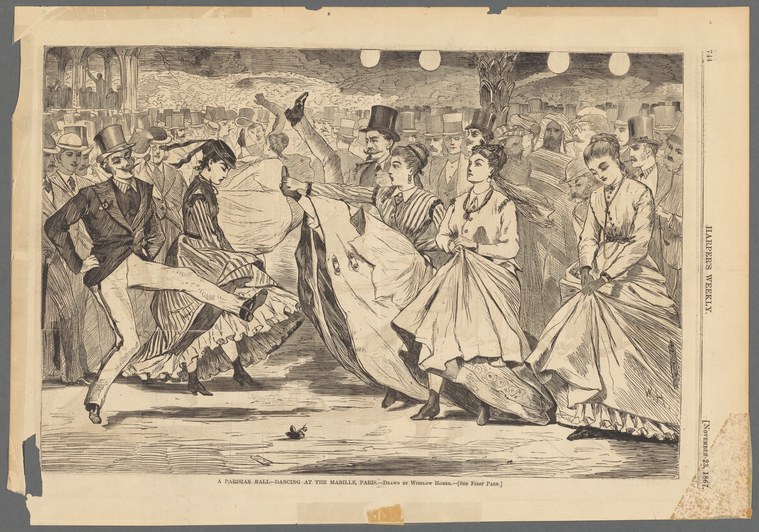
A Parisian ball; dancing at the Mabille, Paris; drawn by Winslow Homer
Unknown artist
- Collection:
- Prints depicting dance
- Source:
- New York Public Library
- Rights:
- Public domain — free to use, share and adapt.
- Recorded as:
- Public Domain
This image documents a crucial moment in the democratization of dance in Europe. The Mabille was where ordinary Parisians went to dance in public, not a court or a theater; the engraving captures a social venue and social practices that had no equivalent in earlier periods. For historians of dance and social history, it is direct evidence of what people wore, how they held their bodies, and how they moved together in a celebrated public space.
What you are looking at
A crowded ballroom at the Mabille, a famous Parisian dance hall, captured in a moment of exuberant social dancing. The scene is rendered in pen and ink with lively cross-hatching that conveys movement and energy. In the foreground, couples dance amid a throng of spectators in evening dress—men in tailcoats and top hats, women in full-skirted gowns. The composition is packed with figures; some dance, others watch and gesture animatedly. The artist has positioned the foreground dancers prominently, capturing a woman mid-turn with her skirt billowing outward, her partner reaching toward her with extended arm. Hanging globe lights illumine the scene from above, and the background recedes into a crowd of onlookers and further dancers, suggesting the scale and energy of the venue. The whole effect is one of vivacity and social spectacle—this is a fashionable public entertainment at its height.
The dancing
The principal figures are in open or semi-open frame, engaged in what appears to be a turning or pivoting action typical of galop or polka. The man's posture is forward-leaning and engaged; the woman's body is in a pronounced turn, her weight shifted to create the billow in her skirt. Other couples visible in the composition adopt similar frames—upright, energetic, with arms extended and bodies in dynamic relation to one another. The drawing style captures momentum and bounce rather than the precise alignment of formal court dances. Faces are animated, suggesting participation in the social and visual spectacle as much as the dance itself.
The dance depicted
This depicts social ballroom dancing at the Mabille, a mid-19th-century Parisian dance hall famous for public social dancing among the working and middle classes. The style is most consistent with the galop or polka, both fast turning dances that were enormously popular in Paris in the 1850s–1870s and that produced exactly this kind of exuberant, skirt-billowing movement. The Mabille was not a venue for formal court dances or ballet, but rather for vigorous social partnered dances that prioritized speed, turning, and visible pleasure. The image captures the democratic, public character of the venue—dancing was entertainment and participation combined, watched by spectators as much as performed by dancers.
How it was made
This is a wood engraving or steel engraving, a technique that allowed for fine detail and wide circulation through mass printing. The artist (identified in the record as Winslow Homer) has used dense cross-hatching and fine line work to suggest movement, light, and the texture of fabrics and flesh. The technique was well suited to newspaper and periodical illustration, and this work likely appeared in a illustrated journal or newspaper. Wood and steel engraving required skilled translation of the artist's drawing onto the plate, making the work a collaborative production between artist and engraver; the vigorous, expressive line work suggests a hand skilled in capturing spontaneous social scenes for a wide public audience.
About this work
This is a journalistic illustration of social dance at the Mabille, a famous Parisian public ballroom, rendered as an engraving in the mid-to-late 19th century. The work captures a moment of exuberant social dancing—fast turning dances like the galop or polka performed in a crowded, fashionable public venue. The composition emphasizes both the dancers and the spectators, treating the scene as a social and visual spectacle rather than a formal performance.
The work is significant as a record of how ordinary (or at least non-aristocratic) people danced in a commercial public venue, and as an example of journalistic illustration—visual reporting on contemporary social life. It documents not just the dance form but the social context in which it was performed: the public nature of the venue, the role of spectacle and fashion, and the visual pleasure of watching and being seen.
How to look at it
Attend to the moment of the turn—the artist has frozen the action at the point where the woman's skirt is at its fullest billow, capturing the centrifugal force that made these fast dances so visually spectacular. Notice how the artist has rendered the crowd: not as background, but as integral to the scene, with watching faces and gesturing bodies as animated as those of the dancers. The engraving technique allows fine detail even in dense areas; look at how fabric texture, light, and motion are conveyed through line and cross-hatching rather than shading. This was a technique designed for newspaper reproduction, so the artist has prioritized clarity and visual drama over subtle modeling.
The artist
The catalogue record attributes the drawing to Winslow Homer, an American illustrator and painter (1836–1910) known for his work as a war correspondent and social illustrator during the American Civil War and in the years after. Homer made his reputation as an illustrator for wood engraving; he was trained in lithography and became one of the most prolific and skilled illustrators of the mid-19th century. If this attribution is correct, the work may have been made during Homer's time in Europe or based on sketches made during a visit. However, the attribution should be verified; Homer's known works do not prominently feature French dance-hall subjects, and the record notes authorship as uncertain.
The period
The Mabille was one of the most celebrated dance venues in Paris from the 1840s onward, particularly famous in the 1850s and 1860s. It catered to a broad middle- and working-class clientele and was the site of the public performance of galops and polkas—fast, turning dances of Central European origin that had become fashionable in Paris. These dances replaced the slower, more formal quadrille as the leading social dances of the period. The venue itself was part of a broader expansion of commercial leisure in urban Europe; public dance halls proliferated as cities grew and as dancing became a form of paid entertainment and social spectacle. Journalistic illustration, particularly in the form of wood engraving, was the dominant medium for recording contemporary social scenes for newspapers and illustrated periodicals; this was the era before photography became common enough to serve this function.
Where it lives
The work is held in the Prints collection at the New York Public Library, identified as a reproduction or clipping of an engraved illustration. The record provides minimal information on date, original publication, or printing history.
Dance in this work
Questions about this work
What was the Mabille and who danced there?
The Mabille was a public dance hall in Paris, celebrated in the mid-19th century as a venue where Parisians of ordinary means could go to dance socially. It was famous for fast turning dances like the galop and polka, and became a subject of fascination for artists, writers, and journalists. Unlike court balls or theaters, it was a commercial venue where people paid admission to dance and watch others dance.
What dance is being shown here?
The movement and the setting point to the galop or polka, both fast turning dances that were hugely popular in Paris in this period. These dances are characterized by speed, turning, and the kind of billowing skirt visible here. Both were of Central European origin and had become fashionable in Paris by the 1850s.
Why is this an engraving and not a painting?
Wood or steel engraving was the standard technique for mass-producing illustrations in newspapers and periodicals in the mid-19th century. A skilled engraver would translate the artist's drawing onto the wooden or steel plate, and the plate could then be printed thousands of times. This technique allowed contemporary visual reportage to reach a wide public—it was the equivalent of photography in a modern newspaper.
Is this actually by Winslow Homer?
The record attributes it to Homer, but with uncertainty. Homer was a prolific illustrator in this period and worked on many social and contemporary subjects. However, his known works do not prominently feature French dance subjects, so the attribution should be treated as provisional pending further research.
More dance artwork





