49 works in this view — arrow keys or swipe to move between them.
Dance in Art
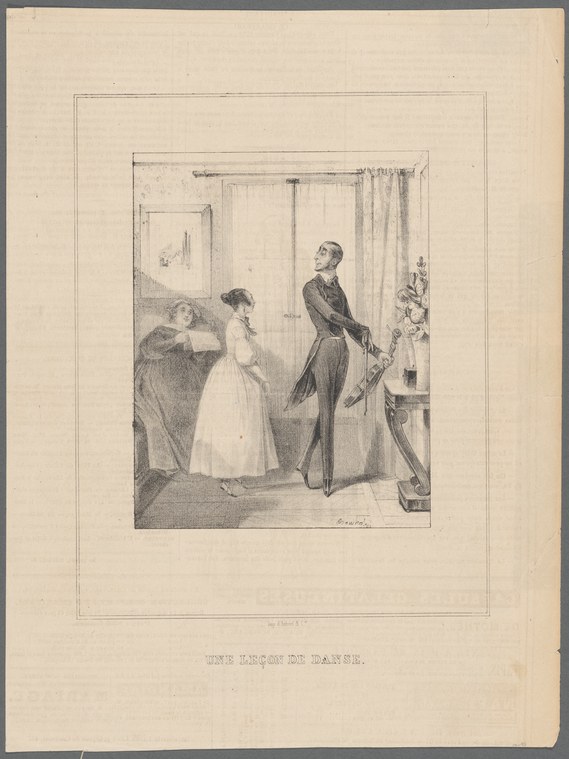
Une leçon de danse
Unknown artist
- Collection:
- Prints depicting dance
- Source:
- New York Public Library
- Rights:
- Public domain — free to use, share and adapt.
- Recorded as:
- Public Domain
The image is a rare direct record of how dance was actually taught and understood in the nineteenth century outside the theater: not as virtuosity or spectacle, but as a component of genteel female education and deportment. For historians of dance pedagogy and social history, it documents the dancing master as a professional type and the domestic space in which social dance was transmitted across classes.
What you are looking at
A young woman in a white muslin gown stands at the center of an elegant interior, receiving instruction from a tall gentleman in dark formal dress—a dancing master or choreographer. Behind her, an older woman in dark clothing watches from the shadows. The room is defined by tall windows with heavy curtains and classical architectural details; a small table with flowers sits to the right. The lighting is soft and diffused, concentrated on the student and instructor in the foreground. The composition frames this as an intimate moment of social accomplishment: the formal instruction of a young woman in deportment and dance, a marker of genteel education in the nineteenth century.
The dancing
The young woman stands in an upright, composed posture with her weight balanced; her arms hang at her sides in a relaxed but proper carriage. The dancing master leans slightly toward her with an extended arm and open gesture, gesturing as if demonstrating or correcting her position. His posture is authoritative but not harsh; he instructs rather than reprimands. The watching chaperone remains passive and distant. No active stepping or turn is depicted—this is the moment of instruction and correction, not execution.
The dance depicted
The scene represents a dance lesson in the ballroom tradition, almost certainly a waltz or quadrille given the period and domestic setting. The work depicts the pedagogical context of nineteenth-century dance: a young woman of means receiving tuition from a professional dancing master, a common and essential component of female accomplishment among the middle and upper classes. The moment chosen is static and formal—the pause between movements in which the master corrects the student's position or explains the next sequence. Nothing here requires advanced technique; this is social dancing at its foundation, not theatrical performance.
How it was made
This is a lithograph or engraving on paper, evidenced by the fine linear hatching, the tonal modeling through parallel lines, and the characteristic delicacy of light control typical of mid-nineteenth-century reproductive printmaking. The technique allowed for sharp detail in the figures' dress and faces while maintaining atmospheric recession in the background. The refined finish and careful composition suggest this was a finished print intended for distribution and collection, not a preliminary sketch—likely circulated among the genteel classes who could afford such instruction.
About this work
This lithograph or engraving captures a quintessential scene of nineteenth-century social life: the private instruction of a young woman in the basic decorum of ballroom dance. The dancing master—a recognizable professional figure of the era—stands in a position of instructive authority, correcting or guiding the student's posture and frame. The work documents not a performance or a moment of virtuosity, but the foundational labor through which dance was transmitted in polite society: patient, repetitive, corrective, and primarily concerned with bearing and propriety. Dance here is neither art nor entertainment, but accomplishment—one of the skills that marked a woman's fitness for marriage and social participation. The presence of a chaperone underscores the propriety and formal nature of the transaction, even as the one-on-one focus creates an intimate pedagogical space.
How to look at it
Observe the postures: the student's formal upright frame, the master's slightly forward lean and open gesture of instruction. Notice that no step is being executed—the artist has chosen the moment of pause and correction, the verbal or gestural explanation rather than the physical demonstration. The facial expressions are composed and dignified; this is not a moment of joy or social ease, but of formal pedagogy. The chaperone in the background, though secondary, is essential to the meaning: her presence ensures propriety and marks this as an official educational transaction, not a social encounter.
The period
The print dates to the nineteenth century, a period in which ballroom dance had become the primary social dance form across Europe and North America. The waltz, quadrille, and cotillion dominated fashionable society. Dance instruction was professionalized and formalized: the dancing master was an established professional, often with published methods and pedagogical systems. Simultaneously, dance instruction had become a marker of class aspiration; the ability to dance well and move with proper deportment was essential to female respectability and marriageability. This image reflects that cultural moment when dance was both a social necessity and an expression of refinement.
Where it lives
The work is held in the New York Public Library's collection of prints depicting dance. It is an unattributed nineteenth-century print, likely of European origin given the interior décor and the stylistic conventions of the figure drawing.
Dance in this work
Questions about this work
Who was the dancing master?
In the nineteenth century, the dancing master was a professional instructor, usually male, who taught ballroom and social dances to members of the middle and upper classes. They were typically trained in a specific method or system and often published instruction manuals. They held an important social position, as they mediated between professional theatrical dance and the social practices of polite society.
What would a lesson like this actually have involved?
A lesson typically involved learning the basic positions and frames of ballroom dance, practicing the fundamental steps of waltz, quadrille, or cotillion, and correcting the student's posture, carriage, and partnering. The master would demonstrate, the student would imitate, and correction would follow. Lessons were often conducted in the home and were essential preparation for balls and public assemblies.
Why is the chaperone present?
The presence of a chaperone ensured the propriety and respectability of the lesson. Even though dance instruction was routine and respectable, the one-on-one contact between an unmarried young woman and a male instructor required a witness to maintain her reputation. This reflects the strict social conventions governing contact between unrelated men and women in this period.
More dance artwork





