49 works in this view — arrow keys or swipe to move between them.
Dance in Art
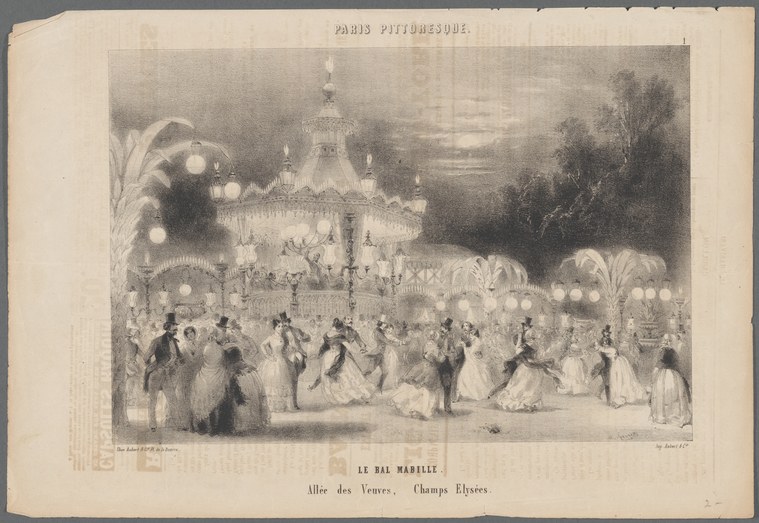
Le bal Mabille. Allée des Veuves, Champs Elysées
Unknown artist
- Collection:
- Prints depicting dance
- Source:
- New York Public Library
- Rights:
- Public domain — free to use, share and adapt.
- Recorded as:
- Public Domain
The Bal Mabille was one of the first purpose-built, commercialized dance venues in Paris, and its popularity (it operated 1840–1870) marks a shift in how dance moved from court and aristocratic salons into public, ticketed, mixed-class urban spaces. This image is one of the few surviving visual records of that venue and of the Romantic waltz as it was actually danced in its social context, not in theater. For dancers and historians, it is evidence of the social rituals that structured ballroom practice, the role of costume in defining participation, and the emergence of dance as urban spectacle.
What you are looking at
A grand nocturnal ball scene set in the Allée des Veuves at the Champs Élysées in Paris. The composition is dominated by an ornate, illuminated structure at center—a large pavilion or ballroom with a prominent tower or cupola—flanked by tall trees strung with countless hanging lanterns that create a constellation of light across the composition. Hundreds of elegantly dressed figures populate the space: couples dancing, groups standing in conversation, and solitary figures moving through the scene. The women wear full skirts with bare shoulders in the Romantic fashion, while the men are in dark evening dress with pale shirts. The lighting is theatrical and artificial, suggesting gaslight or similar illumination technology new to public spaces in this period. The atmosphere is one of metropolitan sophistication and leisure—this is a fashionable public dance venue at night, designed to spectacle as much as to dance.
The dancing
The dancers depicted are chiefly in closed hold—man and woman facing each other with hands joined—executing what appears to be a smooth, gliding motion across the floor. Many couples are captured mid-turn or in progression. The hold is formal and symmetrical, the upper bodies upright and restrained, the movement flowing rather than percussive. Some figures stand stationary in groups, observing. The weight of the dancers appears centered and the frame vertical, with little visible flexion or ground contact emphasis. This is ballroom dancing of the mid-19th century: controlled, partnered, and executed with an elongated line.
The dance depicted
This is social ballroom dancing of the Romantic era, almost certainly waltzes and quadrilles, the dominant partner dances of fashionable Parisian society in the 1840s–1860s. The Mabille (or Bal Mabille) was a famous open-air dance garden that operated in Paris during this period, attracting both society figures and the working classes in an unusually mixed social environment. The image shows the characteristic costume and closed-hold partnering of the Romantic waltz, though the outdoor and semi-public setting (and the presence of stationary onlookers) suggests the social ritual was as much about being seen as about the dance itself. The number of simultaneous couples and the formal spacing indicate a managed social space governed by implicit rules of propriety and decorum.
How it was made
This is a lithograph, recognizable by the characteristic tonal gradations, the way light is built through layered shading rather than line, and the soft, slightly granular quality of the image. Lithography was the dominant medium for dance imagery in 19th-century Paris because it reproduced atmospheric effects—light, shadow, fabric texture—better than engraving, and could be printed in editions large enough to reach a middle-class audience. The technique allowed the artist to suggest the nocturnal setting through tonal control: the lanterns glow against darker foliage, and the figures emerge from shadow. This suggests the work was produced for popular circulation, likely as a broadsheet or periodical illustration, documenting a celebrated public spectacle.
About this work
This is a lithographic record of social ballroom dancing in mid-19th-century Paris, specifically at the Bal Mabille, a fashionable open-air dance garden. The work captures the Romantic era's idealized vision of public sociability: elegantly dressed couples executing the waltz and quadrille under artificial light in a specially designed landscape of trees and lanterns. The artist has chosen to emphasize the theatrical and congregational aspects of the event—the lighting design, the density of the crowd, the mixing of dancers and observers—rather than the technical details of the dance itself. The work belongs in a dance archive both as documentation of a specific historical venue and as evidence of how dance and spectacle were intertwined in the construction of modern metropolitan leisure.
How to look at it
The viewer should attend to the composition of light: note how the artist has used the lanterns strung overhead as the visual anchor of the scene, drawing the eye upward and outward to suggest the scale and architectural ambition of the venue. Look at the variation in the clarity and definition of figures: those nearest are rendered with more detail and specificity, while those in the background dissolve into shadow and tone, a technique that suggests both the actual conditions of nocturnal outdoor viewing and the social structure of the event (some dancers are prominent, others peripheral). Notice the stillness of many figures—this is not a frozen moment of frenzied motion but a prolonged exposure of social ritual, with dancers and onlookers equally important to the scene. The artist has chosen to represent the dance not through technical virtuosity but through atmosphere and social context.
The period
The Romantic era (1820–1890) saw the waltz rise from aristocratic scandal to mainstream social practice across Europe, codified in etiquette manuals and celebrated in literature and visual culture. Paris in the 1840s–1860s experienced rapid urbanization and the emergence of new public leisure spaces—open-air gardens, dance halls, cafés—that democratized social dancing and created new audiences. The Bal Mabille, located in what was then the fashionable western quarter of Paris, capitalized on this demand; it became famous for attracting both respectable bourgeoisie and working-class dancers and spectators, a social mixing that contemporary critics found both thrilling and morally ambiguous. In visual culture, lithography had become the primary medium for documenting urban life and public spectacle, allowing artists to capture atmospheric effects—light, crowd, movement—that earlier engraving could not. Dance imagery proliferated in periodicals and broadsheets, making the ballroom a canonical subject for urban social commentary.
Where it lives
The work is held in the New York Public Library's collection of prints depicting dance. It is catalogued as a lithograph but lacks a recorded artist, date, or publication information in the current record. The inscription 'PARIS PITTORESQUE' at the top and the title 'LE BAL MABILLE' suggest it was part of a larger series of Parisian tourist or social interest prints, likely produced for a Parisian or European audience in the mid-to-late 19th century.
Dance in this work
Questions about this work
Was the Bal Mabille a real place?
Yes. The Bal Mabille was an actual open-air dance garden located on the Allée des Veuves (now Avenue Montaigne) in the Champs Élysées quarter of Paris. It operated from approximately 1840 to 1870 and was famous for attracting a socially mixed clientele—bourgeois families, dandies, working-class dancers, and curiosity-seekers—making it unusual for its era and a subject of intense contemporary commentary.
What dance are they doing?
The closed-hold partnering and flowing progression visible in the image indicate the waltz, though quadrilles (a group dance in square formation) would also have been danced at such venues. The waltz was the signature dance of mid-19th-century public ballrooms; it had evolved from its earlier association with scandal into the respectable foundation of social dancing by this period.
Who danced at the Bal Mabille?
The Bal Mabille's fame lay partly in its social mixing: respectable bourgeois families, young professionals, students, and working-class Parisians all attended. This was unusual in an era of rigid social stratification, and contemporary accounts reveal anxiety and fascination about this mixing. The venue became a subject for realist literature and social commentary.
Why is it lit up at night?
The Bal Mabille was one of the first large public spaces in Paris to be extensively illuminated by gas light, a new technology in the 1840s–1860s. The lanterns visible overhead created an artificial landscape designed to extend sociability into evening hours and to make the venue itself a spectacle. Night lighting was expensive and marked the venue as modern and fashionable.
More dance artwork





