49 works in this view — arrow keys or swipe to move between them.
Dance in Art
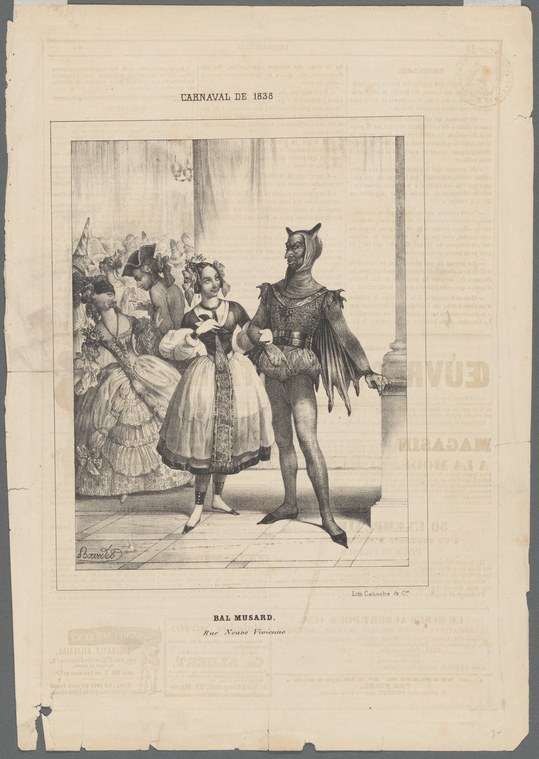
Bal Musard, Rue Neuve Vivienne
Unknown artist
- Collection:
- Prints depicting dance
- Source:
- New York Public Library
- Rights:
- Public domain — free to use, share and adapt.
- Recorded as:
- Public Domain
This work documents the role of public masquerades and balls in 1830s Parisian social life—venues where conventional restrictions on gender interaction and social behavior were temporarily suspended. It is evidence of how dance and costume functioned not only as aesthetic performance but as social practice and courtship ritual. For historians of leisure, gender, and urban modernity, it illustrates the rise of commercialized public entertainment and the visual recording of that culture through popular prints.
What you are looking at
A masquerade ball in progress at the Rue Neuve Vivienne, a fashionable Paris address. The scene captures a moment of social encounter between two figures center stage: a woman in an elaborate white ball gown with voluminous skirts and a decorative bodice, her face turned toward a man dressed in a striking devil or demon costume—dark, winged, with exaggerated features and a grotesque mask. The woman's companions cluster behind her in colorful silks and satins; other dancers and attendees populate the background in formal dress. The setting is an interior space with classical architectural detail—columns visible at right—suggesting an elegant ballroom or salon. The composition emphasizes the theatrical contrast between the woman's refined white gown and the man's grotesque costume, capturing the playful transgression that masked balls permitted in 1830s society.
The dancing
The woman stands upright, her posture open and engaged, her elaborate skirts dominating the foreground. The man in the devil mask leans slightly toward her in a posture of exaggerated courtesy or courtship—a grotesque parody of galant attention. Both figures occupy nearly the same vertical plane, facing each other across a narrow space. The supporting figures behind the woman are posed as attentive witnesses to this encounter, their body language suggesting amusement and social play rather than dance in the strict sense. No closed holds or partner frame is visible; this is social encounter rather than choreographed movement.
The dance depicted
This is not a depiction of a specific dance technique or style, but rather a social scene from a masquerade ball—a form of public entertainment and courtship ritual prominent in Paris during the July Monarchy (1830–1848). The Bal Musard (also called Bal de l'Opéra Comique or similar public masquerades) was a famous venue for such events. The image documents the social performance and flirtation that masquerade balls enabled: the freedom of anonymity and costume permitted encounters and behaviors that daytime society would not allow. The 'dance' here is social choreography—the rituals of approach, response, and spectation—rather than any formalized dance style.
How it was made
This is an engraving or steel engraving, as confirmed by the fine linear hatching, the tonal modeling through parallel lines, and the signature 'Lith Galerie' at the bottom (indicating a lithographic printing process). The technique allowed for fine detail in costume and facial expression while maintaining tonal depth. The image appears to be a popular print—reproductive, distributed, and addressed to a broad middle-class audience interested in social satire and Parisian life. The presence of a title, clear labeling, and a publication mark suggests this was part of a series or book illustrating contemporary manners, similar to the satirical prints of Honoré Daumier or the fashion and society prints circulating in the 1830s–1840s.
About this work
This is a satirical or observational print documenting social life at a Parisian masquerade ball circa 1830s. It captures a moment of flirtation and social encounter between a fashionably dressed woman and a man in grotesque costume, witnessed by companions in an elegant ballroom. The work belongs to a broader genre of social and satirical prints depicting Parisian life and manners in the July Monarchy—a period of urban growth, rising middle-class leisure culture, and public entertainment venues. The masquerade ball was one site where conventional social hierarchies and courtship rituals were suspended and inverted through costume and anonymity. This print documents not a ballet or folk dance, but the social performance and choreography of urban leisure and desire.
How to look at it
Look at the costume contrast: the woman's refined white silk and the man's grotesque winged mask are locked in visual opposition, and the print's composition emphasizes this tension through the empty space between them and the attention of witnesses. The title 'Bal Musard' (or similar) signals that this is a specific, recognizable venue, not a generic scene. The artist has chosen the moment of encounter—not movement or dancing, but the social pause before or after contact. Notice how the grotesque figure's exaggeration (the demonic mask, the spindly legs, the theatrical wings) is the point: masquerade permitted a mockery of courtly gallantry and a reversal of power relations through costume.
The artist
The artist is unrecorded in the catalogue. The style, technique, and subject matter are consistent with the production of Parisian satirical and social prints in the 1830s–1840s—a period of rapid expansion in lithographic and engraved prints aimed at middle-class readers and interested in documenting contemporary life and manners. Such prints were often anonymous or attributed to minor commercial printmakers, engravers, and illustrators whose names were not preserved.
The period
The 1830s–1840s saw the rise of public commercial entertainment venues in Paris, including masquerade balls, cabarets, and dance halls catering to middle-class and working-class pleasure seekers. Masquerade balls had a longer history (dating to the 18th century) but became more frequent and more publicly accessible in the 19th century. Simultaneously, the visual culture of satire and social observation—pioneered by artists like Daumier—created a market for prints depicting Parisian life, manners, and social rituals. Ballet was undergoing its own transformation during this period (Romantic ballet was emerging), but the Parisian public ball or masquerade occupied a different cultural register: commercial, social, participatory, and often satirized as a site of moral transgression and sexual ambiguity.
Where it lives
The work comes from the New York Public Library's collection of prints depicting dance. It is listed as part of a broader archival holding of social and satirical prints, likely 19th-century French, documenting public entertainment and leisure.
Questions about this work
Was the Bal Musard a real place?
Yes. 'Musard' (or 'Mussard') refers to a series of popular public balls held in Paris, especially in the 1830s–1840s, often associated with the Opéra-Comique or other entertainment venues. They were commercial masquerade events attended by a mix of social classes and known for their permissive atmosphere and social satire.
Is this a dance scene?
It depicts social encounter at a dance venue, but does not show choreographed dance or a specific dance style. The 'dance' is social and flirtatious, not formal. It belongs to the history of public entertainment and courtship ritual rather than dance technique.
Why is the man in a devil costume?
Masquerade balls permitted and encouraged grotesque, transgressive, and sexually suggestive costumes as a form of social play. The devil or demon figure was a stock character in such events, used to parody courtly seduction and to suspend ordinary social rules through anonymity and costume.
What is the social meaning of this image?
The print documents and likely satirizes the new public leisure culture of 1830s Paris—a world of commercial entertainment, gender mixing, and social inversion where costume permitted behaviors forbidden in daylight society. It is both a record of actual social practice and a commentary on its transgressive potential.
More dance artwork





