49 works in this view — arrow keys or swipe to move between them.
Dance in Art
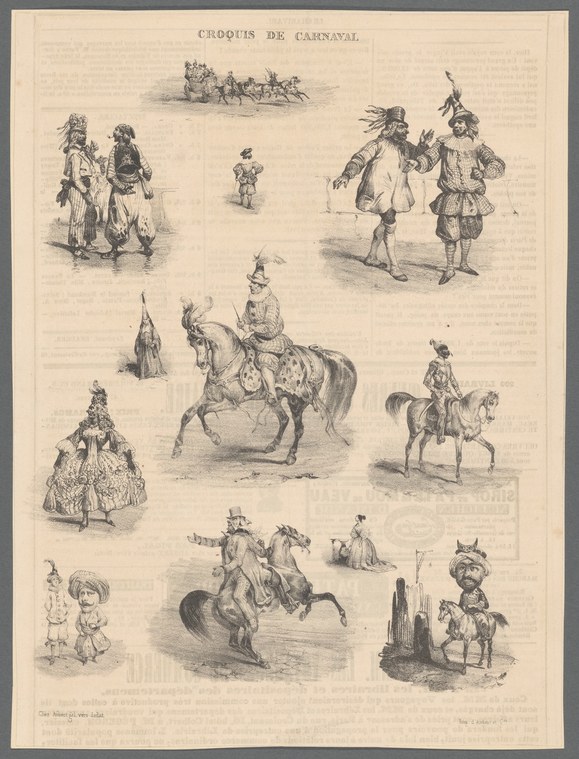
Croquis de carnaval
Unknown artist
- Collection:
- Prints depicting dance
- Source:
- New York Public Library
- Rights:
- Public domain — free to use, share and adapt.
- Recorded as:
- Public Domain
Carnival was a licensed space for transgressive performance and social satire, and this engraving documents the visual language through which class, gender, and character types were performed in public. For dancers and historians, it reveals how costumed spectacle, masquerade, and processional performance functioned as alternatives to or alongside formal dance. The specificity of the costume details—the engineering of silhouettes, the choice of grotesque or exaggerated features—shows how carnival participants used clothing and appearance to embody character and entertain.
What you are looking at
This engraved sheet presents a composite study of carnival costume and character types, arranged across the page as separate vignettes without unified setting or narrative. Each figure occupies its own space, allowing detailed examination of dress and posture. At top, a procession of carnival-goers in costume rides in a carriage or float. Below are individual and paired figures: a woman in elaborate wide-skirted dress with feathered headdress; two figures in contrasting dress—one rotund, one thin—standing together; a mounted figure in military or formal dress on a prancing horse; another rider in similar formal attire; a figure in checkered or patterned dress; children in costume; and figures wearing masks or grotesque headdresses. The engraving employs fine cross-hatching and line work typical of 19th-century reproductive prints, with careful attention to fabric texture, trim, and the exaggerated silhouettes fashionable in carnival dress. The composition treats each figure as a specimen or type to be studied, rather than depicting a single coherent scene.
The dancing
The figures display a range of postures characteristic of Carnival performance and display: upright, frontal stances suited to costume exhibition; exaggerated silhouettes created by padding, hoops, and voluminous skirts; theatrical gestures with arms positioned to showcase dress; and a few figures in animated conversation or interaction. Weight is often shifted for display rather than movement, with feet positioned to balance elaborate costume elements. The mounted figures sit stiffly in formal seats, showing no dynamic horsemanship. Several figures appear to be portrayed as caricatures or grotesques—outsized heads, distorted proportions—typical of carnival masquerade convention.
The dance depicted
This is not a record of danced movement but rather a study of Carnival costume types and masquerade characters. Carnival—particularly the Venetian or Continental European tradition—involved processional display, costumed performance, and theatrical character types rather than formal dance steps. The figures here are costume studies; the engraving documents what participants wore and how they carried themselves in public during festive season. Any movement depicted is postural or processional rather than choreographed. The work captures the visual culture of carnival spectacle and the character archetypes (military fop, grotesque, peasant, aristocrat) that populated such festivals.
How it was made
This is a steel or copper engraving, established from the fine parallel line work (hatching and cross-hatching), the precision of the image, and the uniform tone. Engraving allowed for wide circulation as printed sheets; this format was ideal for publishing costume studies, fashion plates, and documentary imagery of contemporary spectacles to a middle-class audience. The technique's capacity for fine detail made it well-suited to recording the elaborate trim, feathering, and construction of carnival dress. The page would have been hand-colored in some copies, though this example shows the engraved line alone.
About this work
This is a documentary engraving of Carnival costume types, likely French or Franco-Belgian in origin, presenting masked and costumed figures as a visual inventory of carnival performance characters and dress conventions. Rather than depicting a specific carnival event or choreographed dance, it functions as a reference sheet for costume design and character types—the visual record of how carnival participants styled themselves for public festivity. The work belongs in a dance collection not because it depicts dance steps but because it documents the costumed performance culture and character archetypes of Carnival, a festive tradition with strong theatrical and processional elements that animated European street life and public celebration.
The engraving's value lies in its specificity: it preserves the silhouettes, trims, headpieces, and accessories of a particular historical moment in carnival fashion and performance, allowing scholars to understand how these characters were embodied and displayed. The arrangement as separate studies emphasizes costume study over narrative action, suggesting the print was intended as a reference work for artists, costume makers, or spectators seeking to understand carnival convention.
How to look at it
Examine each figure not as a unified scene but as a costume specimen. Note how the engraver chose frontal or near-frontal views to display the construction of each costume: the width of skirts, the placement of trims and feathers, the shape and substance of headpieces, the relationship between mask and body. The artist emphasizes exaggeration and caricature—disproportion is intentional, part of the carnival aesthetic. The mounted figures' stiffness and the grotesque proportions of some characters are not failures of anatomy but faithful records of how carnival performers styled themselves to be visually striking and recognizable as character types. The grouping of varied figures on a single page suggests the idea of carnival as a parade or taxonomy of recognizable types.
The artist
The artist is not recorded. The title and style suggest a professional engraver working in the 19th century, likely for a publisher specializing in theatrical, fashion, or satirical imagery. The print's distribution through New York Public Library indicates it circulated in the anglophone world, possibly as part of a larger series on Continental European festive customs or theater.
The period
Carnival traditions experienced a cultural resurgence in 19th-century European cities, particularly Venice and Nice, after earlier suppression. The appetite for prints documenting European customs and spectacles—especially theatrical and festive ones—grew with the rise of mass-circulation illustrated periodicals and the middle-class fashion for collecting costume studies. Engraved costume sheets served multiple audiences: theater makers seeking inspiration for productions, artists studying human figure and dress, and travelers and enthusiasts documenting European customs. The theatrical character types shown here—military fops, rotund figures, grotesques—are stock characters from commedia dell'arte and carnival tradition, which experienced a revival of interest across Europe in this period.
Where it lives
The work is held in the New York Public Library's collection of prints depicting dance. It entered the collection as part of the institution's broad acquisition of theatrical and costume imagery, reflecting the library's role in documenting performance traditions and visual culture.
Questions about this work
Is this a record of an actual carnival event?
No. The engraving is a composite study of costume types, not a documentation of a specific carnival or its participants. The separate vignettes and the title's generic reference to 'carnival sketches' (croquis) indicate this is a reference sheet for costume design, performance character types, and carnival convention. It likely drew on observed carnival traditions but organized them for study and circulation rather than to record a single event.
Why are some of the figures so grotesquely proportioned?
Grotesque exaggeration—outsized heads, distorted limbs, unnatural proportions—was a deliberate aesthetic of carnival masquerade and commedia dell'arte character types. These deformations made characters visually striking, immediately recognizable, and comic. The engraver faithfully recorded these exaggerations as part of the carnival aesthetic, not as artistic error.
Is this French or Italian?
The title is French, and the style suggests a French or Franco-Belgian printmaker. However, carnival traditions were shared across Europe, and the character types shown—military fop, peasant, grotesque—appear in both French and Italian carnival and commedia dell'arte traditions. The print likely documents Continental European carnival convention broadly rather than a single national tradition.
More dance artwork





