49 works in this view — arrow keys or swipe to move between them.
Dance in Art
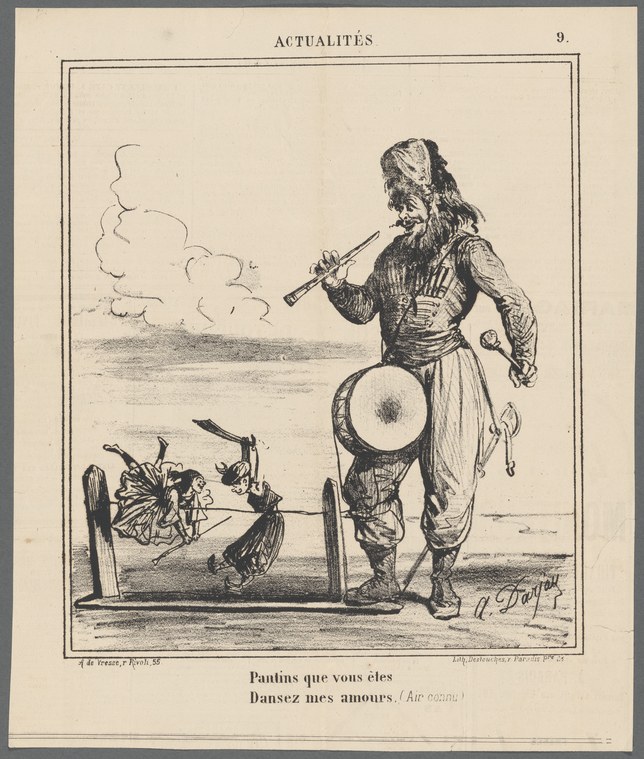
Pantins que vous etes, dansez mes amours (Air connu)
Unknown artist
- Collection:
- Prints depicting dance
- Source:
- New York Public Library
- Rights:
- Public domain — free to use, share and adapt.
- Recorded as:
- Public Domain
This print demonstrates that dance in 18th-century popular culture was often framed as mechanical, artificial, and subject to external control—a critique that says as much about power and performance as about movement itself. For historians of dance, it offers evidence of how satire used bodily motion as a vehicle for social commentary, and how the puppet became a figure for the trained, obedient body.
What you are looking at
A bearded man in 18th-century military dress—elaborately tailored coat with buttons and braid, loose breeches, and a headwrap—stands upright, facing left. He holds a long pipe to his mouth and gestures with his right hand toward two small winged figures (putti or cherubs) who tumble and writhe on the ground before him. The putti are nude or loosely draped, their bodies contorted in exaggerated postures of distress or wild movement. Clouds of smoke billow from the pipe. The setting is sparse and undefined, rendered in light wash and line: a few horizontal strokes suggest ground. The tone is satirical and carnivalesque—the title reads "Pantins que vous etes, Dansez mes amours" (Puppets that you are, dance my loves), punning on "pantin," a jointed doll or puppet.
The dancing
The central male figure is static and commanding, planted firmly in profile with his arm extended in a gesture of instruction or summons. The two putti are rendered in violent, disjointed motion: limbs flung outward, torsos twisted, bodies seemingly jerked by invisible strings. There is no partnered hold or formal frame. The contrast between the man's controlled posture and the chaotic gyration of the cherubs suggests puppetry—bodies moved not by intention but by external force (the smoke, the command, or the man's will). The exaggeration of joint and limb is deliberate and grotesque.
The dance depicted
This is not a depiction of a known theatrical dance form but rather a satirical genre scene that *uses* the language of dance—and specifically puppetry—to make a joke. The "dancing" putti are pantins (jointed dolls), and the inscription suggests the man is commanding them to dance as lovers would. The piece likely comments on the artificiality of courtly love, the mechanical nature of social ritual, or the control exerted over performers (literal or metaphorical puppets). The style and dress suggest a French or Francophone source, probably 18th century, when the pantin was a fashionable toy and metaphor for constraint.
How it was made
This is an engraving or etching on paper, executed in line with light tonal wash. The technique is rapid and assured: the principal figures are rendered in firm, parallel lines that describe form through hatching; the background is almost empty, allowing the satire to rest on the figures alone. The inscription and artist signature ("H. Daumier" or similar—difficult to read with certainty in this reproduction) appear at the base. The technique and circulation suggest this was a popular print, likely from a series, intended for a broad audience familiar with theatrical and carnival imagery.
About this work
This is a satirical print from the 18th century that exploits the visual language of dance—or rather, of puppet dance—to comment on social control and the artificiality of courtly performance. The bearded man commanding two gyrating putti is not a dancer, nor are the cherubs, but the print *depicts dance-like movement* in order to ridicule it. It belongs in a gallery of dance in art because it shows how dance imagery was used in popular satire, and because the pantin (puppet) became a loaded metaphor for constrained bodies in motion. The work is a document of how dance was perceived not as an art form in its own right but as a spectacle to be mocked, a set of jerking movements produced by external command.
How to look at it
Attend to the contrast between the man's stillness and command and the putti's violent, jerked motion. The artist has chosen the moment of maximum distortion: the cherubs are not dancing in any recognizable form, but flailing. The extended arm and the pipe are instruments of command. Notice how the title—punning on "pantin" and "dansez"—requires you to read the image as satire: what looks like dance is actually puppetry, and what looks like pleasure (dancing, love) is actually constraint. The looseness of the line and the emptiness of the background intensify the mockery by refusing to give the scene any dignity or grandeur.
The artist
The catalogue record does not attribute the work with certainty. The signature is difficult to read in this reproduction. If it is indeed H. Daumier (unlikely given the date) or another 18th-century printmaker working in France or the Low Countries, the print would belong to a tradition of social and theatrical satire in engraving. The style and subject matter are consistent with popular prints circulating in Paris or Amsterdam in the mid-to-late 18th century, when such satirical commentary on manners and artifice was common.
The period
The 18th century saw both the rise of ballet d'action—narrative dance with expressive movement—and a parallel satirical tradition that mocked courtly affectation and the control of the body. The pantin, a jointed doll with strings, became a fashionable toy and a metaphor for constraint: if you are a pantin, you are a puppet, moved by forces outside yourself. This print captures that critique at the moment when dance was becoming an object of intense scrutiny—both as an art form (ballet) and as a target for ridicule (satire). The smoke from the pipe, the exaggerated gesture, the writhing putti: all suggest intoxication, bewitchment, or loss of control, themes that recur in 18th-century comic and carnival imagery.
Where it lives
The work is held in the New York Public Library's prints collection on dance. It is a single-sheet popular print, likely one of many circulating in the 18th-century print market, and may be part of a series.
Questions about this work
Is this a ballet?
No. This is a satirical print that *uses the image of dance* to mock the artificiality of courtly life and performance. The "dancers" are putti (cherubs or cupids) rendered as jointed puppets—pantins—being jerked around by a pipe-smoking man. It is a comment on dance and constraint, not a depiction of an actual dance form.
What does 'pantin' mean?
A pantin is a jointed wooden doll with strings, a toy popular in 18th-century France. The word also became a metaphor for anyone whose actions are controlled by external forces, or who is constrained to act against their nature. The title plays on this double meaning: the putti are pantins (toys, puppets) being commanded to 'dance' as lovers—a comment on the mechanical and coercive nature of courtly love.
Who made this print?
The catalogue record does not provide certain attribution. The signature at the base is difficult to read in this reproduction. The style and subject matter are consistent with 18th-century French or Francophone satirical printmaking, but the artist's identity remains uncertain.
When was it made?
The catalogue record does not provide a date. The style of dress (the man's coat and headwrap), the engraving technique, and the imagery suggest the mid-to-late 18th century, but this cannot be confirmed from the record alone.
More dance artwork





