49 works in this view — arrow keys or swipe to move between them.
Dance in Art
Lucile Grahn
Unknown artist
- Collection:
- Prints depicting dance
- Source:
- New York Public Library
- Rights:
- Public domain — free to use, share and adapt.
- Recorded as:
- Public Domain
Grahn was one of the great ballerinas of the Romantic period and a key figure in the international spread of ballet; this image documents how dancers of her rank were marketed and memorialized as public figures. The portrait reveals the gap between the dancer's working life on stage and her presentation in bourgeois domestic space, a tension central to nineteenth-century ballet culture.
What you are looking at
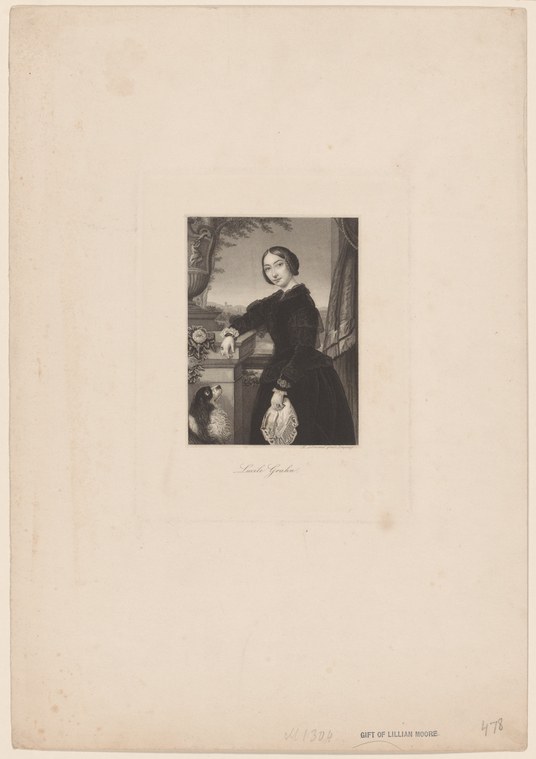
A woman in dark Victorian dress stands in three-quarter profile against a interior setting framed by heavy drapery. She wears a long black gown with full skirt and fitted bodice, her posture erect and composed. Behind her, visible through a window or opening, is a landscape with trees and distant architecture. The light is soft and controlled, creating a sense of intimacy and stillness. A small dog sits at her feet, adding a domestic note to what is clearly a formal portrait. The woman gazes downward with an air of quiet dignity, her hands folded or resting at her sides.
The dancing
A single standing figure, alone, in a pose of repose rather than motion. Her weight is evenly distributed, her body aligned in a graceful S-curve characteristic of mid-nineteenth-century posture. There is no active dance gesture or physical engagement visible; this is a portrait of stillness, not movement. The small dog is a static element, not a participant.
The dance depicted
This is not primarily a dance image, despite the subject's identity as a dancer. It is a formal portrait of the dancer Lucile Grahn, rendered in a studio convention of the period. The work documents her as a public figure and stage personality, not as a performer in motion. No specific dance style or movement is depicted or legible from the image alone.
How it was made
This appears to be a steel or copper engraving, likely a reproductive print made from a painting or drawing. The technique creates a monochromatic image with fine linear detail, allowing for the subtle rendering of fabric texture and the play of light across the figure. Such engravings were affordable and widely distributed, making them a standard medium for theatrical portraiture in the nineteenth century. The composition and finish suggest this was made for public circulation, possibly as sheet music cover or promotional material.
About this work
This is a formal portrait engraving of Lucile Grahn, a celebrated ballet dancer of the Romantic era. Rather than depicting her in performance or in a dance pose, it presents her as a woman of refinement and status in her civilian dress. The print belongs to the tradition of theatrical publicity and celebrity culture that grew around major dance figures in the nineteenth century, allowing audiences to own an image of their favorite performers.
How to look at it
Look at the tension between motion and stillness in the composition. The dancer is presented in perfect repose, her costume and bearing suggesting cultivation and gentility. Note the treatment of the fabric—the engraver has paid careful attention to the weight and drape of her gown. The gaze downward and the small dog suggest a domestic interior, placing the dancer in private space rather than the theatrical stage. This is a document of Grahn as a public personality, not a record of her performance.
The artist
The artist is not recorded. Based on style and technique, this is likely a reproductive engraving made by a commercial printmaker working from an original painting or drawing, possibly made for a theatrical publisher or dance impresario. The work belongs to a large body of anonymous reproductive prints that circulated during the heyday of Romantic ballet.
The period
Lucile Grahn danced in the 1840s–1860s, at the height of the Romantic ballet era. Ballet was undergoing professionalization and celebrity culture; major dancers achieved international fame and commanded high fees. Theatrical portraiture in engraved form was a standard medium for promoting dancers and allowing audiences to own images of their stage idols. Simultaneously, the conventions of Romantic ballet emphasized ethereal, otherworldly femininity on stage, while off-stage portraiture presented dancers as respectable women of the era.
Where it lives
The work is held in the New York Public Library's collection of prints depicting dance. The inscription "Lucile Grahn" is printed below the image. The print is catalogued as part of a broader collection of theatrical portraiture from the nineteenth century.
Questions about this work
Who was Lucile Grahn?
Lucile Grahn was a Danish-Swedish ballet dancer who became one of the most celebrated ballerinas of the Romantic era, dancing professionally from the 1840s through the 1860s. She achieved international fame, danced in the major European ballet centers, and was particularly known for her technical virtuosity and dramatic presence. She appeared in many of the canonical Romantic ballets and was a favorite of audiences across Europe.
Why is this a portrait rather than a dance scene?
Theatrical portraiture of the nineteenth century typically presented performers in civilian dress and domestic space, emphasizing their status and respectability rather than their stage work. This convention separated the dancer's public theatrical persona from her private social identity. While Grahn was famous for her dancing, this print documents her as a celebrated public figure and commodified celebrity, not her actual performance technique.
What can this print tell us about nineteenth-century ballet?
The existence and wide distribution of such prints shows that major ballet dancers were celebrities whose images were commercially valuable and actively marketed. The emphasis on the dancer's elegance, refined dress, and domestic gentility reflects how Romantic-era ballet promoted an ideal of ethereal, respectable femininity. The print is evidence of the professionalization of dance and the rise of celebrity culture around individual performers.
More dance artwork





