49 works in this view — arrow keys or swipe to move between them.
Dance in Art
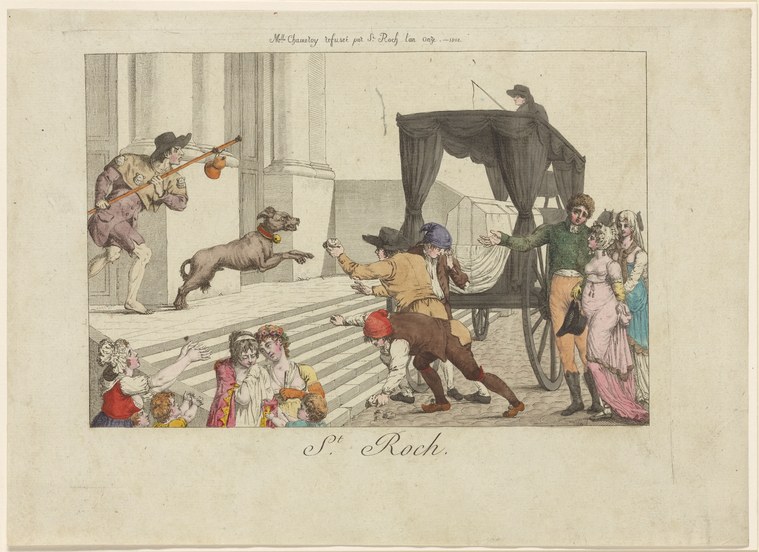
M'elle Chameroy refusée par St. Roch, l'an onze - 1802
Unknown artist
- Collection:
- Prints depicting dance
- Source:
- New York Public Library
- Rights:
- Public domain — free to use, share and adapt.
- Recorded as:
- Public Domain
This work shows how ballroom and courtly movement vocabularies were used in theatrical satire and comedy, not merely to document dance practices but to mock or comment on them. For historians of theater and dance, it illustrates the close relationship between ballroom deportment and the physical languages of farce and pantomime in Napoleonic France. For visual culture scholars, it exemplifies the hand-colored engraving as a vehicle for satirical narrative and social commentary aimed at educated urban audiences.
What you are looking at
A satirical theatrical scene set in an ornate interior with tall classical columns and heavy drapery. On a raised platform at center, a canopied bed or throne-like structure stands draped in dark fabric. To the left, a musician in purple coat and breeches plays a violin with exaggerated posture, aiming his instrument at the platform like a weapon. The central action shows a dog in mid-leap, apparently being launched or fleeing from the platform, while figures in colorful dress—a woman in pink, men in yellow and brown coats—react with animated gestures. At the foreground left, children and young women in fashionable dress watch the chaos unfold. The scene is rendered in hand-colored engraving with careful attention to fabric textures, architectural detail, and the theatrical arrangement of figures across the stage-like space. The title references Mademoiselle Chameroy and Saint Roch, suggesting this depicts a specific incident or performance, possibly comic or scandalous.
The dancing
The bodies throughout display exaggerated, expressive postures typical of theatrical comedy or farce. The musician leans back at an impossible angle, treating his violin as a prop for physical comedy rather than music-making. The dog's body is captured in a dynamic leap with rear legs extended. The attendant figures use open arm positions and turned-out stances—hands gesturing, bodies pivoting—that suggest ballroom-influenced movement vocabularies adapted for comedy. Weight is distributed dramatically rather than functionally; no figure appears in a natural standing position. The composition treats bodies as visual elements to be arranged for maximum theatrical effect rather than as dancers executing technique.
The dance depicted
This does not appear to depict an actual dance or dance performance, despite the theatrical setting and the movement vocabulary of the figures. The scene is a satirical narrative rather than a dance event: a farce or comedy sketch in which a musician, dog, and assembled court or household enact some kind of chaos or scandal. The exaggerated postures and gestural language draw on the pantomimic and physical comedy traditions of French theater, particularly the tradition of commedia dell'arte and féerie (magical spectacle theater). While the figures' deportment shows influence from ballroom and court movement conventions, they are not dancing but rather acting out a humorous incident. The title's reference to a specific named person (Mademoiselle Chameroy) and Saint Roch (invoked in refusal or rejection) suggests a satirical comment on a real or fictional scandal, possibly sexual in nature.
How it was made
This is a hand-colored engraving, executed with fine line work characteristic of 18th-century French print production. The coloring—applied by hand after printing—uses subdued tones (purples, yellows, pinks, browns) that enhance the theatrical composition without overwhelming the architectural detail and figural precision of the engraved lines. The technique allowed for both the fine detail visible in facial expressions, fabric folds, and ornamental architecture, and the broad compositional clarity needed to tell a narrative joke across a crowded stage. The hand-coloring marks this as a luxury print, produced for wealthy collectors and suitable for binding into bound sets or albums of satirical theater imagery. The circulation would have been limited to educated urban audiences capable of reading the French title and understanding the theatrical and social reference.
About this work
A hand-colored satirical engraving from 1802 depicting a farcical or comedic theater scene rather than an actual dance performance. The image stages an absurdist tableau in which a musician, a leaping dog, and fashionably dressed attendants enact some kind of household chaos or scandal, with the title's reference to Mademoiselle Chameroy and Saint Roch suggesting a pointed comment on a real or imagined social incident. The work belongs in a dance collection because it draws on the physical vocabularies and gestural languages of ballroom and court performance to express theatrical comedy, demonstrating how movement conventions could be exaggerated or inverted for satire. It is a document of how bodies and movement were mobilized in French theater and social satire at the turn of the 19th century.
How to look at it
Attend to the contrast between the dignified architectural setting (classical columns, formal drapery) and the anarchic action unfolding within it. The musician's absurd posture and the dog's trajectory are the focal points of comedy, while the attendant figures' reactions—their open gestures, turned bodies, and animated stances—are rendered in a physical vocabulary adapted from courtly movement but inverted into chaos. Note how the artist freezes the moment at maximum visual confusion: the dog is mid-leap, the musician is off-balance, the bystanders are mid-gesture. This compositional choice emphasizes the theatrical and anarchic rather than the graceful or ordered. The hand-coloring creates visual hierarchy: the bright yellows and pinks of the central figures draw the eye to the chaos, while the architecture recedes.
The period
This engraving dates to 1802, during the Napoleonic period in France when hand-colored satirical prints were a thriving medium for social and political commentary. French theater of this era was marked by the coexistence of high tragedy and ballet on one hand, and thriving traditions of comedy, féerie, and pantomime on the other. The commedia dell'arte tradition had been naturalized into French theater, and exaggerated physical comedy was a staple of popular entertainment. Ballroom culture was central to upper-class social life, and its conventions—the closed hold, turned-out postures, formal positioning—would have been instantly recognizable to the print's intended audience as material for satire. The reference to a named individual (Chameroy) suggests the work may be commenting on a specific performer, scandal, or incident within Parisian theater or society.
Where it lives
This is a hand-colored engraving from the New York Public Library's collection of prints depicting dance, one of a series of works documenting theatrical performance and movement practices in late 18th and early 19th-century France. It is catalogued under the broad heading "dance" but is better understood as a satirical theater print.
Questions about this work
Is this actually a dance performance?
No. While the scene is theatrical and figures use movement vocabularies drawn from ballroom and court dance, the action depicts a farcical or comedic sketch—a narrative involving a musician, dog, and attendants—rather than an organized dance. The exaggerated postures are comic rather than technical.
Who was Mademoiselle Chameroy?
The title references a specific named person whose identity is now unclear. She may have been a performer, a society figure, or the subject of gossip or scandal. The phrase "refusée par St. Roch" (refused by Saint Roch) suggests rejection or scandal, possibly of a sexual nature, making the title a satirical joke accessible to contemporaries but requiring historical knowledge to fully decode.
Why is a dog in a theater scene?
The dog's presence contributes to the absurdist comedy: its uncontrolled energy and mid-leap trajectory contrast with the controlled movement expected in ballroom culture and formal theater. The scene may be satirizing theatrical excess, social pretension, or a specific real incident involving an unexpected animal intrusion into a formal setting.
What does the musician's pose mean?
The violinist's exaggerated backward lean and weapon-like aiming of the instrument are comic inversions of proper musical posture. Rather than making music, he appears to be launching an attack or performing an absurdist action, emphasizing the farcical nature of the entire scene.
More dance artwork





