49 works in this view — arrow keys or swipe to move between them.
Dance in Art
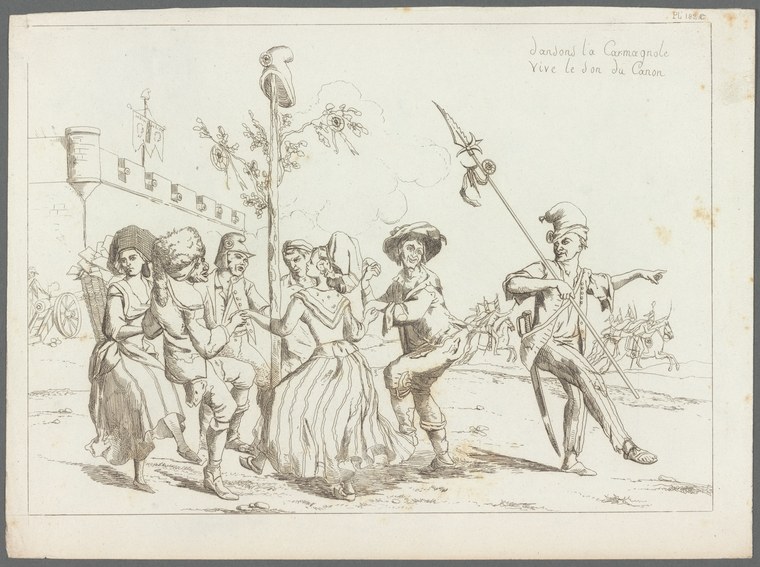
Dansons la carmagnole, vive le son du canon
Unknown artist
- Collection:
- Prints depicting dance
- Source:
- New York Public Library
- Rights:
- Public domain — free to use, share and adapt.
- Recorded as:
- Public Domain
The Carmagnole represents one of the rare moments in European dance history when a new political movement created its own dance form and disseminated it as a mass practice. This image is among the few surviving visual records of how the dance actually looked and in what social context it was performed. For dancers and choreographers studying the relationship between politics and movement, or the history of participatory or social dance outside the ballroom, the Carmagnole and its visual documentation offer a powerful example of dance as direct political expression.
What you are looking at
A mixed group of figures stands in an open landscape beneath a wooden pole or mast from which hangs a lantern or light source. The composition is crowded and energetic, with at least eight figures arranged loosely around the central pole. The figures wear late 18th-century dress: the women sport long skirts and bonnets or caps; the men wear breeches, coats, and hats. To the right, a figure in military dress strikes a dramatic pose with one arm extended outward. In the background, a landscape recedes with what appears to be buildings or fortifications suggested by linear marks. The style is a pen or chalk sketch rendered in brown ink on cream paper, with hatching used to create volume and shadow in the drapery and forms.
The dancing
The figures display varied postures rather than a unified choreographic line. Some appear to be in motion or mid-gesture; others stand relatively still. A woman in the center holds her skirt, which billows outward. The military figure on the right thrusts one arm forward in a gesture of command or exhortation. The overall arrangement is informal and scattered rather than paired or processional, suggesting a moment of spontaneous or prompted movement rather than ballroom formation.
The dance depicted
This is most likely a depiction of the Carmagnole, a revolutionary-era French dance that emerged during the 1790s and was associated with radical politics and carnival celebration. The title—'Dansons la carmagnole, vive le son du canon' ('Let us dance the carmagnole, long live the sound of the cannon')—is the opening line of the most famous song set to this dance. The Carmagnole was danced by mixed groups, often outdoors or in public spaces, with energetic, ungoverned movement that contrasted sharply with aristocratic courtly dance. The military figure and the cannon reference in the title situate this as a Revolutionary period celebration.
How it was made
This is a pen-and-ink drawing or possibly an engraved or etched print, rendered with fine hatching lines to build form and shadow. The technique allows rapid capture of gesture and expression while maintaining clarity of individual figures. The brown ink on cream paper and the linear handling suggest either a preliminary study or a print intended for circulation among those interested in contemporary political events and popular culture. The sketchiness of the background and the emphasis on the figures themselves indicate a focus on the human drama of the moment rather than a detailed narrative setting.
About this work
This drawing documents a specific moment in French Revolutionary social and political history: the Carmagnole as a mass public dance. The work captures the radical reimagining of dance as a vehicle for collective expression and political allegiance, moving away from the formality and hierarchy of courtly tradition. The Carmagnole was danced by ordinary people—soldiers, citizens, women of all stations—in streets and public gatherings, making dance a tool of social upheaval. The image preserves not a performance in a theater but a lived, popular practice that embodied the egalitarian ideals (or at least the egalitarian rhetoric) of the Revolutionary moment. For historians of dance, this is crucial evidence of how political change manifested in the body and in social gathering.
How to look at it
Attend to the lack of formal structure in the grouping—no couples in closed hold, no processional line, no hierarchy of placement. The figures are gathered around the pole as if responding to music and impulse rather than following choreographic prescription. The woman's billowing skirt and the military figure's aggressive gesture convey physical energy and spontaneity. The setting (the open air, the lantern, the distant fortifications) grounds this as a public, outdoor event rather than a salon or theater. The clothing places the work firmly in the 1790s, and the cannon reference in the title confirms the Revolutionary military context.
The period
This drawing was made during or immediately after the French Revolution, a period of radical social upheaval (1789–c.1799). The Carmagnole dance emerged in the early 1790s and became ubiquitous in Revolutionary celebrations, military gatherings, and popular festivals. It represented a deliberate break from ancien régime courtly dances like the minuet; the energy, mixed-gender participation, and outdoor settings of the Carmagnole embodied Revolutionary ideology. In visual culture, printmakers and draftsmen documented contemporary political events and popular practices as a form of journalism and propaganda. This drawing sits within that documentary tradition, capturing a moment of lived Revolutionary culture.
Where it lives
The work is held in the New York Public Library's collection of prints depicting dance. It is catalogued with minimal metadata: the title and an era label of 'unknown,' though the style and subject matter place it clearly in the French Revolutionary period.
Dance in this work
Questions about this work
What is the Carmagnole?
The Carmagnole was a French Revolutionary-era dance that emerged in the early 1790s and became a symbol of radical politics and popular resistance. Unlike courtly dances, it was performed by mixed groups of ordinary people—soldiers, citizens, women—in public spaces and at Revolutionary celebrations. The most famous song set to the Carmagnole begins with the very words in this image's title. The dance represented a deliberate break from ancien régime formality and expressed the egalitarian ideals of the Revolution.
Why does the title mention 'the sound of the cannon'?
The cannon reference connects the dance to military victory and Revolutionary struggle. During the 1790s, the Carmagnole was often danced to celebrate military successes or to express solidarity with the Revolutionary army. The phrase 'vive le son du canon' ('long live the sound of the cannon') captures the fusion of public celebration, military power, and popular politics that defined the Revolutionary moment. This image thus documents not just a dance but a political statement in motion.
How is this different from ballroom dances of the same period?
Ballroom dances like the minuet or the cotillion were formal, hierarchical, and performed by trained dancers (or the educated classes imitating training) in controlled indoor spaces. The Carmagnole was outdoor, spontaneous, mixed in gender and social class, and ungoverned by rigid steps or formation rules. This drawing shows no paired couples in ballroom hold, no processional order—just a crowd responding to music and political fervor. The Carmagnole represents a democratic reimagining of dance itself.
More dance artwork





