49 works in this view — arrow keys or swipe to move between them.
Dance in Art
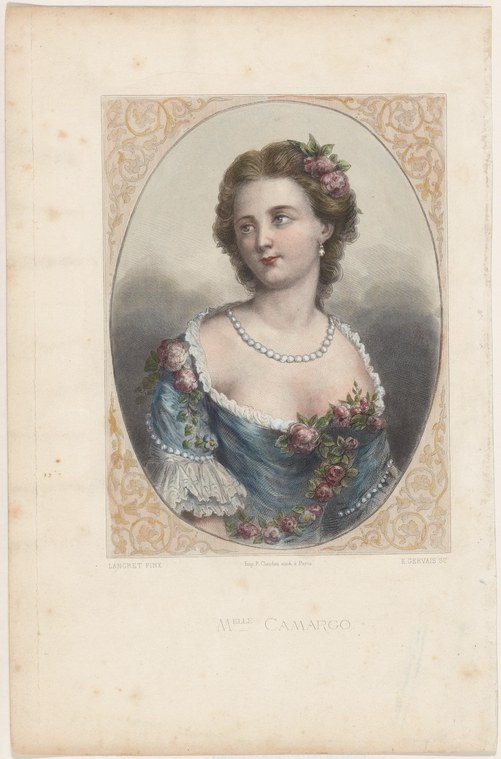
Melle Camargo
Unknown artist
- Collection:
- Prints depicting dance
- Source:
- New York Public Library
- Rights:
- Public domain — free to use, share and adapt.
- Recorded as:
- Public Domain
Marie-Thérèse Camargo (1710–1770) was the first dancer to shorten her skirt on stage, enabling visible footwork and technical display that changed ballet forever. This portrait documents her cultural status as a celebrity whose image was marketable and collectible—a reminder that dance history is inseparable from the print culture and celebrity apparatus that recorded it.
What you are looking at
A three-quarter length portrait of a young woman in an oval frame set within an ornamental gold border. She faces the viewer with a composed, slightly melancholic expression. Her light brown hair is arranged in loose waves and crowned with small pink flowers. She wears a low-cut dress in shades of blue-grey silk with white lace trim at the neckline and a white lace fichu draped over one shoulder. A pearl necklace encircles her neck. Pink roses and green foliage are arranged across her bodice and at her hip, creating a decorative floral element. The background is a soft, diffused grey, emphasizing the figure against a delicate ground. The overall effect is intimate and flattering, characteristic of 18th-century aristocratic portraiture of a dancer or performer.
The dancing
The figure is shown standing in a relaxed, frontally-oriented pose with no suggestion of active movement or dance position. Both arms hang naturally; the left arm is partially obscured by the framing, while the right rests near the body. The posture is that of a society portrait rather than a performance image—upright but without the tension or extension associated with theatrical dance. The absence of any dynamic gesture, extended line, or turned-out position indicates this is a commemorative portrait rather than a depiction of dance action.
The dance depicted
This is not a depiction of dance in action, but rather a formal portrait of Mademoiselle Camargo, one of the most celebrated dancers of the 18th century. The title and the flowers suggest this is a commemorative image, possibly used for circulation among the aristocracy or as a theatrical souvenir. Camargo was famous for her technique, speed, and the shortened skirt she pioneered, which allowed greater visibility of her footwork—innovations that transformed ballet. No evidence of dance vocabulary or movement is visible in the portrait itself; instead, the image captures her as a society figure.
How it was made
This is a hand-colored engraving or lithograph, printed on cream paper with visible foxing and age-related discoloration. The technique allows for fine linear detail in the decorative border and careful gradation of tone in the face and drapery. The color has been applied by hand or in a limited palette, with particular attention to the roses and the blue-grey of the dress. The scale and presentation suggest this was a commercial print, produced for collection and distribution to ballet patrons and society figures. The ornamental border and formal layout indicate a work of some prestige and cost.
About this work
This is an 18th-century portrait print of Mademoiselle Camargo, a legendary figure in ballet history. Rather than capturing her in performance, it presents her as an object of aristocratic admiration—dressed in fashionable silks and adorned with flowers, the conventions of gallant portraiture applied to a performer. The work belongs in a dance gallery not because it shows dance, but because it documents how dancers were celebrated and circulated as images, and because Camargo herself was transformative to the art form. The portrait is a artifact of ballet's emergence as an aristocratic entertainment and the cult of personality that surrounded its stars.
How to look at it
Approach this as a historical document of celebrity rather than a performance image. Note the floral props—the crown of small pink flowers and the roses scattered across her bodice—which transform her into an allegorical or mythological figure, a convention of the period. Observe the shortness of her visible skirt and the elegant slippered foot: these are deliberate choices signaling modernity and the innovations Camargo introduced. The careful rendering of her face and the soft lighting emphasize her status as an object of aesthetic and erotic admiration, central to how 18th-century performers were seen and sold.
The artist
The engraver is not identified in the catalogue. The style and execution suggest a professional reproductive print shop, likely French or producing work for a French market. The quality of hand-coloring and the ornamental framing indicate a work aimed at an educated, affluent audience familiar with ballet and able to afford original prints.
The period
This portrait was likely created during or shortly after Camargo's performing career (she retired from the stage in 1751). The 1730s–1750s were a period of rapid change in ballet: dancers were beginning to move away from the rigid court style, technique was accelerating, and the theater was replacing the court as the primary venue. Camargo's innovations in costume and her virtuosity made her an international star; portraits of dancers became fashionable commodities. The floral ornaments in this image echo the allegorical language of 18th-century theater, where dancers were often represented as muses or goddesses.
Where it lives
This work is held in the NYPL's print collection dedicated to dance imagery. It belongs to a large body of 18th- and 19th-century theatrical portraiture—prints of named performers distributed as souvenirs, promotional materials, and objects of connoisseurship.
Questions about this work
Who was Mademoiselle Camargo?
Marie-Thérèse Camargo (1710–1770) was a Flemish dancer and one of the superstars of the Paris Opera in the 1730s and 1740s. She is remembered for shortening her skirt to mid-calf, allowing audiences to see her fast, precise footwork—a radical innovation at a time when long skirts had dominated stage costume. She was also known for her speed, elevation, and technical brilliance. She retired from professional dancing in 1751 but remained a celebrated figure in European culture.
Why are there flowers in this portrait?
The flowers are part of the allegorical language of 18th-century theater. Dancers were often depicted as muses, nymphs, or figures of Spring and Beauty, and floral ornaments—especially roses—signaled grace, youth, and refinement. They also reinforced the idea of the dancer as a decorative object for aristocratic consumption, part of a visual economy that positioned women performers as muses and companions to the viewer.
Is this a performance image?
No. This is a formal portrait, not a depiction of Camargo dancing. It was created for circulation among the aristocratic and theatrical public as a souvenir or collectible—a way to own an image of a famous performer. Many such prints were produced and sold; they served as early forms of theater merchandise.
What does her costume tell us?
Her dress is fashionable French court or society wear, not stage costume. However, the visible shortness of her skirt and the elegant slippers are cues to her identity as an innovative dancer. The whole image—from her fashionable hair to her refined posture—places her in the aristocratic world where she performed and socialized, emphasizing that great dancers of this period were celebrities who moved between the theater and court society.
More dance artwork





