49 works in this view — arrow keys or swipe to move between them.
Dance in Art
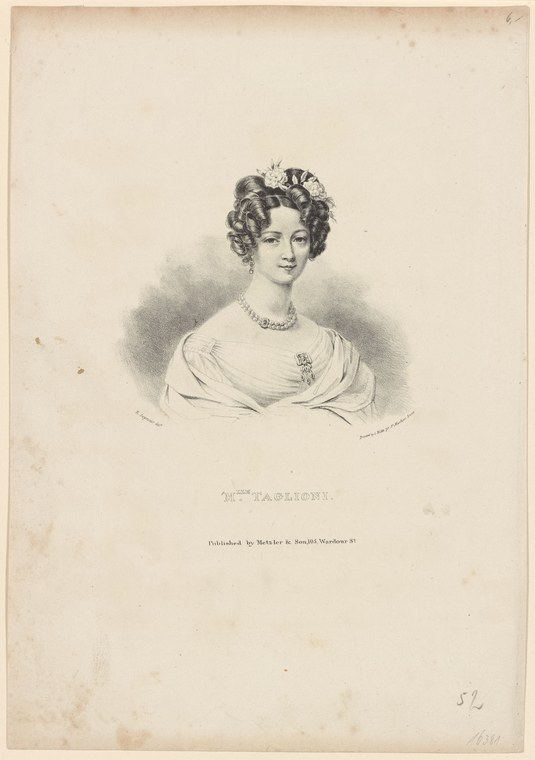
Mlle. Taglioni
Unknown artist
- Collection:
- Prints depicting dance
- Source:
- New York Public Library
- Rights:
- Public domain — free to use, share and adapt.
- Recorded as:
- Public Domain
Taglioni defined Romantic ballet and the figure of the ethereal, pointe-dancing ballerina. This portrait is evidence of how dancers were marketed and remembered in the 19th century—not through images of them dancing, but through refined portraits that emphasized beauty and status. For historians of dance celebrity and the early star system, this is primary material.
What you are looking at
A bust-length portrait of a young woman shown in three-quarter view against a plain background. She wears a white or cream-colored off-shoulder dress with classical drapery, and around her neck is a decorative beaded or jeweled collar. Her dark hair is arranged in elaborate ringlets piled atop her head and adorned with what appears to be a small tiara or ornamental comb. The rendering is a lithograph or engraving executed in fine tonal gradations, with careful attention to the modeling of her face and the soft fabric of her garment. The work has the hallmark of a refined theatrical or society portrait from the 19th century, produced for circulation as a print.
The dancing
The sitter is shown from the bust upward, her shoulders relaxed and her gaze directed slightly to the viewer's left. There is no suggestion of active movement or dance posture—the frame is that of a formal portrait. Her arms are not visible, and her body presents the composed, stationary bearing of portraiture rather than the engaged musculature of performance.
The dance depicted
The title names this as a portrait of Mlle. Taglioni, the legendary Italian-Swedish ballerina (Maria Taglioni, 1804–1884) who was the leading dancer of the Romantic era and the star of La Sylphide (1832). However, the image itself is a studio portrait, not a depiction of Taglioni dancing. It captures her as a celebrated public figure, in the manner of society portraiture of the period. No dance movement, costume, or theatrical setting is present.
How it was made
This is a lithograph or fine engraving, identifiable by the delicate tonal modeling, the precision of the line work, and the monochromatic palette. The technique allowed for multiple impressions and relatively affordable circulation, making this a print intended for public sale—likely marketed to admirers of the famous dancer. The quality of execution suggests a professional artist working in the popular tradition of theatrical portraiture.
About this work
This is a portrait print of Maria Taglioni, the defining dancer of Romantic ballet, shown as a fashionable society figure rather than in performance. The work belongs in a dance archive because Taglioni was among the most influential dancers in dance history, and this image documents how she was celebrated and commodified in her own time—as a celebrated public personality whose image circulated widely. The portrait tells us something about the cultural status of the Romantic prima ballerina: she is presented with the refinement and adornment of an aristocrat or society beauty, not as a working artist.
How to look at it
This is not an action portrait but a formal one, so the viewer should attend to what Taglioni is being asked to represent: elegance, refinement, and fashionable beauty rather than physical virtuosity. Note how her dress and adornment place her in the world of high society rather than explicitly the stage. The slight turn of her head and the direct gaze create an intimacy typical of portraiture meant to create a personal connection between dancer and admirer.
The period
Maria Taglioni danced in the 1820s–1840s, during the height of Romantic ballet. The fashion visible in this portrait—the off-shoulder neckline, the tiara, the ringlet hairstyle—dates to the 1830s–1840s. During this period, lithography and fine engraving were the standard media for the mass production of celebrity portraiture, particularly of opera singers and dancers. Portrait prints of famous performers were sold in theaters and through print shops, allowing admirers to possess an image of their idol.
Where it lives
This print is held in the NYPL's collection of prints depicting dance. It was likely produced during or shortly after Taglioni's performing career, as a commercial portrait print sold to the public.
Questions about this work
Is this Taglioni actually dancing?
No. This is a formal portrait bust, not a stage image. Taglioni is shown in off-stage dress and adornment, in the manner of society portraiture. No dance movement or theatrical setting is present.
Why would a dance collection hold a portrait with no dancing in it?
Because Taglioni was one of the most influential dancers in history, and this print documents how she was celebrated and remembered in her own time. It shows how dancers were marketed and consumed as celebrities—through refined portraiture rather than action images.
When was this made?
The catalogue record does not record a date. Based on the style of dress and hair, and Taglioni's performing career (1820s–1840s), this is likely from the 1830s–1840s. A definitive date would require further research.
More dance artwork





