49 works in this view — arrow keys or swipe to move between them.
Dance in Art
Polkamania
Unknown artist
- Collection:
- Prints depicting dance
- Source:
- New York Public Library
- Rights:
- Public domain — free to use, share and adapt.
- Recorded as:
- Public Domain
This work documents not just what the Polka looked like, but what it meant socially—the excitement, comedy, and gender performance surrounding one of the 19th century's most significant dance crazes. It reveals how dance was perceived and satirised in popular culture, offering insight into the relationship between fashion, propriety, and pleasure in the ballroom.
What you are looking at
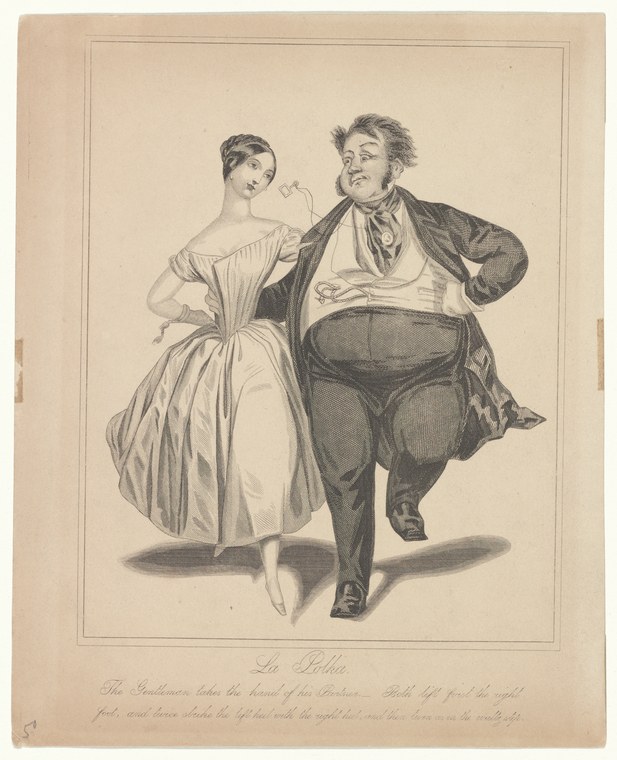
A satirical engraving of a rotund, portly gentleman and a slender young woman in an exuberant dance pose. The man wears dark formal attire—tailcoat, waistcoat, and trousers—with his coat-tails flying outward, suggesting vigorous movement. His face is animated with exertion or delight, his hair tousled. The woman wears a light, high-waisted Empire-line dress typical of early 19th-century fashion, with her shoulder bare and her skirts billowing. She leans toward him with arm raised, her posture graceful and flirtatious. The pair occupy the center of the composition against a plain background, their bodies caught in a moment of energetic interaction. Below the image is a caption and a brief verse about the dance, indicating this is a social satire of the period rather than a neutral documentary of dance practice.
The dancing
The man and woman face each other in loose contact rather than a closed ballroom hold. Her arm is raised toward or away from him; his arms are open, one pulled back with his coat-tail. Both figures lean slightly forward, suggesting forward momentum and playful engagement. The woman's weight appears to shift onto one leg, her free leg light, while the man's stance is broader and heavier, grounded despite the theatrical tilt of his torso. Their relative sizes and body types are exaggerated for comic effect—a formal contrast rather than a technical study of partnered dancing.
The dance depicted
This is a representation of the Polka, the fashionable couple-dance that swept through European ballrooms in the 1840s and 1850s. The title 'Polkamania' confirms this, a pun on the craze for the dance. The Polka is characterised by a quick, bouncy step in 2/4 time, and the print captures the informal, spirited quality of the dance—a departure from the stateliness of earlier Regency dances like the Quadrille. The satire targets not the dance itself but the social spectacle of it, particularly the comic contrast between the enthusiastic but ungainly male dancer and his more graceful partner. This was a fashionable social dance among the middle and upper classes, danced in drawing rooms and public ballrooms.
How it was made
This is an engraving or etching, likely hand-coloured or printed in sepia tones, produced for mass circulation as a satirical print. The technique allows for sharp linear detail in the drapery and facial features while maintaining the expressiveness required for caricature. The composition and style suggest publication in a periodical or as a standalone satirical sheet, a common form of social commentary in the early-to-mid 19th century. The presence of a printed caption and verse indicates it was intended for broad public consumption—a form of entertainment and social critique.
About this work
A satirical print from the era of Polka-mania—the mid-19th-century craze for the newly fashionable Polka dance. The image captures a moment of exuberant social dancing between a portly, overdressed gentleman and a slender woman in contemporary high-waisted dress. Rather than instructing in dance technique, it lampoons the social spectacle of dancing, the disparity between male and female bodies on the dance floor, and the infectious enthusiasm of the ballroom crowd. The print preserves both the visual character of the Polka as a bouncy, intimate, and informal dance, and the gender and class dynamics of early-Victorian social dancing.
How to look at it
The artist has frozen a moment of energetic forward motion, with flying coat-tails and billowing skirts conveying speed and lightness. Attend to the compositional imbalance—the man's heaviness contrasted with the woman's delicacy—which is the work's satirical point. The open, informal hold and the lack of rigid posture mark this as a modern dance, not a stately baroque minuet or regency quadrille. The caption and verse below anchor the image as social satire, not neutral documentation.
The period
The Polka emerged in Bohemia in the 1830s and spread rapidly across Europe and North America in the 1840s, becoming a symbol of modernity, youth, and informal pleasure—a contrast to the formal, regulated dances of the Regency and early Georgian periods. This print dates from the height of Polka-mania, when the dance inspired music, caricatures, and heated social debate about its propriety. Satirical prints were a major form of commentary on social trends, and the exaggerated figures here—the grossly corpulent man, the fashionably slender woman—align with contemporary aesthetic anxieties about the body, gender, and social display.
Where it lives
This print is held in the New York Public Library's collection of prints depicting dance. It is a mass-produced satirical print from the mid-19th century, the kind circulated in periodicals and sold as standalone sheets to a broad urban audience.
Dance in this work
Questions about this work
What is the Polka and why did it cause such a sensation?
The Polka is a brisk couple-dance in 2/4 time, originating in Bohemia and spreading across Europe in the 1840s. It was new, lively, and informal—a break from the prescribed steps of earlier ballroom dances. Its popularity inspired music, fashion, and satirical commentary like this print.
Why is the man drawn so much fatter than the woman?
The exaggeration is satirical. It mocks the gap between male and female bodies in the ballroom and pokes fun at the ungainly enthusiasm of an out-of-condition older man. The print reflects anxieties about masculinity, age, and the body in public space.
Is this a reliable record of how the Polka was actually danced?
Only partially. The basic posture—open, bouncy, informal, face-to-face—is accurate to the Polka. But the exaggerated bodies and the focus on social comedy mean this is satire, not instruction. For a more technical record, you would look to dance manuals or formal ballroom paintings of the period.
More dance artwork





