49 works in this view — arrow keys or swipe to move between them.
Dance in Art
Antonietta Dupen
Unknown artist
- Collection:
- Prints depicting dance
- Source:
- New York Public Library
- Rights:
- Public domain — free to use, share and adapt.
- Recorded as:
- Public Domain
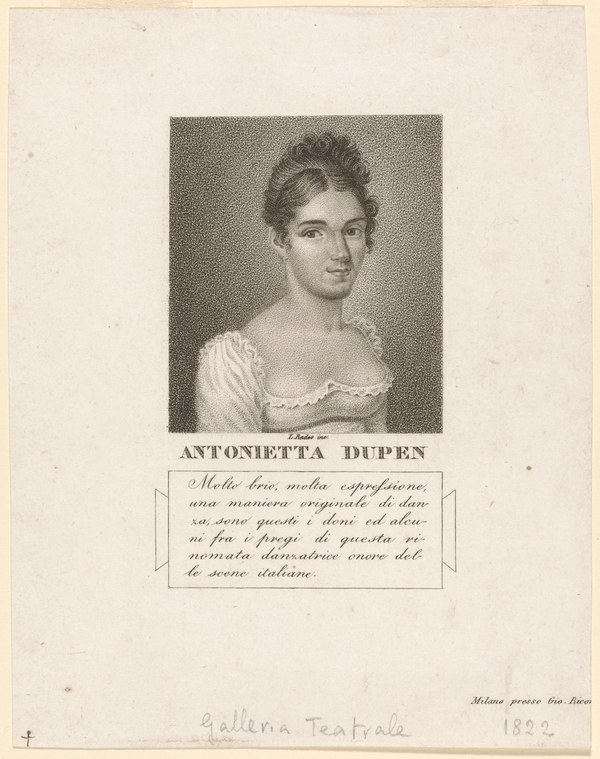
This print is evidence that women dancers of the Regency era were celebrated public figures whose images circulated widely, and that the dissemination of theatrical portraiture was a major industry. It shows how dance was documented and commodified before photography: through the skilled craft of the engraver and the commercial network of theatrical publishers.
What you are looking at
A portrait engraving of a young woman identified as Antonietta Dupen, shown from the shoulders up in a three-quarter view against a stippled grey background. She wears a high-waisted Empire-style dress with short puffed sleeves and a low neckline trimmed in lace or ribbon. Her dark hair is pinned up in the Regency fashion, with a few loose curls framing her face. The engraving is finely executed in the neoclassical manner, with careful attention to the delicate modeling of her features and the soft textures of fabric. Below the portrait runs a dedication in Italian script, suggesting this is a commemorative or theatrical print. The inscription identifies her and includes a brief poetic phrase about her manner and style of dancing.
The dancing
The figure is static and frontal, posed as a formal portrait rather than captured mid-movement. The shoulders are relaxed and squared; the head tilts slightly, with a composed, forward gaze. There is no visible indication of the body position or stance a dancer would adopt. This is a portrait of a person who was a dancer, not a representation of her dancing.
The dance depicted
The inscription and the print's inclusion in a collection of dance imagery suggest Antonietta Dupen was a professional dancer, likely active in the early 19th century. The dress, hairstyle, and neoclassical engraving style place her in the Regency era (circa 1810–1820). The Italian dedication suggests she may have performed in Italian theaters or for Italian audiences. However, the image itself contains no choreographic information: no partner, no evidence of movement, no setting that would indicate what style of dance she performed—whether ballet, social dance, or theatrical pantomime.
How it was made
This is a stipple engraving, a technique that builds tone and form through thousands of small dots rather than lines, allowing for fine tonal gradation and the soft modeling of skin and fabric. The method was laborious but produced highly refined results suited to portraiture and circulation among elite audiences. The presence of a publisher's name and Italian inscription (visible at lower right as 'Milano presso Gio Ricordi') indicates this was a commercial theatrical print, likely distributed to audiences or collectors following a notable performance.
About this work
This is a commemorative theatrical portrait engraving of an early 19th-century professional dancer, Antonietta Dupen. It belongs in a gallery of dance imagery as documentary evidence of a performer from the Regency era and as an artifact of theatrical culture—specifically, the custom of circulating engraved portraits of celebrated dancers to their audiences. The work reveals how dancers of the period were presented to the public: dignified, fashionably dressed, and isolated from the stage itself. The engraving format and publisher mark show that dance celebrity was mediated through prints, a primary means of building and maintaining a performer's reputation before photography.
The image also documents the dress and appearance conventions of the period. The high-waisted Empire silhouette and Regency hairstyle are consistent with early 19th-century fashion and stage costume. The neoclassical style of both the engraving and the sitter's presentation reflects the aesthetic values of the moment, when theatrical culture aspired to refinement and elegance.
How to look at it
Attend to the print's technique: the stippled texture that creates soft modeling and elegant finish, which was the height of refinement for theatrical portraiture. Notice the care taken in rendering the fabric and hair—the delicate lace at the neckline, the texture of the dress, the arrangement of the curls. The pose is formal and composed, presenting the dancer as an object of cultural regard rather than in motion; this convention of the portrait print removes the dancer from the stage and places her in a realm of celebrity and refinement. The Italian inscription grounds the image in a specific theatrical culture and moment.
The artist
The engraving is attributed to an unnamed artist on the surviving impression, but carries the publisher mark 'Milano presso Gio Ricordi'—the Ricordi firm, one of Europe's leading music and theatrical print publishers. The firm, founded in Milan, specialized in operatic and theatrical imagery and distributed prints throughout Europe. The quality and finish of the work are consistent with the Ricordi house style of the early 19th century.
The period
Antonietta Dupen was active during the height of Romantic ballet and the popularity of theatrical dance in Italian and European cities. This was an era when dancers—especially women—achieved significant celebrity and when their portraits were actively collected. The Regency period (1811–1820 in England, paralleled by similar aesthetic movements across Europe) privileged neoclassical refinement and elegance, which is reflected both in the engraving's style and in Dupen's presentation. Theatrical prints were a major industry; Ricordi and other firms supplied audiences with images of performers, helping to build and sustain their reputations between seasons.
Where it lives
Held by the New York Public Library in its collection of prints depicting dance. This is an impression from a commercial edition published by Ricordi of Milan, likely issued in the early 19th century and circulated to theatrical patrons and collectors.
Questions about this work
Was Antonietta Dupen a famous dancer?
The survival of her portrait in engraved form and its publication by a major theatrical publisher suggests she was a celebrated performer of her era. However, detailed biographical information about her does not appear in major dance histories available to us. The print itself is the primary evidence of her status and is valuable precisely because it documents a performer who might otherwise be lost to history.
What style of dance did she perform?
The image does not indicate the specific genre—whether ballet, social dance, pantomime, or operatic dance. The elegant neoclassical presentation and the Regency-era dress suggest she performed in a refined theatrical context, but the portrait format does not show her dancing, so the choreography and style remain unknown.
Why is this a print rather than a painting?
Engraved prints were far cheaper and faster to produce than paintings and could be distributed widely to audiences and collectors. Theatrical publishers like Ricordi made their business by supplying performers' portraits in this format, allowing a single image to reach thousands of people across multiple cities and countries.
What does the Italian inscription say?
The inscription praises her manner and style of dancing ("molte leve, molte espressione," among other phrases), indicating the qualities for which she was known. A complete transcription and translation would require closer examination of the text.
More dance artwork





