49 works in this view — arrow keys or swipe to move between them.
Dance in Art
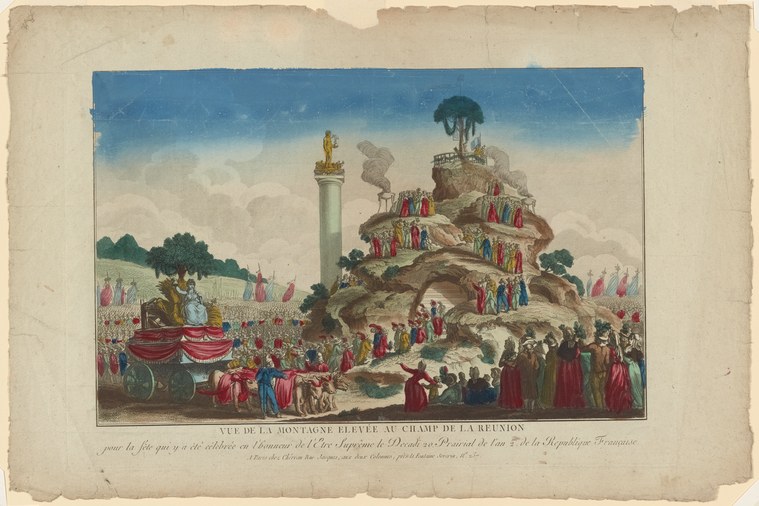
Vue de la montagne elevée au champ de la Reunion pour la fête qui y a êté célebrée en l'honneur de l'Etre Suprême le decadi 20 prairial de l'an 2.me de la République française
Unknown artist
- Collection:
- Prints depicting dance
- Source:
- New York Public Library
- Rights:
- Public domain — free to use, share and adapt.
- Recorded as:
- Public Domain
For dance historians, this work documents a moment when political authority attempted to organize and aestheticize mass movement outside the ballroom or stage—an early experiment in what would later become fascist spectacle and, differently, modern mass choreography. It shows that choreography and dance need not mean entertainment or virtuosity, but can be technologies of collective action and state meaning-making.
What you are looking at
A hand-colored engraving depicts a massive artificial mountain constructed in an open field for a Revolutionary festival. The mountain rises in tiers, dotted with figures in red and blue clothing distributed across its slopes and summit, where a palm tree marks the pinnacle. To the left stands a tall obelisk or monument on a cylindrical base. In the foreground, a large ornate carriage with draped red fabric contains dignitaries or officials. Thousands of spectators fill the field in organized groups, many wearing the red, white, and blue cockades and clothing of the Revolutionary period. Flags are planted throughout the crowd. The sky is soft and luminous, rendered in pale blue with white clouds. This is a festival of civic spectacle rather than theatrical performance—a moment of state ceremony.
The dancing
The figures on the mountain and in the crowd are rendered at a distance, making individual movement difficult to assess, but the distribution across the terrain suggests procession and gathering rather than coordinated choreography. Some figures on the mountain appear to be in forward-facing postures, possibly singing or declaiming. The crowd below forms loose clusters and lines. No recognizable ballroom hold, frame, or footwork pattern is visible. This is assembly and mass participation rather than trained dance.
The dance depicted
This depicts a Revolutionary civic festival rather than a trained dance performance. The date (20 Prairial Year II of the Revolutionary calendar, corresponding to June 8, 1794) identifies this as one of the Festivals of the Supreme Being organized by Robespierre. Such festivals involved mass processions, singing, and symbolic movement by assembled citizens, which occupied a borderland between ceremony and dance—what historians call 'choreography of the state.' The mountain and monument frame the movement as sacred and civic rather than entertainment.
How it was made
This is a hand-colored engraving, as shown by the fine hatching visible in the sky and landscape, with watercolor or gouache applied afterward. The technique allows for both fine architectural detail (the obelisk, the carriage, the mountain's terraces) and the suggestion of vast crowds through repetition and massing. Such engravings were produced for circulation in prints and albums documenting Revolutionary ceremonies—this work would have reached educated audiences as both political record and artistic representation.
About this work
This is a historical document of Revolutionary spectacle from June 1794, recording one of the Festival of the Supreme Being ceremonies that attempted to embed civic and spiritual meaning in mass movement and assembly. The engraving sits at the intersection of political theater, ceremonial practice, and mass choreography. It shows not a ballroom dance or theatrical ballet but the state's attempt to choreograph collective feeling and loyalty through architecture, costume, and symbolic spatial arrangement.
How to look at it
Attend to the scale and organization: the mountain is not a stage but a terrain for mass participation, and the crowd is not an audience but a congregation. The engraver has captured a moment of stillness or ceremony rather than motion—the festival frozen in its formal arrangement. Notice how the red, white, and blue clothing and insignia unify the crowd despite its size, and how the obelisk and mountain provide vertical focus to direct gaze upward, a spatial device borrowed from religious and monarchical tradition but repurposed for Republican virtue.
The artist
The artist is not recorded. The work was produced as part of the documentary and propaganda effort surrounding the Revolutionary festivals. Such engravings were typically commissioned and often unsigned, serving as instruments of official representation rather than individual artistic expression.
The period
The Revolutionary period (1789–1799) inherited Enlightenment ideals of reason, nature, and virtue, which French revolutionaries attempted to embody in new civic ceremonies replacing the Catholic liturgy and royal spectacle of the Old Regime. The festivals of 1794, organized under Robespierre's influence, aimed to sacralize the Republic and the 'Supreme Being' through mass assembly, music, and procession. Simultaneously, classical ballet was evolving toward narrative and spectacle under figures like Jean-Georges Noverre, but these Revolutionary festivals represented a parallel, if differently motivated, impulse to organize bodies in space as meaning.
Where it lives
Held in the NYPL Prints collection as part of the body of dance-related imagery. The work is catalogued under the descriptive French title as it appears in contemporary documents.
Dance in this work
Questions about this work
Is this actually a dance?
Not in the ballroom or theatrical sense. It documents a civic festival involving mass procession, singing, and symbolic movement. Historians of dance increasingly recognize such state ceremonies as choreographed—organized movement designed to convey meaning—even when they are not entertainment or virtuosity.
What is the Supreme Being festival?
On 20 Prairial Year II (June 8, 1794), Robespierre and the Committee of Public Safety organized a national ceremony to celebrate a civic religion of the Supreme Being, intended to replace Catholic worship with Republican virtue. Thousands participated in processions and mass gatherings like the one depicted here. The festivals lasted only a few weeks before Robespierre's fall.
Why was a mountain built?
The artificial mountain served as a symbolic and spatial focus for the assembled crowd—a architectural device to direct attention upward and create hierarchy and meaning. It echoed both classical and baroque festival traditions while representing the natural virtue the Revolution claimed to restore.
What do the flags represent?
The flags planted throughout the crowd are civic insignia marking the organization of the crowd into sections and communities. They served both a practical (identifying groups) and symbolic function (marking participation in the unified Republican body).
More dance artwork





