49 works in this view — arrow keys or swipe to move between them.
Dance in Art
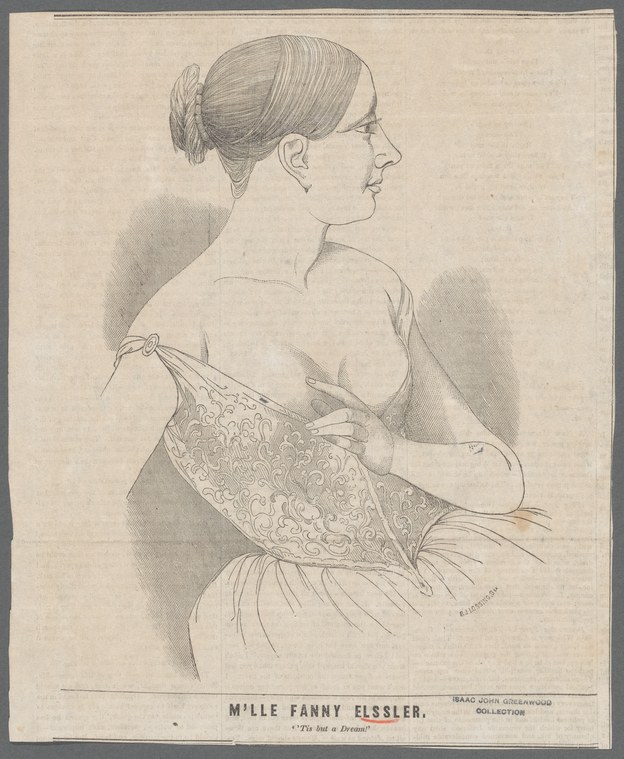
M'lle Fanny Elssler, 'Tis but a dream!
Unknown artist
- Collection:
- Prints depicting dance
- Source:
- New York Public Library
- Rights:
- Public domain — free to use, share and adapt.
- Recorded as:
- Public Domain
This print preserves not the dance itself but the cultural mythology surrounding a Romantic-era prima ballerina—showing how performers were commodified, collected, and memorialized in the nineteenth century. For historians of dance and visual culture, it reveals the parallel economy of portraiture that surrounded theatrical celebrity, distinct from the documentation of choreography or technique.
What you are looking at
This is a portrait study of a woman shown in three-quarter profile, facing right, rendered in graphite with skillful tonal shading. She wears her dark hair swept back into a knot or chignon at the nape of her neck, a fashion of the mid-nineteenth century. The upper half of her body is bare or draped with only sheer fabric; the lower body is wrapped in an ornately patterned garment—possibly a shawl or skirt—with intricate scrollwork or floral designs rendered in fine detail. The background is plain, with subtle shading that suggests depth around her shoulders and back. The artist has paid particular attention to the contours of her face, neck, and shoulder, capturing a composed, almost serene expression. This is not a dance scene but a portrait of a named individual in a moment of repose or presentation.
The dancing
A single seated or standing female figure shown from the waist up, her body angled in profile. Her posture is upright and dignified; one arm (the nearer one) is visible, resting or positioned with the hand near her draped garment. There is no active movement or dance position; the gesture is restful and contemplative. The weight appears balanced and still. The bare or semi-draped shoulders and the graceful line of the neck suggest a classical or academic portrait tradition.
The dance depicted
This image does not depict dance. It is a portrait of an individual, identified by the inscription as 'M'lle Fanny Elssler' and titled 'Tis but a dream!' While Fanny Elssler was a celebrated Romantic-era ballet dancer, this print documents her as a subject of portraiture rather than in performance. The title suggests an allegorical or sentimental reference—possibly to romance, aspiration, or theatrical life—but the image itself shows a stationary, posed figure rather than any choreographic moment.
How it was made
This is a portrait print, executed in graphite or pencil on paper. The technique shows considerable skill in cross-hatching and tonal modulation to create volume and shadow, particularly in the hair, the ornate garment, and the shoulders. The fine detail of the decorative pattern on the lower garment suggests either a high-quality hand-drawn work or possibly a reproductive print (engraving or lithograph) based on a drawn original. The inscription at the bottom is printed. The medium and technique indicate this was intended for circulation as a portrait print—likely a souvenir or promotional item associated with the dancer or the theatrical world of the 1840s–1860s.
About this work
This is a mid-nineteenth-century portrait print of Fanny Elssler, one of the most celebrated ballet dancers of the Romantic era. Rather than capturing her in performance, the image presents her as a subject of portraiture: a composed, elegantly dressed woman in three-quarter profile, rendered with considerable technical skill in graphite. The work belongs to a category of theatrical ephemera and celebrity portraiture that circulated widely during this period, allowing the public to own an image of a famous performer. Although Elssler was renowned for her dancing, this print documents the cultural status of the performer as a named individual worthy of artistic attention and domestic display.
How to look at it
Attend to the artist's choice to show Elssler in repose rather than in motion—a choice that emphasizes her status as a celebrated individual rather than documenting her technique. The careful rendering of fabric and ornament, and the classical profile pose, situate her within a tradition of dignified portraiture. The title suggests a layer of meaning beyond the visual: the phrase 'Tis but a dream!' invites the viewer to reflect on the ephemeral nature of theatrical performance and perhaps on the sitter's inner life or romantic imagination. The bare or semi-draped shoulders reference classical ideals of beauty, conflating the dancer with timeless artistic subjects.
The artist
The artist is not recorded in the catalogue. The print is marked as part of the Isaac Dion Greenwood Collection, suggesting it was acquired as part of a broader gathering of dance-related prints and ephemera. The quality of execution indicates a trained draftsperson, likely a commercial portrait artist or reproductive engraver working for a theatrical print publisher.
The period
Fanny Elssler performed across Europe and the Americas from the 1830s through the 1850s, reaching peak fame during the height of Romantic ballet—an era when ballet prioritized ethereal, sensual, and emotionally expressive movement over pure technical virtuosity. The circulation of portrait prints of dancers was a standard form of theatrical promotion during this period. Unlike later photographic methods, hand-drawn and engraved portraits required significant labor and cost, marking them as valuable collectibles for devoted fans and cultural institutions. The sentimental title 'Tis but a dream!' aligns with Romantic-era aesthetics that emphasized sentiment, aspiration, and the transient beauty of performance.
Where it lives
This work is held in the Prints depicting dance collection at the New York Public Library, part of the Isaac Dion Greenwood Collection. It is a portrait print, a category of theatrical ephemera that was produced and collected in significant quantity during the nineteenth century.
Questions about this work
Who was Fanny Elssler?
Fanny Elssler (1810–1884) was an Austrian dancer who became one of the most celebrated performers of the Romantic ballet era. She was known for her technical brilliance, her sensuality on stage, and her popularity throughout Europe and the Americas. She famously competed with Marie Taglioni for public favor during the 1830s–1840s.
Why is this a portrait rather than a dance image?
Portrait prints of famous performers were a major form of theatrical merchandise and fan culture in the nineteenth century. This allowed the public to own an image of a celebrity outside the theater. Artists often drew or engraved dancers in costume or in posed, dignified attitudes—emphasizing their status as celebrated individuals rather than documenting their technique.
What does the title 'Tis but a dream!' mean?
The title likely carries romantic or sentimental associations common to Romantic-era theater and poetry, suggesting themes of aspiration, transience, or yearning. It may reference a theatrical role, a personal sentiment attributed to the sitter, or the broader cultural mythology surrounding performers of this era.
How was this print made?
The image was created using graphite on paper, with careful tonal shading and cross-hatching to create volume and detail. It may have been hand-drawn as an original or produced as a reproductive print (engraving or lithograph) based on a drawing. Either way, it represents a labor-intensive process designed for circulation among a theater-going public.
More dance artwork





