49 works in this view — arrow keys or swipe to move between them.
Dance in Art
Carlotta Grisi
Unknown artist
- Collection:
- Prints depicting dance
- Source:
- New York Public Library
- Rights:
- Public domain — free to use, share and adapt.
- Recorded as:
- Public Domain
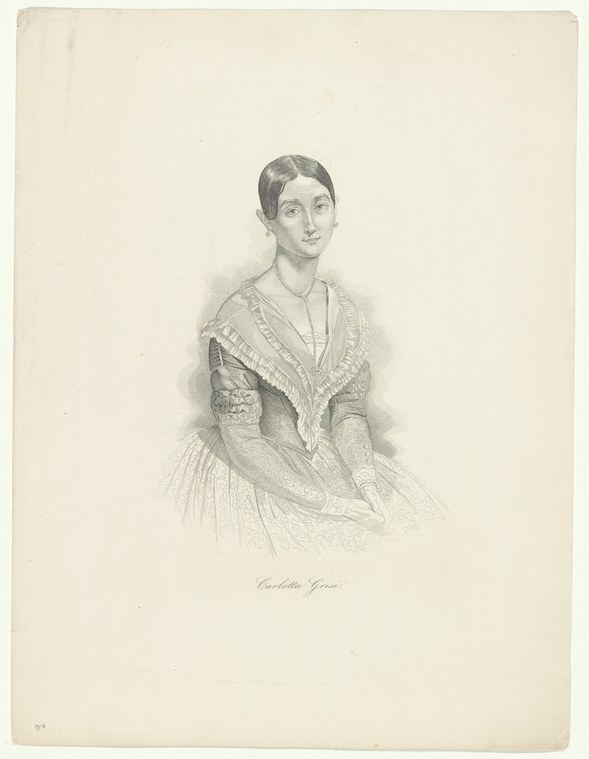
Grisi was one of the finest dancers of the Romantic era, and this portrait captures her as a public icon at the height of her fame. For historians of nineteenth-century dance and visual culture, such prints document how performers were marketed, celebrated, and memorialized in their own time, and what image of the dancer was presented to the paying public.
What you are looking at
A three-quarter-length portrait of a woman in mid-nineteenth-century dress, shown against a plain cream background. She wears a dark dress with short sleeves trimmed in lace, and a white collar or fichu draped across her shoulders. Her hair is parted and smoothed close to her head in the fashion of the 1840s. Her body is turned slightly to the left, and her posture is upright but not rigid. The artist has captured a moment of stillness rather than motion—she gazes toward the viewer with a calm, direct expression. The work is a lithograph or engraving, rendered entirely in graphite tones with careful attention to the modeling of her face and the delicate texture of her dress.
The dancing
A single standing figure, viewed from approximately waist-up, in a neutral, frontal pose. Her weight appears evenly distributed. Her arms hang naturally at her sides, with her hands just visible at the edge of the frame. There is no theatrical extension or balletic frame—this is a portrait stance, not a dance position. The figure's composure and stillness suggest a moment captured outside of active performance.
The dance depicted
This is a portrait of Carlotta Grisi, a celebrated Romantic-era ballet dancer, but the image itself does not depict her dancing. Grisi was famous for roles including Giselle (which premiered in 1841) and was one of the most admired performers of the Romantic ballet period. The portrait captures her as a public figure and celebrity rather than in performance. The image documents her as a person known for dance, but the formal portrait convention—static, frontal, in street dress—means we learn nothing about her technique, her roles, or how she moved on stage.
How it was made
This is a lithograph or engraving rendered in pencil or crayon on paper. The fine, even tone and the careful graduated shading suggest a professional reproductive print, likely made from a drawing or painting. The technique allowed for wide distribution—this was a popular, affordable way to circulate images of famous performers to fans and the curious public. The quality of the rendering and the format suggest this was a commercial print, one of many celebrity portraits produced in the mid-nineteenth century.
About this work
This is a portrait of Carlotta Grisi, a leading Romantic ballet dancer of the 1840s, rendered as a lithographed engraving. It documents her as a celebrity of the period rather than showing her in dance. The image belongs in a gallery of dance imagery because Grisi was a transformative figure in theatrical ballet—a dancer whose artistry defined an era—but viewers should understand that this is a portrait of a dancer, not a depiction of dance itself. It speaks to how nineteenth-century print culture circulated images of performers and how dancers were understood as public figures and celebrities whose likenesses were collected and displayed.
How to look at it
Look at how the artist has presented Grisi as a person, not a performer in motion. Her stillness, her direct gaze, and her everyday dress are all markers of portraiture rather than theatrical imagery. Notice the care taken in rendering the texture of her clothing and the delicate modeling of her face—this was expensive work, and it signals her status as a celebrated artist worth the investment. The composition is formal and frontal, following the conventions of fashionable portraiture, which tells us how dancers were understood in polite society.
The artist
The artist is not recorded. The print was produced by a commercial publisher or print workshop, likely in London or Paris where Grisi performed. Such portraits were made by engravers and lithographers working from drawings or paintings, often by more senior artists. The quality suggests the work of an established printing house circulating celebrity images.
The period
This portrait was made during the height of the Romantic ballet era, approximately the 1840s or early 1850s. Grisi was one of the four greatest dancers of the period, alongside Marie Taglioni, Fanny Elssler, and Lucile Grahn. Lithography and engraving were the dominant technologies for reproducing images in this era, and prints of famous performers were widely collected. The formal, dignified pose reflects the conventions of portraiture in the mid-nineteenth century, when a dancer's public image was carefully constructed and circulated through such prints.
Where it lives
The work is held in the New York Public Library's prints collection documenting dance. It is described simply as a portrait of Carlotta Grisi, with no attribution, date, or medium recorded in the catalogue.
Questions about this work
Is this engraving showing Carlotta Grisi dancing?
No. This is a portrait of Grisi in street dress and a neutral pose, not a performance image. It presents her as a celebrity and public figure rather than documenting her technique or roles. Many portrait prints of famous performers were made and collected during the nineteenth century, separate from theatrical imagery.
Who was Carlotta Grisi?
Grisi (1819–1899) was an Italian dancer who became one of the greatest stars of the Romantic ballet era. She premiered the role of Giselle in 1841 and was celebrated across Europe for her artistry, technique, and dramatic power. She was also known as a mime and actress on stage.
Why would a print collector want this image?
Lithographed and engraved portraits of famous performers were fashionable commodities in the nineteenth century, circulated much like photographs or fan cards today. Grisi's celebrity meant that her image had market value, and such prints were affordable ways for the public to own a likeness of a favorite artist.
More dance artwork





