49 works in this view — arrow keys or swipe to move between them.
Dance in Art
American fashion plates
Unknown artist
- Collection:
- Prints depicting dance
- Source:
- New York Public Library
- Rights:
- Public domain — free to use, share and adapt.
- Recorded as:
- Public Domain
Fashion plates are primary sources for the actual dress of dancers in the period they illustrate. Understanding what dancers wore, how garments moved on the body, and what physical possibilities or constraints fabrics imposed is crucial to reconstructing historical movement practices. A historian studying 1890s theater, ballroom, or social dance cannot work from paintings alone; commercial fashion documentation shows the mundane, repeated versions of costume that shaped dancers' bodies and defined the era's aesthetic.
What you are looking at
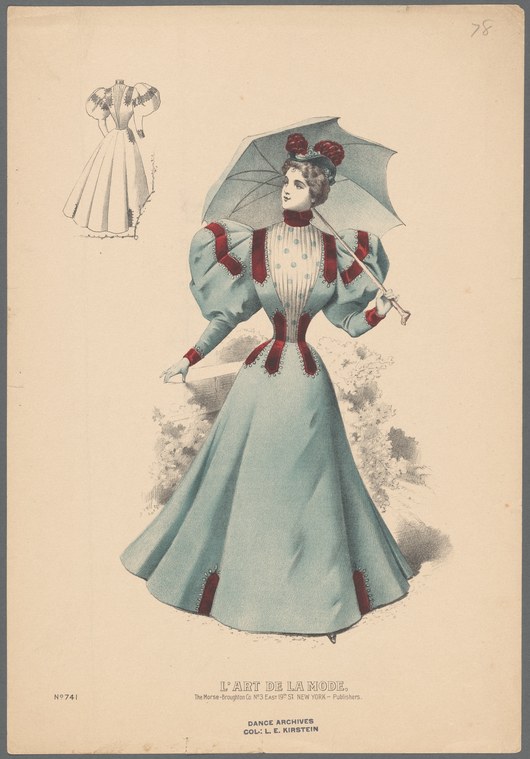
A fashionably dressed woman in the 1890s stands in three-quarter view against a plain cream background, holding a parasol in her right hand. She wears a pale blue-grey day dress with distinctive puffy leg-of-mutton sleeves reaching to the elbow, trimmed with deep red ribbon. The bodice is fitted white with red decorative bands running vertically; the skirt is full and sweeping, gathered at the waist and falling to her ankles, also trimmed with red at the hem. Her dark reddish hair is styled high on her head in the Gibson Girl manner of the period. The parasol she holds is grey with a dark handle. A small fashion sketch of the same dress appears in the upper left corner of the plate, showing the design from the front in simplified form. The composition is a classic fashion plate: a single figure presented at full length to display the cut and ornament of a complete outfit.
The dancing
The woman stands with her weight on one leg, the other slightly relaxed, in a pose of elegant repose rather than movement. Her left arm rests naturally at her side; her right arm is raised to hold the parasol at shoulder height. The posture is upright and formal, with the torso held erect and the shoulders back, displaying the silhouette of her dress to best advantage. This is the characteristic stance of a fashion model: stationary, poised, and oriented to show the garment rather than to convey dance or dynamic action.
The dance depicted
This image does not depict dance. It is a fashion plate—a commercial illustration for the clothing trade—showing the construction and ornament of a day dress for women in the 1890s. The woman's pose is a static display posture, not a dance position or movement. While fashion plates of this era are sometimes found alongside dance imagery in archival collections, this particular work serves no dance purpose and contains no dance vocabulary.
How it was made
This is a hand-colored lithograph or chromolithograph, a process that allowed cheap, rapid color printing ideal for fashion magazines and trade catalogs. The colored portions—the blue dress, red ribbon trim, and parasol—are applied in successive passes of pigmented stone or metal plates, with delicate outlines rendered in black lithographic ink. The technique allowed precise reproduction of minute details of tailoring and ornamentation, making it the standard medium for commercial fashion dissemination in the late nineteenth century. The archival number (NJ741) and credit line "Danse Archives, Coll. L.E. Kirstein" indicate this was collected as part of a broader documentation of movement and costume, though its inclusion in a dance archive is a matter of custodial context rather than content.
About this work
This is an American fashion plate from the 1890s, a commercial illustration promoting a woman's day dress of pale blue-grey wool with red ribbon trim and exaggerated leg-of-mutton sleeves. It exhibits the aesthetic conventions of the period: the Gibson Girl silhouette, the high pompadour hairstyle, the formal upright posture, and the parasol as an accessory of leisure and respectability. Fashion plates are not dance imagery, but they are essential visual documents of what dancers and the bodies that danced actually wore. The dress here—with its restricted movement, weight of fabric, and emphasis on display of silhouette over mobility—embodies the physical constraints and sartorial values of the 1890s stage and ballroom.
How to look at it
Notice the parasol: held at shoulder height with the arm bent, it is an accessory of display, not a tool in active use. The pose is deliberately still and frontal, designed to let the eye travel across the body and register every seam, tuck, and trimming of the dress. The exaggerated sleeves—the most fashionable and impractical element of the silhouette—are given prominence by the parasol's placement, drawing the eye to the shoulder. The print is a document of how fashion was sold to women, not how it was worn in motion.
The artist
The artist is not recorded. Fashion plates of this era were typically produced by commercial publishing houses or fashion houses (in this case likely French, given the title "L'Art de la Mode"), with lithographs designed and colored by studio artists whose names were not always credited. The consistent quality and finish suggest a professional atelier rather than an individual artist of recognized reputation.
The period
The 1890s saw the crystallization of the Gibson Girl ideal—a tall, athletic-looking woman with a full bust and narrow waist, achieved through heavy corseting and the dramatic silhouette of the period. This was the decade of the bicycle craze and the "New Woman," yet ironically women's fashion became more restrictive, with skirts narrower than before and sleeves of exaggerated fullness. In stage dance, this was the tail end of the Romantic ballet era in America and the height of music hall and burlesque popularity. Social dancing—quadrilles, waltzes, and the emerging two-step—required mobility that this dress, for all its fashionable appeal, severely limited.
Where it lives
This print is held by the New York Public Library as part of the Danse Archives collection, assembled by curator Lincoln Kirstein. The collection mixed original dance imagery with costume documentation and commercial fashion materials, reflecting Kirstein's scholarly interest in the material and visual contexts of dance history.
Questions about this work
Is this a dance costume?
No. This is a day dress for street or leisure wear. While fashionable dress of this era was worn socially and sometimes on stage, this plate was made to sell clothing, not to document theatrical costume. The pose and purpose are commercial, not choreographic.
What are those enormous sleeves?
The leg-of-mutton sleeve was the defining silhouette of the 1890s: full from shoulder to elbow, then fitted from elbow to wrist. They were difficult to construct, expensive to produce, and severely limited arm movement—which is exactly why fashionable women wore them. Tight sleeves would have been considered dowdy.
Could someone dance in this dress?
Not easily. The heavy wool, the weight of the skirt, the tight waist from corseting, and the immense sleeves all restricted movement. Professional dancers of the period wore lighter, less voluminous versions for performance. This is what an upper-middle-class woman wore to go shopping or receive visitors—not what she wore to waltz at a ball or attend the theater.
Why is this in a dance archive?
Fashion plates like this one document the actual dress of the period, including what dancers wore offstage and what the fashionable silhouette of the day looked like. Understanding historical movement requires understanding what moved it—the weight, cut, and feel of period garments.
More dance artwork





