49 works in this view — arrow keys or swipe to move between them.
Dance in Art
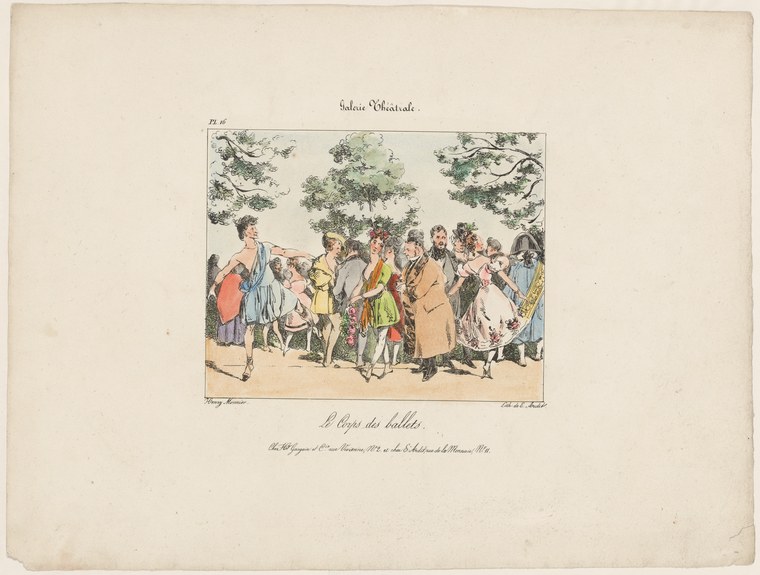
Le corps des ballets
Unknown artist
- Collection:
- Prints depicting dance
- Source:
- New York Public Library
- Rights:
- Public domain — free to use, share and adapt.
- Recorded as:
- Public Domain
As a titled representation of a named professional group—the corps de ballet—this print offers rare documentary evidence of how ballet companies were perceived and presented to the public during the Romantic era. It captures not a performance or technique, but the ensemble as a social entity, which tells us how the ballet world and artists understood themselves and their place in society. The work's focus on the group off-stage and in everyday dress shifts our understanding from choreography and virtuosity to the lived experience and professional identity of ballet dancers during a transformative moment in the art form's history.
What you are looking at
A group of approximately fifteen dancers and attendants gather beneath leafy trees in what appears to be a formal garden or park setting. The figures are arranged in a loose semi-circle, dressed in the high-waisted gowns and coats of the early nineteenth century—women in long muslins and empire-silhouette dresses with short sleeves, men in tailored coats and breeches. The composition suggests a moment of social gathering rather than active dancing: some figures stand at ease, others gesture conversationally, and the overall mood is one of refined leisure. The artist has used soft watercolor washes to depict the foliage overhead and the pale dresses of the women, with pen outlines defining the figures and their clothing. The light is diffused and natural, consistent with an outdoor daytime scene. The title inscription below the image reads "Le Corps des ballets" (The corps of the ballet), indicating this depicts the ensemble dancers of a professional ballet company in a moment of repose or social interaction rather than performance.
The dancing
The dancers stand in relaxed, upright postures typical of Regency-era deportment, with no one in active dance movement or theatrical frame. Several women have their arms at their sides or gestures of conversation; one or two appear to be turning slightly toward companions. The men stand with arms down or gesturing. There is no evidence of a closed ballroom hold, partnered frame, or any technical ballet vocabulary—no en pointe positioning, no turned-out legs, no lifted arms. The group reads as a social ensemble rather than a performing one, and none of the figures demonstrate the physical vocabulary of ballet technique even in a Romantic era context.
The dance depicted
The work is titled *Le Corps des ballets*, identifying the figures as members of a professional ballet company's corps de ballet. However, the image does not depict them dancing or in performance costume. Instead, it shows them in contemporary street dress, socializing outdoors—likely a study of the dancers themselves as a social class or professional identity rather than a record of a specific dance or choreography. The style of dress and the soft, naturalistic setting suggest this dates to the early nineteenth century, the Romantic ballet era, yet there is no choreographic content visible. The work seems more interested in the ensemble as a group of professional performers in their everyday life than in documenting dance technique or style.
How it was made
This is a hand-colored engraving or lithograph, executed with pen outlines and watercolor or gouache washes. The technique is characteristic of early nineteenth-century theatrical or social prints: fine pen lines define the figures and their clothing with precision, while pale washes of color—greens for foliage, flesh tones for faces and hands, yellows and blues for garments—are applied loosely over the printed image. This hybrid method was common for theatrical prints and social scene documentation in France and Britain during the 1810s–1820s, allowing for both detailed figure definition and quick, colorful finish. The quality suggests a print made for a broader audience than a unique drawing, though the hand-coloring indicates modest circulation rather than mass production.
About this work
This is an early nineteenth-century hand-colored print depicting the corps de ballet of a professional dance company in a moment of social relaxation rather than performance. The title *Le Corps des ballets* explicitly identifies the group, yet the image shows them in street dress, gathered conversationally beneath trees, with no choreographic activity or theatrical framing. The work is a document of ballet's social and professional world during the Romantic era—a record of who these dancers were as a group and how they appeared in everyday life, rather than a demonstration of their craft. Its significance lies not in what it shows of dance technique or style, but in what it reveals about the status, appearance, and social presence of professional ballet ensembles in the early nineteenth century.
How to look at it
Attend to the absence of dance: the artist has deliberately positioned these figures in conversational repose rather than choreographic action. Notice the contemporary Regency dress—high waistlines, muslin gowns, tailored coats—which places the scene in everyday life rather than on stage. Look at the upright, natural postures and the informal grouping, which suggest the dancers as themselves rather than as performers embodying a role. The soft, outdoor setting and diffused light reinforce the documentary or social aspect rather than the theatrical. The work invites you to see the corps de ballet as a professional group or social class, not as an abstract ensemble performing a function on stage.
The period
The image dates stylistically to the early nineteenth century, during the emergence of Romantic ballet (c. 1810s–1830s). This was the era when ballet was transitioning from court entertainment and neoclassical spectacle toward the ethereal, narrative-driven works associated with Romantic aesthetics. Professional ballet companies expanded in size and social prominence during this period, and the corps de ballet—the ensemble of dancers who provided background, symmetry, and large-scale effects—became a central visual feature of the theatrical spectacle. Hand-colored prints documenting ballet dancers, both in performance and in social contexts, were a growing market during the 1810s–1820s, aimed at a theater-going public fascinated by the ballet world. This print reflects that popular interest in ballet as both an art form and a social phenomenon.
Where it lives
The work is held in the New York Public Library's collection of prints depicting dance. It appears to be a French or British print of the early nineteenth century, likely issued as a theatrical souvenir or social print for distribution to the theater-going public.
Questions about this work
Is this a scene from an actual ballet performance?
No. Although the figures are identified as members of a professional ballet corps, the image depicts them in everyday street dress in a garden setting, not in costume or in the act of performing. This is a social or documentary image of the dancers themselves, not a record of choreography or stagecraft.
Can you tell what ballet company this is?
The print is titled *Le Corps des ballets* but does not name a specific company, theater, or choreographer. The style and execution suggest a French or British print from the 1810s–1820s, but without further inscription or provenance, the specific troupe cannot be identified from the image alone.
What does 'corps de ballet' mean?
The corps de ballet is the ensemble of professional dancers in a ballet company who perform as a unified group, providing background, geometric formations, and large-scale visual effects. Dancers in the corps were and are distinct from soloists and principals, and the corps as a collective was (and is) a central component of ballet spectacle.
Why would an artist make a print of dancers just standing around?
During the Romantic era, ballet and its dancers fascinated the public as both artists and celebrities. Prints depicting dancers in social or everyday contexts—not just in performance—were popular souvenirs and documents of the ballet world, reflecting public curiosity about the lives and appearance of these professional performers.
More dance artwork





