49 works in this view — arrow keys or swipe to move between them.
Dance in Art
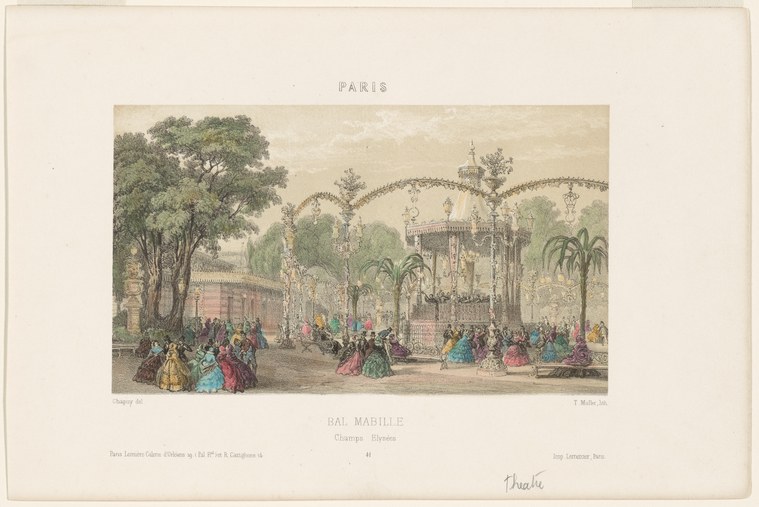
Bal Mabille: Champs Elysées
Unknown artist
- Collection:
- Prints depicting dance
- Source:
- New York Public Library
- Rights:
- Public domain — free to use, share and adapt.
- Recorded as:
- Public Domain
For historians of dance, this print offers concrete evidence of how the waltz and quadrille were actually danced in public venues, the scale of women's skirts and their effect on movement, and the social structure of mid-century ballroom culture. It also captures a moment when dance was becoming a commercial spectacle and a mark of modernity—the Bal Mabille was famous precisely because it was a new kind of public space, neither fully elite nor fully popular, and this image preserves that liminal quality.
What you are looking at
A fashionable outdoor public garden at the Bal Mabille, the famous Parisian dance venue on the Champs-Élysées, in full evening revelry. The composition centers on an ornate bandstand or pavilion with elaborate iron lattice arches, beneath which an orchestra performs. The setting is framed by mature trees on the left and decorated with potted palm trees, suggesting a horticultural pleasure garden. Dozens of figures in mid-19th-century dress populate the scene: women in voluminous crinoline skirts in jewel tones—emerald, magenta, sapphire—and men in dark coats and top hats. Some figures dance in couples; others promenade, chat, or watch from the sides. The hand-colored lithograph captures the warm glow of artificial light, with a cream-colored sky suggesting evening illumination. The overall effect is one of elegant public leisure and social mixing—this was a venue where different classes mingled under cover of the garden's fashionable respectability.
The dancing
The dancers visible in the foreground and middle ground show couples in what appears to be a closed ballroom hold, with partners facing one another in the formal frame of 19th-century salon dancing. The women's enormous crinolines dominate the visual weight; their skirts sweep the ground and create a striking silhouette when women turn or promenade. Men maintain upright posture, arms positioned to manage their partner's bulk. Groups of spectators stand at the margins—some women seated or standing in conversation, some men in formal observation. The scale of the skirts means that even a simple walking step or turn reads clearly as purposeful movement within the crowd.
The dance depicted
This depicts the Bal Mabille in its heyday as a venue for fashionable social dancing, principally the waltz and quadrille—the dominant salon dances of the 1840s–1860s. The Bal Mabille was a semi-public garden dance hall where the middle and upper classes came to be seen and to dance under the stars. The image captures the social function of the venue as much as the dance itself: it was as much about display, courtship, and fashionable promenade as about the actual steps. The open-air setting, the band pavilion, and the mixed crowd suggest the democratic aspect of this venue, which was simultaneously exclusive and accessible in ways that fascinated contemporaries.
How it was made
This is a hand-colored lithograph, a medium perfectly suited to the fashionable print market of the mid-19th century. The technique allowed for relatively rapid production and wide circulation among a middle-class audience hungry for images of contemporary leisure and fashion. The color has been applied after printing, which gives the work the characteristic flatness and bright palette of commercial fashion prints and keepsakes. The signature 'T. Mollier' appears at lower right, identifying the artist as a lithographer whose name appears on many such Paris scene prints. This type of print was sold individually or in series and served as both souvenir and social commentary on contemporary amusements.
About this work
The Bal Mabille was one of the most famous public dance venues in 19th-century Paris, an open-air garden on the Champs-Élysées where the middle and upper classes came to dance, display themselves, and experience modernity. This hand-colored lithograph documents the venue in full operation, capturing both the architecture of pleasure—the bandstand, the fairy-lit garden, the crowd—and the actual dancing: couples waltzing and promenading in the formal ballroom frame that dominated elite social dance. The image is a primary document of salon dancing culture and of how dance functioned in the emerging modern city as a site of social mixing, fashion, and leisure.
How to look at it
Look first at the silhouettes created by the enormous crinolines—they read as a visual language of propriety and display. Watch how the artist has positioned couples: the men are nearly invisible beside their partners' skirts, yet they frame and support the women's bodies in the formal hold of salon dancing. Note the orchestra pavilion as the organizing principle of the scene—everything radiates from it, the music as the invisible center of gravity that makes the dancing possible. The use of bright, saturated color (particularly the magenta, emerald, and sapphire skirts) was a convention of commercial prints meant to catch the eye and suggest luxury and pleasure. The evening garden setting—with its artificial light and its freedom from the ballroom's walls—was itself a modern novelty worth advertising.
The artist
The print is signed 'T. Mollier,' a lithographer active in Paris in the mid-19th century, producing fashion plates and topographical views of contemporary amusements. Mollier's work sits in the tradition of commercial prints documenting Parisian leisure culture for a mass market. These prints were often sold cheaply as souvenirs or as inserts in magazines and newspapers, making them the visual equivalents of gossip and reportage about fashionable life.
The period
The 1840s–1860s saw the waltz and quadrille at the height of their social prestige. The Bal Mabille itself became famous from the 1830s onward as a venue that democratized fashionable dancing—it was public, it charged admission, it mixed social classes in ways that scandalized conservatives and delighted liberals. By the time this print was made, the Bal Mabille was already iconic, a symbol of modern Paris and modern leisure. Simultaneously, the fashion for enormous crinolines (at their widest in the 1850s) was at its peak, and any depiction of fashionable women dancing in this era must contend with the sheer visual dominance of the skirt. The medium of the colored lithograph was also at its commercial height, supplying an insatiable market for images of fashion, entertainment, and contemporary life.
Where it lives
The print is held by the New York Public Library in their collection of prints depicting dance. It is catalogued under 'Bal Mabille, Champs Élysées' and attributed to the area of Paris, confirming that the venue and location are the primary subject of interest for the collecting institution.
Dance in this work
Questions about this work
What is the Bal Mabille?
The Bal Mabille was a famous public dance garden on the Champs-Élysées in Paris, active from the 1830s to 1870. It was semi-public, charging admission, and became iconic as a space where different social classes could dance together—particularly the waltz and quadrille—under the stars. It was celebrated in prints, songs, and literature as a symbol of modern, democratic leisure.
Why are the women's skirts so enormous?
The crinoline—a hoop skirt made of horsehair, whalebone, or steel hoops—was fashionable from the 1840s onward, reaching its greatest width in the 1850s and 1860s. The scale of these skirts was a mark of fashion, leisure, and respectability: they signaled that a woman did not work and had servants to help her dress and move. They also made dancing a distinct physical challenge, requiring strength and balance in the partner and affecting how couples positioned themselves.
How was this print made?
This is a hand-colored lithograph: an image drawn or transferred onto a stone, printed in black ink, and then hand-tinted with watercolor or gouache. This technique was fast enough and cheap enough to serve the commercial market for contemporary fashion and amusement prints, which were sold as souvenirs, illustrations for journals, or decorative inserts.
What dances are depicted here?
Based on the formal closed hold and the outdoor garden setting, these are most likely waltzes and quadrilles—the dominant ballroom dances of the mid-19th century. Both were considered fashionable and respectable, and both required the formal frame visible in the print.
More dance artwork





