49 works in this view — arrow keys or swipe to move between them.
Dance in Art
Egg dance
Unknown artist
- Collection:
- Prints depicting dance
- Source:
- New York Public Library
- Rights:
- Public domain — free to use, share and adapt.
- Recorded as:
- Public Domain
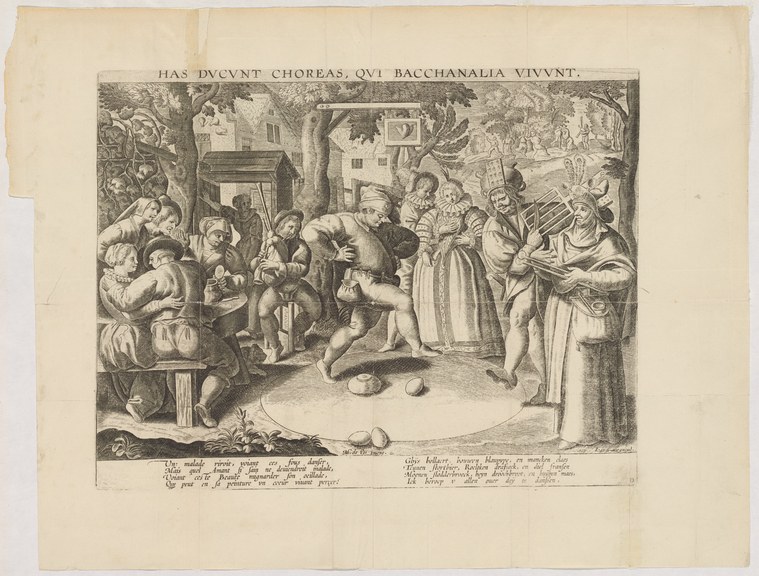
The egg dance is a historical form of physical entertainment and social amusement largely undocumented except through prints and literary references. This engraving is rare evidence of how such games were performed, staged, and witnessed in a specific social context—a garden gathering of mixed ages and genders—and it shows that playful, comic physicality was a valued form of collective entertainment. For dance historians, the image reveals that not all valued movement of the period was formal court dance; domestic and festive entertainments involving awkward, exaggerated, or comic embodied action were equally part of the period's movement culture.
What you are looking at
This engraving depicts a lively outdoor gathering centered on a game or dance involving eggs scattered on the ground. A large group of figures—men, women, and children—occupies a wooded garden setting with classical architecture visible in the background. In the foreground, a central figure bends or crouches toward the eggs with the exaggerated posture of someone engaged in an awkward, comic movement; surrounding spectators gesture, point, and lean in with apparent delight at the activity. The composition is crowded and animated, with figures distributed across the shallow stage space in a mix of engaged participation and observing amusement. The Latin inscription at top, "HAS DUCUNT CHOREAS, QUI BACCHANALIA VIVUNT" ("These lead the dances, those who live as Bacchants"), frames the scene as a festive, wine-related revelry—a garden party or carnival game. The woodland setting, classical structures, and the scale of participation suggest this is a documented social entertainment rather than a formal theatrical performance.
The dancing
The central figure is captured in a deep bend or squat, arms extended for balance as they reach toward the eggs on the ground—a posture of comic exertion and loss of dignity. Surrounding figures display the varied responses of spectators: some lean forward in engaged interest, others point, gesture animatedly, or clasp their hands. The group is mixed in age and dress, from small children to elderly men and women in period costume (long dresses, doublets, caps). The spatial relationship is one of collective focus on a single performer, with the peripheral figures creating a frame of social witness and amusement around the central action.
The dance depicted
This is an egg dance, a documented game or entertainment of the Renaissance and early modern periods in which a performer attempted to move through or pick up eggs placed on the floor without breaking them—an act requiring awkward, careful footwork and often resulting in comic loss of balance. The inscription's reference to Bacchanalian revelry suggests this was a social amusement tied to festive, often drunken gatherings rather than formal choreography. The posture and the eggs-on-ground setup are consistent with German and Dutch engravings of the 16th–17th centuries documenting such games as folk entertainment or carnival activities. The egg dance was less a technical dance form than a choreographed game of physical comedy, performed for collective amusement in domestic or garden settings.
How it was made
This is an engraving, identifiable by the fine parallel lines (hatching) used to create tone and shadow, the sharp definition of detail, and the printed texture. The technique allowed for mass reproduction and wide circulation; the Latin inscription and learned classical allusion suggest this was addressed to an educated audience interested in documenting social customs and manners. The level of compositional detail—individual faces, varied postures, architectural setting—indicates a skilled printmaker working from a design, likely after a painting or drawing. The scale and complexity suggest a formal publication, possibly part of a series documenting games, entertainments, or social life.
About this work
This engraving documents the egg dance, a game-entertainment of the Renaissance and early modern period in which a performer navigated eggs on the ground in an awkward, comic display of physical control and comic loss of control. The work is part of a tradition of Northern European printmaking that recorded folk and festive entertainments as social curiosities, often with learned classical references (here, the Bacchanalian allusion) that elevated popular amusements to the status of documented custom. The composition emphasizes the social nature of the entertainment: it is not a solo performance but a collective act of witnessing, with the crowd's reactions as central to the image as the performer's exertion. The engraving belongs to a category of Renaissance and early modern art that captured vernacular leisure and games as subjects worthy of fine art attention.
How to look at it
Attend first to the central performer's exaggerated bend and the careful placement of their feet near the eggs—this frozen moment captures the tension between attempting control and risking ridiculous failure, which is the entire point of the game. Notice how every other figure in the composition is oriented toward this central action: the engraver has used the crowd's attention and varied reactions (pointing, leaning, gesturing) to direct the viewer's eye and to establish that this is a social event, not a solo performance. The archival engraving style—with its fine detail and formal composition—paradoxically lends dignity to a comic, undignified moment, which is itself a form of early modern visual humor: important-looking printed documentation of deliberately silly behavior.
The period
This engraving dates from the 16th or 17th century, a period when Northern European printmakers were intensely interested in documenting and often satirizing social manners, games, and entertainments. The tradition of recording folk and festive practices reached its height with artists like Pieter Bruegel the Elder and his followers, who used engravings and paintings to capture peasant festivals, games, and entertainments as windows into social life. The egg dance appears in several surviving prints and paintings from this period, often as a subject of both anthropological interest and gentle mockery. The Bacchanalian reference in the inscription connects the game to classical learning and the festive, often libertine culture of early modern garden parties and carnival gatherings.
Where it lives
This engraving is held in the Prints collection of the New York Public Library, catalogued as a work depicting dance in the genre collection. It is a printed work, likely created from an engraved plate and circulated in prints as part of an album, series, or publication documenting social entertainments.
Dance in this work
Questions about this work
Was the egg dance a real Renaissance game or just an artistic invention?
The egg dance was a documented game, attested in literary sources, paintings, and multiple engravings from the 16th and 17th centuries, particularly in German and Dutch contexts. It was a real form of domestic entertainment, usually performed at parties or festive gatherings, combining physical skill and deliberate comedy. The game appears to have been popular enough to be worth recording in fine art, which suggests it held social significance as a marker of festive, uninhibited leisure.
What is the Bacchanalian reference in the inscription?
Bacchus was the Roman god of wine and festive abandon; a Bacchanal was a revel or drinking party associated with uninhibited behavior. By calling this an egg-dance among Bacchants, the engraver is framing the game as part of drunken, licentious revelry—marking it as entertainment tied to wine, celebration, and the temporary suspension of normal decorum. The reference elevates a folk game to classical-literary status while also suggesting this kind of entertainment was tied to the festive, often rowdy culture of garden parties and carnival.
Why would anyone want to watch someone carefully walk around eggs?
The humor and appeal lay in the deliberate awkwardness required and the high risk of failure and comic loss of dignity. Performers often became flustered or lost their footing, and the tension between attempting graceful control and risking ridiculous breakdown was the entertainment. This kind of physical comedy—where the performer is set up to fail or appear foolish—was a valued form of amusement in early modern festive culture, much as slapstick and comic pantomime remain popular today.
Is this a formal dance or a game?
It is a game rather than a formal dance—it has no set choreography, music, or technical vocabulary. However, it is a form of structured, rule-bound physical performance designed for collective viewing and enjoyment, which makes it kin to dance in its social function. Early modern concepts of 'dance' were broader than modern categories; games, entertainments, and formal dances could overlap, and all involved valued embodied knowledge and the ability to move in stylized, rule-bound ways.
More dance artwork





