49 works in this view — arrow keys or swipe to move between them.
Dance in Art
Folk and ethnic dancing in wood engravings
Unknown artist
- Collection:
- Prints depicting dance
- Source:
- New York Public Library
- Rights:
- Public domain — free to use, share and adapt.
- Recorded as:
- Public Domain
The image preserves documentation of folk dance as a social practice at a moment when such customs were being systematized and collected by artists and ethnographers. For dancers and historians, it illustrates the informal, participatory nature of village recreation and the central role of music and community gathering in folk celebration—aspects often lost when dance is later formalized or staged.
What you are looking at
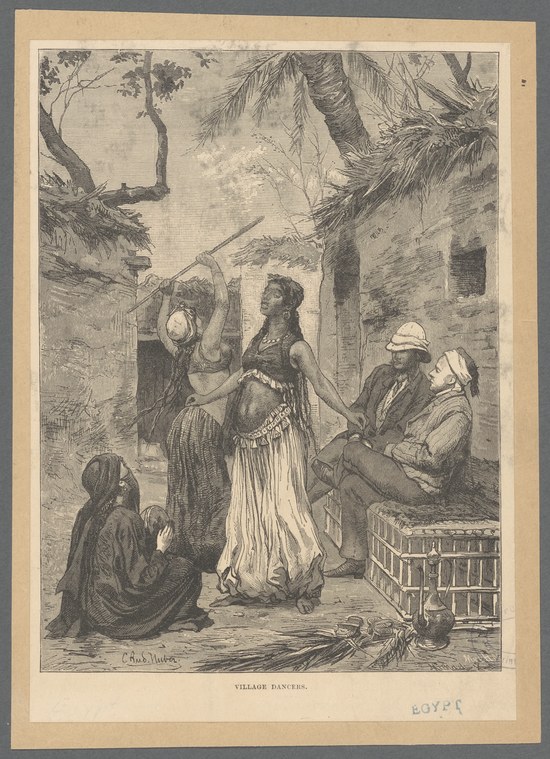
A wood engraving depicting a scene of village dancers in what appears to be a Mediterranean or North African setting, identified by the label as "Village Dances." The composition shows five figures arranged in a loose group within a rustic courtyard bounded by stone walls and draped with climbing vegetation—gnarled tree branches frame the upper portion of the scene. At left, a seated figure watches; in the center, a standing woman in a light draped dress appears to be dancing or gesturing expressively, her body angled and arms raised. Two other figures in darker clothing stand nearby, one appearing to play an instrument or gesture toward the dancer. A fifth figure sits at the right edge. The engraving employs fine parallel lines to create tonal gradation and texture in the stone walls, foliage, and clothing. The scene captures an informal moment of village recreation, with emphasis on the central female figure's movement and the onlookers' attention.
The dancing
The central dancer stands in a relaxed, engaged posture with her weight shifted and arms raised in an expressive gesture characteristic of folk dance. Her body is not in a rigid frame; instead, she appears animated and free in her movement, facing slightly toward the seated observer at left. The other figures are arranged as spectators and musicians rather than dancers, with one appearing to hold an instrument. The composition suggests social, participatory dance rather than formal or choreographed movement—the kind of circle or gathering dance typical of village celebrations.
The dance depicted
This appears to depict a village or folk social dance, likely European or Mediterranean in origin based on the rural courtyard setting and the casual participatory nature of the scene. The label "Village Dances" and the informal grouping suggest a type of celebration dance where community members dance for pleasure and social participation rather than performance. The woman's raised-arm gesture and the presence of musicians hint at dances involving upper-body movement and possibly circular or linear formations. Without more specific iconographic markers (distinctive costume, particular instrument, or regional architectural detail), the exact dance type cannot be confidently identified, but the image clearly documents folk recreational dance as a social practice.
How it was made
This is a wood engraving, recognizable from the fine parallel hatching lines, precise tonal control, and the ability to render small details—characteristics of wood engraving, which uses the end grain of hardwood blocks to achieve greater fineness than traditional woodcuts. Wood engraving was widely used for book and periodical illustration in the 19th century, allowing for mass reproduction and circulation to a broad audience. The artist's signature appears at lower left. The technique's precision and the work's inclusion in a collection of dance prints suggests this was created for publication or as part of a documented series of genre scenes.
About this work
This wood engraving documents a moment of village social dance in what appears to be a 19th-century Mediterranean or European rural setting. The work captures an informal gathering where a woman dances while others play music and watch—a scene of lived, participatory folk culture rather than staged performance. As part of a larger collection of dance prints, it serves as both an artistic representation of movement and a historical record of how ordinary people celebrated together, offering insight into the aesthetics and social function of village dance in the period.
How to look at it
Observe the central dancer's free posture and raised arms—the artist has chosen to capture her mid-gesture rather than in a formalized position, emphasizing movement and expression over static beauty. Notice how the other figures frame her: the seated observer at left creates a viewpoint within the scene, while the standing figures with their own gestures suggest the group participation typical of folk dance. The use of light and shadow in the engraving emphasizes the three-dimensionality of her body and the depth of the courtyard, making the dance feel present and inhabited rather than decorative.
The period
The 19th century saw a growing romantic interest in folk culture, village life, and "authentic" rural practices among European artists and intellectuals. Collections of genre scenes—engravings depicting everyday or ceremonial life in different regions—became popular as both artistic projects and ethnographic documentation. This print is likely part of a broader series intended to illustrate folk customs across regions, reflecting both artistic appreciation for peasant culture and the period's nascent interest in comparative ethnography.
Where it lives
This work is held as part of a collection of prints depicting dance, housed in the New York Public Library. It is part of a larger didactic or ethnographic collection of wood engravings documenting folk and regional dance practices, suggesting it was created for circulation as educational or cultural documentation.
Dance in this work
Questions about this work
Is this a real dance from a specific place, or an imagined scene?
The label "Village Dances" and the Mediterranean setting suggest documentation of actual folk practice, but without more specific markers it is difficult to identify the exact regional dance. The artist may have combined observed elements or worked from descriptions; 19th-century ethnographic prints often mixed direct observation with romantic idealization of rural life.
Why are some people watching and not dancing?
In many folk dances, spectators and dancers are part of the same social event; not everyone dances at once, and watching, playing music, and dancing are roles within a single celebration. The composition emphasizes the dance as a shared community activity rather than a performance for an external audience.
What can you tell from her dress and the setting?
The woman's light draped dress and the Mediterranean stonework, vegetation, and architecture suggest southern European or North African origin, possibly Italy, Greece, Spain, or the Levant. The rural courtyard setting and casual clothing indicate village rather than urban or elite culture.
More dance artwork





