49 works in this view — arrow keys or swipe to move between them.
Dance in Art
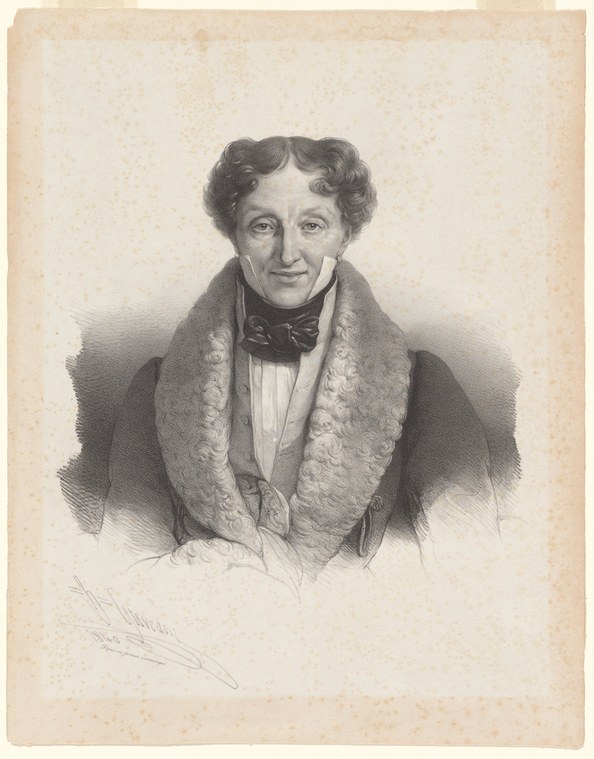
Portrait of Charles-Louis Didelot
Unknown artist
- Collection:
- Prints depicting dance
- Source:
- New York Public Library
- Rights:
- Public domain — free to use, share and adapt.
- Recorded as:
- Public Domain
Didelot was the single most important choreographer and teacher between Noverre and the mid-Romantic ballet masters; his innovations in technique, pantomime, and aerial effects shaped the vocabulary that dancers still use. This portrait is a primary-source record of his physical appearance and the way he was represented to the educated public of his era—a man of intellect and refinement, not a spectacular acrobat.
What you are looking at
A head-and-shoulders portrait of a man in early 19th-century dress, rendered as an engraving or lithograph on cream paper. He faces the viewer with a direct, composed gaze. His dark hair is styled in the Regency fashion, parted and waving slightly at the sides. He wears a black coat with a wide shawl collar in a light-colored fabric—likely fur or a silk wrap—draped across his shoulders. Beneath the coat is a white shirt front and a dark cravat or necktie tied at the throat. The background is plain and slightly shaded to create depth behind the figure. A signature mark appears in the lower left corner of the print. The work is a formal portrait of the type used to commemorate notable figures of the period, printed and distributed to a wide audience.
The dancing
The subject sits or stands with upright posture and square shoulders, presenting a composed, dignified bearing. His hands are not visible in the composition. The face shows the refined, thoughtful expression of a man of status and learning—the eyes are alert and penetrating, the mouth set in a slight, knowing expression. The fur-lined wrap across the shoulders was a mark of rank and respectability in Regency society. There is no active gesture or movement; this is the still, formal presentation typical of commemorative portraiture.
The dance depicted
The image itself does not depict dance or any active movement. It is a portrait of Charles-Louis Didelot, the most celebrated male dancer and ballet master of the Romantic era. Didelot was a central figure in Russian Imperial Ballet and a reformer of ballet technique, but this image shows him in civilian dress, not in a dance role or costume. The portrait commemorates the man, not his art. His importance to dance history is substantial, but this particular work does not visually represent dancing.
How it was made
This is an engraving or fine lithograph, a reproductive print likely made from a painted or drawn original. The technique uses careful cross-hatching and tonal gradation to model the face and create the illusion of three-dimensional form, particularly in the shading around the eyes, cheeks, and under the chin. The uniform pale cream paper and the signature mark suggest a published print made for wide distribution—the standard medium for commemorating notable figures in the early 1800s. Such prints were inexpensive compared to paintings and could reach a broad audience of educated readers and theatre-goers.
About this work
This is a formal commemorative portrait of Charles-Louis Didelot (1767–1837), the French-born dancer, choreographer, and director who transformed Russian Imperial Ballet and pioneered many techniques of modern classical ballet. The work is a fine engraving or lithograph, typical of the reproductive prints that circulated to celebrate notable artistic figures of the Romantic period. Though the image shows only Didelot's face and shoulders in civilian dress, it serves as a record of one of dance's most influential reformers during a pivotal moment in ballet history—the transition from court entertainment to theatrical spectacle and the birth of Romantic ballet.
How to look at it
Study the face carefully: Didelot's direct gaze and composed expression convey the intelligence and authority that contemporaries remarked upon. The fur wrap and formal attire situate him as a man of rank and education, qualities essential to his role as director and reformer of ballet at the imperial court. Notice the fine work in the engraver's handling of the hair and the subtle modeling of the cheeks and temples—this level of detail was reserved for important personages. The plain background focuses all attention on the sitter's face and bearing, the conventions of dignified portraiture. The signature in the lower corner confirms this as a published print meant for collection and display.
The artist
The artist is not recorded in the catalogue. The print is signed, but the signature is difficult to read clearly in reproduction. The work is consistent with the style of early 19th-century French or Russian reproductive engraving, and may have been made during or shortly after Didelot's lifetime. Prints of this type were often made by professional engravers working from portrait paintings; it is likely that an original oil or watercolor portrait existed, now lost or untraced.
The period
This portrait was made in the early Romantic era, when ballet was shifting from court spectacle to public theatrical entertainment and from social accomplishment to specialized professional art. Didelot, who worked principally in Russia from 1801 until his death, was at the center of this transformation. He introduced new techniques of elevation, ballon, and pantomimic expression that moved beyond the stilted formality of 18th-century court dance. The fashion of his dress—the high collar, the cravat, the fur wrap—and the style of the engraving both date to the 1810s–1830s. Portraiture of this kind was a standard way to honor artists, writers, and intellectuals; Didelot's appearance in this format acknowledges him as a figure of cultural importance, not merely an entertainer.
Where it lives
The work is held in the New York Public Library's collection of prints depicting dance. It is part of a body of 19th-century reproductive engravings and lithographs that document the appearance of notable dancers and choreographers of the Romantic era.
Questions about this work
Who was Charles-Louis Didelot and why is he important?
Didelot (1767–1837) was a French dancer and choreographer who spent most of his career in Russia, where he was the ballet master of the Imperial Theatre in St. Petersburg. He is credited with revolutionizing classical ballet technique by introducing new methods of elevation, ballon (the illusion of weightlessness in the air), and dramatic pantomime. His students and methods shaped Russian Imperial Ballet, which in turn shaped all modern classical ballet. He is considered the bridge between the old court ballet and Romantic ballet.
Is this Didelot in a costume or a dance role?
No. This is a formal portrait in civilian dress, not a representation of Didelot dancing. He is shown as a gentleman and man of letters, not as a performer. This type of commemorative portrait was made to honor his status and achievements, not to capture him in the act of dance. It is the person being honored, not the art itself, that is the subject.
What technique was used to make this print?
This is an engraving or fine lithograph, a reproductive print likely made from a painted original. The technique allowed the image to be printed in large numbers on inexpensive paper, making it affordable for a broad educated audience. The delicate tonal work and cross-hatching are characteristic of early 19th-century reproductive engraving.
What does his clothing tell us about him?
His attire—the fine black coat, the fur-lined wrap, the white linen, the formal cravat—all mark him as a man of rank, wealth, and respectability. In early 19th-century society, such dress was worn by gentlemen of education and standing. The fur wrap in particular was a mark of distinction. This visual language told viewers that Didelot was not a common entertainer but a cultivated professional and man of authority.
More dance artwork





