49 works in this view — arrow keys or swipe to move between them.
Dance in Art
Folk and ethnic costumes
Unknown artist
- Collection:
- Prints depicting dance
- Source:
- New York Public Library
- Rights:
- Public domain — free to use, share and adapt.
- Recorded as:
- Public Domain
For historians of dance, this image is crucial evidence of how Highland identity was visualized and commodified in print culture, shaping European understanding of Scottish dance and dancers before photography. The iconic costume shown here—tartan, kilt, bonnet, plaid—became the visual shorthand for 'Highland dance' itself, influencing how the form was marketed, taught, and performed well into the 20th century. Understanding this image clarifies how dance genres are partly invented through their visual representation in widely circulated media.
What you are looking at
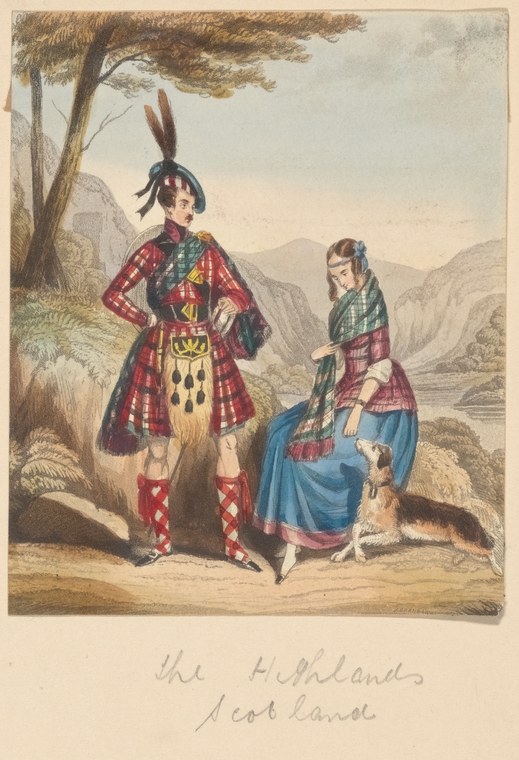
Two figures stand beneath a gnarled tree on a rocky highland landscape, with mountains and a body of water visible in the distance. The standing figure, positioned left, wears a striking red tartan kilt with a dark doublet, sporran, and bonnet with feathers—the costume of a Highland warrior or chief. The seated figure on the right, dressed in a green tartan skirt, a fitted bodice, and a plaid shawl draped over her shoulders, looks upward toward the standing figure. The composition suggests a moment of encounter or dialogue in a wild, romantic landscape characteristic of early 19th-century picturesque aesthetics. The hand-coloring is applied over an engraved or lithographic base, with browns and greens dominating the foliage and earth tones in the clothing.
The dancing
The standing figure adopts a proud, commanding posture with one hand resting on the hip and the other gesturing openly—a pose of authority and confidence. The seated figure, with a more modest and receptive stance, tilts her head toward the standing man in a gesture of attention or admiration. Neither figure is in active dance movement; they are posed in what appears to be a formal tableau rather than mid-choreography. The relationship between them suggests narrative or theatrical convention rather than the kinetic energy of social dance.
The dance depicted
This is not a dance scene but a costume study or historical genre scene depicting Highland Scottish dress and social hierarchy. The image documents the distinctive dress of the Highlands—tartan, kilt, sporran, and plaid—which became symbols of Scottish identity in the Romantic era, particularly after the fashionability of Highland culture following Sir Walter Scott's novels and the royal visits to Scotland. The figures are posed in a hierarchical arrangement typical of theatrical illustration or historical costume documentation rather than engaged in any specific dance form. If this relates to dance at all, it may reference the social contexts in which Highland dances were performed—encounters between nobility and common people, or the romantic narratives surrounding Highland life that circulated in popular culture.
How it was made
This is a hand-colored engraving or lithograph, likely produced in the early 19th century. The base print has been colored by hand or in limited color, a common technique for making popular illustrated prints affordable and visually engaging for a broad middle-class audience. The technique allowed rapid reproduction and wide distribution, making images like this essential to the formation of visual ideas about Scotland and 'the Highlands' during the Romantic period. The quality and style suggest commercial rather than fine-art production—this was made to inform and enchant readers of travel narratives, novels, or popular histories.
About this work
This hand-colored print documents Highland Scottish costume and social identity in the Romantic era, capturing the distinctive dress—tartan, kilt, sporran, plaid—that became iconic markers of Scottish Highlands culture in the early 19th century. The two figures, standing and seated in a landscape, embody a narrative of Highland life rendered through costume and theatrical posture rather than through active movement. The work belongs in a gallery of dance imagery not because it depicts choreographed dance, but because it illustrates the material culture—dress, status, setting, and social encounter—that framed the contexts in which Highland dances were performed and understood. It is a document of how dance identity was constructed through costume and cultural fantasy during a period when Scotland became a tourist and literary obsession for the British and European publics.
How to look at it
Attend to the costume details: the precision with which the tartan patterns, sporran, and feathered bonnet are rendered indicates this is a studied, detailed documentation of dress rather than a casual scene. The landscape setting—wild, rocky, with distant mountains and water—is the Romantic picturesque landscape that became the symbolic background for Highland identity. The hierarchical pose of the two figures (standing, commanding; seated, receptive) follows theatrical and narrative conventions rather than actual social practice, revealing how Highland identity was theatricalized and made comprehensible to non-Highland audiences through familiar visual codes.
The artist
The artist is not recorded. The style and technique suggest a professional commercial print maker or illustrator working in the early 19th-century market for Romantic-period Scottish imagery. Such prints were typically produced in London or Edinburgh publishing centers and sold to the growing audience for Scottish narratives, travel accounts, and historical costume studies.
The period
This print dates to the era of Sir Walter Scott's historical novels (Waverley, 1814; Rob Roy, 1817; The Lady of the Lake, 1810), which created a massive appetite for Highland imagery and made tartan, kilts, and romanticized Highland warrior culture iconic across Europe. This was also the period of the royal visit by King George IV to Scotland in 1822, which formalized Highland dress in courtly and official contexts and launched tartan as a fashion phenomenon. In dance history, this corresponds to the codification of Highland dancing as a distinct theatrical and competitive form, increasingly separated from its working social contexts and increasingly associated with the visual markers of Romantic Scottishness shown here.
Where it lives
The work is held in the New York Public Library's collection of prints depicting dance. It is catalogued as folk and ethnic costume documentation but lacks recorded artist, date, medium, and full provenance. Its presence in a dance collection indicates it was recognized as relevant to dance history, likely because it documents the visual culture surrounding Highland dance and costume identity.
Dance in this work
Questions about this work
Is this a dance scene?
Not in the active sense. The figures are posed in a hierarchical tableau rather than engaged in choreography or social dance. However, it documents the dress and social contexts in which Highland dances were performed and understood. It is a costume study and historical genre scene, not a kinetic record.
What dance does this show?
It shows no specific dance form, but it illustrates the material culture—tartan, kilt, plaid, bonnet—that became the visual identity of Highland dance in the Romantic era. It represents the cultural fantasy through which Highland dance was marketed and understood in early 19th-century Britain and Europe.
When was this made?
The style, costume conventions, and printing technique suggest early 19th century (c. 1810–1830), during the height of the Romantic enthusiasm for Highland culture following Scott's novels and the royal visit of 1822. The exact date is not recorded.
Why is this in a dance collection?
Because it documents the visual and material culture that framed Highland dance identity and performance. Understanding how dance is marketed and imagined through costume and landscape is essential to dance history, especially for forms like Highland dance that became increasingly tied to national identity and theatrical spectacle.
More dance artwork





