49 works in this view — arrow keys or swipe to move between them.
Dance in Art
Waltzer au mouchoir
Unknown artist
- Collection:
- Prints depicting dance
- Source:
- New York Public Library
- Rights:
- Public domain — free to use, share and adapt.
- Recorded as:
- Public Domain
The image captures dance as a social game and family entertainment, showing how dance functioned outside the ballroom and concert hall in early 19th-century European households. It is rare documentary evidence that dance was embedded in children's play and domestic revelry, not only in formal instruction and courtship. The print's survival and circulation suggest that such scenes were familiar and valued enough to warrant reproduction and hand-coloring for household display.
What you are looking at
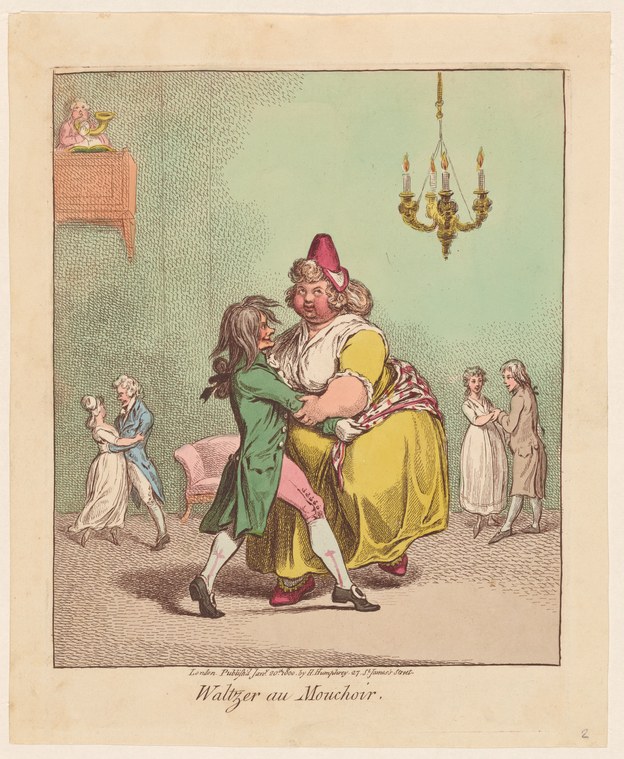
A plump, jovial figure in a cardinal's red cap and yellow coat dominates the center of the composition, clutching a young girl in green to his body in an embrace. The girl leans back from him, her posture suggesting playful resistance or surprise. Around them, several other figures—children and young people in pale muslin dresses—stand watching, some with hands raised in gestures of attention or amusement. The setting is an interior with a pale green wall, a pink-upholstered bench or chair visible on the left, and a gilt chandelier hanging from above. The engraving is hand-colored in soft pastels: greens, pinks, yellows, and flesh tones. The title inscribed below reads "Waltzer au mouchoir" (Waltzing with a handkerchief), suggesting this is a social dance game rather than formal dance. The scene has the character of a parlor game or children's entertainment, with the central figure—possibly an adult entertainer or family member—as the active dancer and the others as participants and observers.
The dancing
The central male figure stands with weight planted, his arms spread wide to embrace the girl, who stands with her back arched away from him in a posture of resistance or exaggerated delight. The girl's legs are positioned naturally, without the turned-out stance of formal dance. The surrounding figures—mostly young people—stand upright with arms at their sides or raised in observational gestures, forming a loose circle or audience. No pair dancing is visible; the action appears to be one person "waltzing" with a child while others watch. The gestures are domestic and theatrical rather than technical—this is not the closed hold or frame of ballroom waltz but rather a game or performance.
The dance depicted
This appears to be a parlor game or children's entertainment dance known as a "waltz with a handkerchief" (waltzer au mouchoir), a social amusement popular in early 19th-century European households. The title is the primary evidence for identification. Such games often involved a single dancer or pair performing while others looked on, sometimes with musical accompaniment. The exaggerated embrace and the girl's expression of surprise or playful resistance suggest this is meant as entertainment—perhaps a comic or flirtatious moment—rather than instruction in ballroom technique. The presence of multiple observers and the domestic interior setting confirm this is a parlor pastime rather than formal dance instruction or social dancing.
How it was made
This is a hand-colored engraving, a reproductive technique that allowed multiple copies to be made for circulation to a middle-class market. The engraved line is fine and controlled, with cross-hatching used to suggest volume and depth, particularly in the walls and clothing. Hand coloring has been applied in discrete, flat areas—no attempt at atmospheric perspective or subtle modeling. The technique was common for satirical, comic, or instructional prints in early 19th-century Europe and allowed relatively inexpensive distribution to homes, schools, and periodicals. The quality and style suggest a professional printmaker, though the record does not identify them.
About this work
This hand-colored engraving documents a parlor game or domestic dance entertainment, the "Waltzer au mouchoir," in which an adult or older youth playfully dances with a child while younger spectators observe. The image is not a record of ballroom waltz technique but rather of social customs around dance and family entertainment in the early 19th century. It belongs in a dance history collection as evidence of how dance functioned in non-professional domestic contexts—as play, courtship ritual, and spectacle—rather than as formalized performance or instruction. The work preserves a moment of social life that would otherwise leave no trace.
How to look at it
Observe the positioning of the figures: the girl's arched-back posture and the man's spread arms create an exaggerated, almost comic version of a waltz embrace. The observers' faces and gestures—some alert, some amused—frame the action as spectacle and game. The hand-coloring is deliberately flat and decorative, not naturalistic, which enhances the sense of social comedy. Notice how the title on the engraving, "Waltzer au mouchoir," is essential to understanding what the image depicts; without it, the scene might read simply as an adult's interaction with a child rather than as a named game or dance entertainment.
The period
This print dates from the early 19th century, a period when the waltz was rapidly gaining popularity across Europe despite moral objections to its close hold and rotational movement. Social dancing was becoming a central leisure activity for the middle and upper classes, and parlor games based on dance movements—often comic or mock-serious—were common entertainments. The image reflects a moment when ballroom dance was both fashionable and somewhat transgressive, making it a natural subject for satirical or comic prints. The presence of children and the domestic setting suggest that dance was understood as a family activity, not solely an adult courtship ritual.
Where it lives
The work is held in the New York Public Library's collection of prints depicting dance. It is an engraving—a multiple—and was produced for relatively widespread circulation, likely in early 19th-century France or the Low Countries, though the record does not specify the printer, publisher, or exact date.
Dance in this work
Questions about this work
What is a 'waltzer au mouchoir'?
A parlor game or domestic dance entertainment, popular in early 19th-century European households, in which one person (often an adult or older youth) danced or played with a child or partner while others observed. The 'mouchoir' (handkerchief) may have been used as a prop or signal in the game. It was a form of social play rather than formal dance instruction or ballroom etiquette.
Is this a record of waltz technique?
No. While the title references the waltz, the embrace and postures shown here are exaggerated and playful, not instructional. This is evidence of how waltz was adapted for children's entertainment and domestic games, not how it was formally danced in ballrooms. The absence of a proper closed hold and the presence of an audience confirms this is a parlor game, not a technical demonstration.
Who made this print?
The catalogue record does not identify the artist, engraver, or printer. The work is catalogued only as a hand-colored engraving in the NYPL's dance prints collection. Stylistic analysis suggests a professional printmaker working in early 19th-century Europe, but attribution would require additional research.
More dance artwork





