49 works in this view — arrow keys or swipe to move between them.
Dance in Art
Folk and ethnic costumes
Unknown artist
- Collection:
- Prints depicting dance
- Source:
- New York Public Library
- Rights:
- Public domain — free to use, share and adapt.
- Recorded as:
- Public Domain
This print documents the visual culture and costume practices of 19th-century theatrical spectacle at a moment when opera and ballet were drawing heavily on classical mythology and setting. For dance historians, it shows how the body and dress were presented in formal theatrical contexts and what visual codes (the hieratic pose, the elaborate ornamentation, the classical setting) carried meaning on stage.
What you are looking at
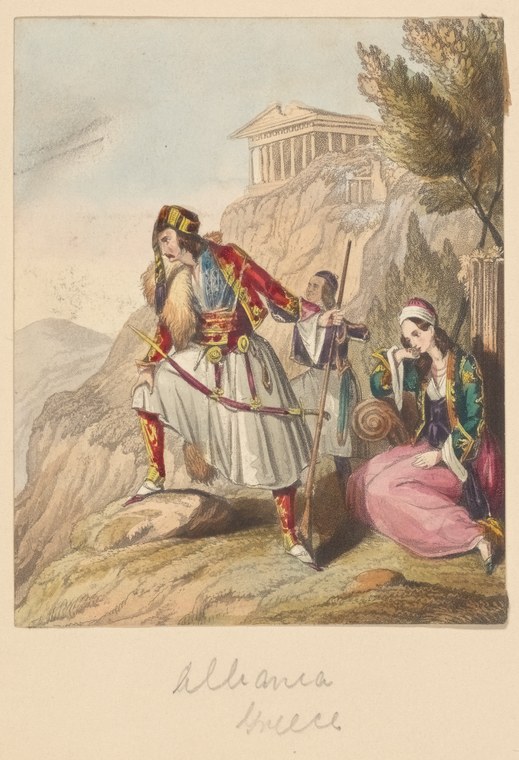
A figure in elaborate theatrical costume stands prominently on rocky terrain before a classical Greek temple (recognizable as the Parthenon) perched on a hilltop. The central figure wears a richly decorated garment combining red, gold, and white fabrics with ornate embroidery and jeweled ornaments, topped with a decorative headdress. Two attendants in simpler dress—one in green and one in pink—flank the figure at lower right. The composition is rendered in hand-colored lithograph or engraving, with atmospheric perspective suggesting depth; the sky is pale and misty, and the rocky foreground is detailed with earth tones. The scene reads as operatic or ballet—a moment of dramatic tableau rather than active movement. A manuscript inscription below the image reads "Alcmene Suisse" (or similar), suggesting the work depicts a scene from classical or operatic source material.
The dancing
The central figure stands in an upright, formal pose with weight evenly distributed, arms positioned expressively rather than in any recognizable ballroom or folk hold. The torso is frontal and the gaze directed outward; there is no partnered embrace or interaction with the attendants. The two smaller figures are static and deferential, their postures subordinate. The overall frame is vertical and stately, characteristic of theatrical presentation rather than social dance participation. The costume weight and ornamentation suggest restricted rather than athletic movement.
The dance depicted
This does not depict active dance but rather a posed dramatic or operatic scene. The figure appears to be a character in theatrical costume—possibly from a classical or neoclassical opera or ballet based on the Greco-Roman setting and the elevated moment captured. The elaborate dress and hieratic composition suggest a scene of pageantry or ceremony. If dance is present, it would be theatrical or court ballet of a formal, presentational kind, but the image freezes a moment of stillness rather than movement.
How it was made
This is a hand-colored lithograph or engraving, evident from the fine line work, the layered color application, and the tonal modeling in the rocky foreground and sky. The technique allowed for reproduction and distribution to a broad audience—this is a print from a commercial or artistic press rather than a unique work. The hand-coloring suggests a mid-to-late 19th-century date and a market for theatrical imagery.
About this work
This is a theatrical costume print depicting a classical or operatic scene set in ancient Greece. The work belongs in a dance gallery not because it shows active dancing but because it documents the aesthetic and costuming of 19th-century theatrical dance and spectacle, especially the operatic or neoclassical ballet tradition that drew on classical sources. The Parthenon backdrop and elaborate dress signal the visual language of grand opera and court ballet, genres that are central to dance history. The image represents the intersection of visual art, theatrical production design, and the fantasy of classical antiquity that shaped Romantic-era theatrical dance.
How to look at it
Attend to the costume itself: the layering of fabrics, the placement of jewels and embroidery, the construction of the headdress. These are not costume sketches but a finished image intended to capture a complete theatrical character. Notice the relationship between the figure and the setting—the Parthenon is not incidental but central to the meaning, establishing that this is a scene of classical grandeur. The subordinate attendants frame the central figure's importance. The stillness of the pose, despite the theatrical dress, suggests a moment of presentation or revelation rather than action.
The period
This work dates stylistically to the 19th century, an era when theatrical productions—especially opera and ballet—drew extensively on classical Greek and Roman subjects. The Romantic movement had intensified the appeal of historical and mythological spectacle, and color lithography had made theatrical prints and costume designs widely available to audiences. Such images circulated as souvenirs of performances and as reference materials for costume makers and stage designers.
Where it lives
The work is held in the New York Public Library's collection of prints depicting dance. The handwritten inscription suggests it may be a titled or catalogued theatrical print from a series.
Questions about this work
Is this an actual dance scene?
No—this is a posed theatrical tableau, likely from an opera or neoclassical ballet. The figure stands still in a moment of dramatic presentation rather than executing dance steps. However, it documents the visual aesthetics and costuming of 19th-century theatrical dance.
What does the Parthenon setting tell us?
It signals that this is a scene set in classical antiquity, reflecting the 19th-century taste for grand historical and mythological opera and ballet. The classical setting was essential to the meaning and prestige of such theatrical productions.
Why is this in a dance collection?
Theatrical prints like this are primary documents of how dance—especially opera and ballet—was conceived, designed, and performed. The costume, the pose, and the theatrical framing are all essential to understanding 19th-century stage practice.
More dance artwork





