49 works in this view — arrow keys or swipe to move between them.
Dance in Art
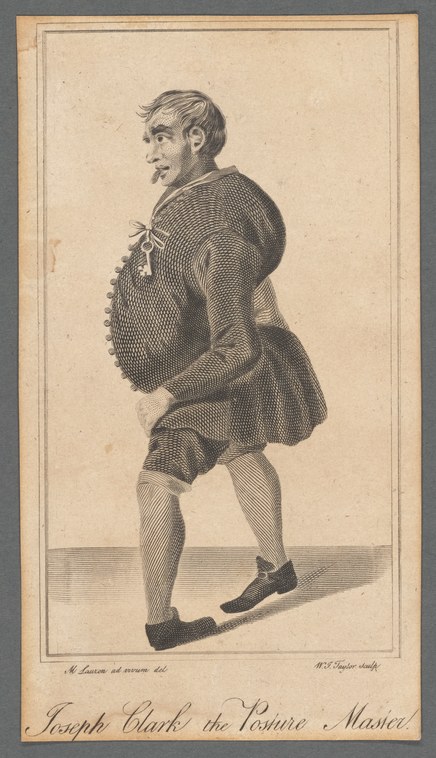
Joseph Clark the posture master
Unknown artist
- Collection:
- Prints depicting dance
- Source:
- New York Public Library
- Rights:
- Public domain — free to use, share and adapt.
- Recorded as:
- Public Domain
The work preserves evidence of a profession that shaped Georgian bodily aesthetics but has been largely erased from dance histories. For historians of dance pedagogy, social practice, and the disciplining of the body in the 18th century, this is primary source material about how movement was taught outside the ballroom and the theater.
What you are looking at
A single male figure occupies the center of a plain cream background, shown in profile facing left. He wears early 18th-century dress: a dark coat with long skirts and prominent buttons down the front, light-colored breeches, and dark shoes with heels. His posture is distinctive and deliberate—the torso leans forward from the hips at an acute angle, the back highly arched, creating an exaggerated S-curve that emphasizes the chest and buttocks. His left arm hangs at his side while his right arm is positioned across his body, and his head is held high with a slight forward tilt. The engraving technique uses fine cross-hatching to model the fabric and musculature, rendering the figure three-dimensional against the flat background. A double-line border frames the composition, and the inscription below identifies the subject.
The dancing
The single figure demonstrates an extreme posture rather than a moving sequence. The body weight appears shifted to engage the core and back extensors; the knees are straight and the stance is narrow, concentrating the balance. The position is held and static, not captured mid-step. The deliberate presentation—the slight turn of the head, the controlled arm placement, the pronounced spinal curvature—suggests this is a display of technical mastery or a stock position for instruction, the kind of formal 'attitude' that would be held and repeated.
The dance depicted
This is not dance in the ballroom sense but rather a demonstration of posture and deportment, possibly part of an instructional system. Joseph Clark identified himself as a 'posture master,' a profession that taught gentlemen and gentlewomen the correct carriage, stance, and bearing required by polite society in the Georgian era. The exaggerated arch and forward lean were valued components of fashionable bearing, signaling elegance, status, and physical control. Such posture masters were common in the 18th century and charged fees for lessons in movement, alignment, and the bodily discipline required to navigate courtly and urban elite spaces.
How it was made
This is a line engraving, executed with fine burin work to create the cross-hatched modeling of light and shadow across the figure. The technique was standard for portrait prints and instructional illustrations in the 18th century, allowing multiple impressions to be taken and distributed. The clean composition, spare background, and formal stance confirm this as a commercial print—likely advertising Clark's services or functioning as a instructional diagram. Engraving's capacity for fine detail made it ideal for demonstrating the precise angles and proportions of the taught posture.
About this work
This engraving documents the teaching practice of Joseph Clark, an 18th-century posture master whose profession occupied an ambiguous space between dance, gymnastics, and etiquette instruction. Rather than representing theatrical or social dance, it preserves evidence of a pedagogical discipline focused on bodily alignment and deportment—the technical foundation underlying elegant movement in society. The image is a working record of what was taught and valued: the body held in a specific, repeatable, and teachable position that signaled breeding and discipline.
Posture masters have left few traces in dance history, crowded out by the more visible figures of ballet masters and ballroom teachers. Yet Clark's engraved portrait is a rare document of this labor: the careful instruction in how to stand, how to carry the back, how to arrange the limbs so that the body itself became a statement of status and self-control.
How to look at it
Attend to the extreme posture itself: the pronounced arch of the back, the forward lean, the positioning of the limbs. This is not a natural stance but a learned, held position—the kind that requires practice and develops specific musculature. The formal, frontal presentation is deliberate; the figure is not dancing but demonstrating, holding the position steady so that it can be observed, copied, and practiced. Notice also the dress: the cut of the coat and the breeches are dateable to the early 18th century, and they frame and emphasize the posture being taught.
The artist
The artist is not recorded. The engraving was commissioned to serve as a publicity print for Joseph Clark's services, a common practice in the 18th century. Such teaching prints were distributed, displayed in coffee houses and assembly rooms, or handed to prospective students. The quality of the line work suggests a competent commercial engraver, but the print's purpose was documentary and promotional rather than fine art.
The period
In the early-to-mid 18th century, bodily deportment and posture were central to the formation of the gentleman and gentlewoman. The rigid, arched stance shown here reflected contemporary ideals of refinement; the exaggerated curve of the back was fashionable and desirable, associated with elegance and social superiority. Posture masters, dancing masters, and fencing masters all competed for the fees of families seeking to polish their children's bearing and movement. The period saw intense attention to the detail of the body in motion—not yet codified into the strict rules of classical ballet, but part of a broader culture of bodily discipline and display in elite society.
Where it lives
The work is held in the New York Public Library's collection of prints depicting dance. It is catalogued with minimal metadata, reflecting the archive's historical focus on theatrical and ballroom dance rather than the pedagogical practice of posture instruction.
Questions about this work
Was Joseph Clark a dancer?
Clark identified himself as a posture master, not a dancer. His profession was to teach the correct bodily carriage and alignment required in polite society—how to stand, walk, and hold the body in ways that conveyed status and breeding. This was distinct from social dancing or theatrical performance, though it shared teachers and spaces with both.
Why does the posture look so exaggerated?
The arched back and forward lean were genuinely fashionable and desirable in early 18th-century elite society. This posture conveyed elegance, refinement, and self-control. It was also practical for the clothes: the long-skirted coats of the era were designed to be worn with the chest forward and the back curved. Habitual practice in this posture would have reshaped the student's spine and musculature over time.
Why is this in a dance archive?
Dance history has traditionally been narrow, focusing on theatrical ballet and ballroom competition. But posture masters taught movement—how the body was carried, positioned, and made to conform to social ideals. This represents a broader history of movement pedagogy and bodily discipline that shaped how people moved in daily life.
More dance artwork





