49 works in this view — arrow keys or swipe to move between them.
Dance in Art
Folk and ethnic costumes
Unknown artist
- Collection:
- Prints depicting dance
- Source:
- New York Public Library
- Rights:
- Public domain — free to use, share and adapt.
- Recorded as:
- Public Domain
This work shows how folk costume and rural female sociability were packaged and sold to metropolitan audiences in the age of the picturesque and the ethnographic print. It is evidence of the visual and commercial framework through which European folk culture—including folk dance—was collected, represented, and consumed in the late 18th and early 19th centuries.
What you are looking at
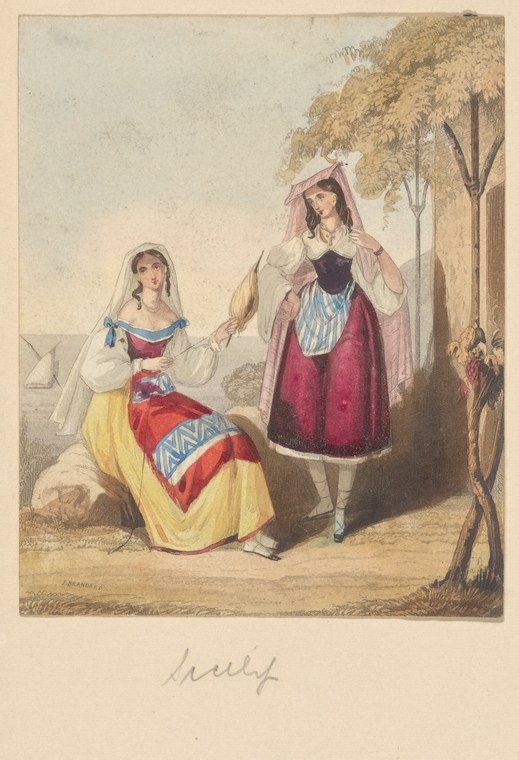
Two young women in folk costume stand outdoors beneath a large spreading tree in an Italianate or Mediterranean landscape. The standing woman on the right wears a deep burgundy dress with puffed sleeves, a striped bodice in blue and white, and a pink shawl draped over her shoulders and head. The seated woman on the left, positioned on a rock or low seat, wears a yellow skirt with a bold red geometric border, a white chemise, and a blue headscarf tied under her chin. Both figures are rendered in soft watercolour tones against an ochre-tinted landscape. The standing woman gestures toward the seated one with an engaged, conversational pose, suggesting a moment of social exchange or courtship. In the background, a distant figure can be glimpsed near the tree, and architectural ruins or structures appear hazily on the right. The composition is intimate and anecdotal, treating the figures as though capturing a genre scene of rural or village life.
The dancing
Both women are upright and at ease, their bodies oriented toward one another. The standing woman's right arm is extended in a natural, gestural pose rather than a formal dance frame. Her weight appears evenly distributed and her posture open and animated. The seated woman looks upward toward her companion with attention, her body relaxed on the seat. Neither figure exhibits the rigid frame, turned-out turnout, or heightened extension associated with trained dance technique. The spacing and relative positions suggest social standing rather than choreographic arrangement.
The dance depicted
This is not a representation of theatrical or concert dance. The figures wear folk or ethnic costume and are positioned in an anecdotal genre scene—a moment of everyday social interaction in a village or rural setting. If movement is implied, it would be the unstructured gesture and deportment of folk custom rather than codified dance. The image documents folk dress and social custom rather than depicting an identifiable dance form or technique.
How it was made
This is a hand-coloured engraving or aquatint, executed with fine linear detail in the drapery and faces and finished with delicate watercolour wash. The technique allowed for soft atmospheric effects in the landscape and foliage while maintaining crisp definition in the figures' clothing and features. The hand-colouring suggests a moderately expensive print, likely intended for the illustrated travel or ethnographic market of the 18th or early 19th century. Such works circulated among educated collectors interested in European regional costume and manners.
About this work
This is a hand-coloured engraving depicting two young women in folk costume in a Mediterranean landscape, rendered as a genre scene of social interaction rather than as a representation of structured dance. The image belongs in a gallery of dance in art because it documents the dress, gesture, and social context of folk life—the material and bodily culture from which regional dance traditions emerged. It preserves a moment in which folk identity was visualized and circulated to wider audiences through the medium of the illustrated print.
How to look at it
Note the specificity of the costume details—the striped bodice, the geometric border on the skirt, the headscarves—which anchor the image in a particular region and social practice. Observe the artist's choice to depict a moment of conversation or greeting rather than active movement; the open, gestural quality of the standing woman's pose conveys ease and sociability rather than trained technique. The landscape setting and the presence of the distant figure on the right suggest this as a scene of everyday village or pastoral life, not a performance or display.
The period
This print dates to an era of intense European interest in regional costume, rural manners, and the 'picturesque'—the aesthetic category that made landscape and folk life subjects for refined taste. The late 18th and early 19th centuries saw the proliferation of hand-coloured prints, costume albums, and travel narratives documenting regional and ethnic dress across Europe and beyond. This interest was entangled with Romanticism, nationalism, and the early development of folklore as a field of study. Folk dance itself was being collected, documented, and staged during this same period, as nationalist movements invested in folk culture as an expression of national character.
Where it lives
The work is held in the New York Public Library's collection of prints depicting dance. It appears to be an example of the hand-coloured engraving tradition of European costume documentation, a genre of print that enjoyed wide circulation in the late 18th and early 19th centuries.
Questions about this work
Is this a dance scene?
Not in the sense of theatrical or formal dance. The women are depicted in a moment of social interaction—conversation or greeting—rendered in the anecdotal genre style of the period. The work documents folk costume and the social contexts of rural or village life rather than a structured dance performance or technique.
What region or ethnic group is represented?
The catalogue does not specify. The costume details—the striped bodice, geometric skirt border, and headscarves—suggest a Mediterranean or Southern European region, possibly Italian or Iberian, but the hand-colouring and artistic convention are typical of the broader European costume print tradition and may reflect the artist's interpretation or idealization rather than documentary precision.
Why is this in a dance gallery if no one is dancing?
Folk dance practice emerges from the social life, bodily culture, and dress traditions of communities. This image preserves the visual and social context in which folk dances were embedded—the everyday gestures, costumes, and female sociability that framed folk performance. It is part of the material and visual history of how folk culture was understood and represented during the period in which folk dance was being identified and documented as a cultural form.
More dance artwork





