49 works in this view — arrow keys or swipe to move between them.
Dance in Art
Folk and ethnic costumes
Unknown artist
- Collection:
- Prints depicting dance
- Source:
- New York Public Library
- Rights:
- Public domain — free to use, share and adapt.
- Recorded as:
- Public Domain
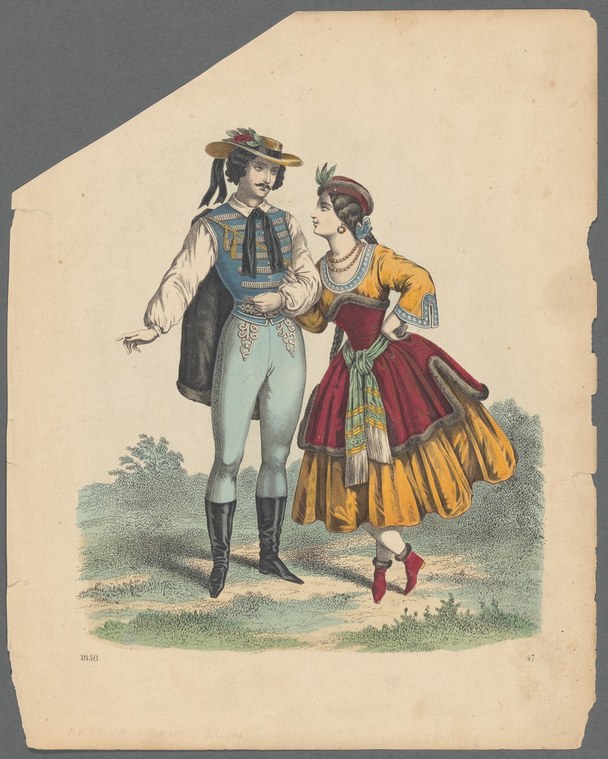
This image is valuable as a historical document of how 19th-century European audiences visualized and consumed representations of non-metropolitan ('folk' and 'ethnic') costume and sociability. It shows the aesthetic and narrative conventions through which print culture commodified regional identity—the careful attention to embroidery and layered skirts, the flirtation pose, the theatrical presentation of 'otherness'—and thus illuminates the visual and social context in which folk dance was understood and performed during the period.
What you are looking at
Two figures stand on a grassy ground against a neutral background, dressed in theatrical folk or ethnic costume. The figure on the left, presenting as male, wears a decorated blue jacket with gold embroidery, a plumed hat, white shirt, light blue breeches, and black boots—a dandified, courtly version of regional dress. The figure on the right, presenting as female, wears a deep red skirt with yellow panels, a yellow bodice with blue trim, a white chemise, decorative beads at the neck, and a patterned headpiece. Both figures are animated and engaged with each other: the male figure gestures with an outstretched hand while looking toward his companion; the female figure leans toward him with evident interest, one hand touching his arm. Their posture suggests a moment of flirtation or courtship rather than formal dance instruction. The hand-colored print renders the costumes in vivid detail—the embroidery and trims of the male figure's jacket are meticulously depicted, as are the layered skirts and ornamental details of the female figure's dress. The style and execution suggest a 19th-century European print, probably French, intended to document or celebrate regional or 'exotic' costume types.
The dancing
Neither figure is captured in a recognizable ballroom or theatrical dance position. Instead they occupy an informal social stance, angled toward each other in close proximity. The male figure's extended arm and open gesture suggest conversation or invitation rather than a dance frame; the female figure's lean and touch on his arm conveys engagement and warmth. Both stand with weight distributed casually rather than on the balls of the feet. The composition frames a moment of social interaction—courtship, perhaps, or a scene of folk sociability—rather than the execution of a specific choreography.
The dance depicted
While the record title claims 'Folk and ethnic costumes,' the image does not depict recognizable folk dance in motion. The two figures are posed in conversation or courtship rather than performing any identifiable dance. The costumes—particularly the male figure's heavily decorated jacket—suggest a romanticized or theatrical interpretation of Eastern European or Balkan regional dress, a common theme in 19th-century European prints. If dance is present here, it is implied as social context (the kind of event where such costumes would be worn) rather than shown as choreographic action. The work documents costume and courtship ritual more than dance technique.
How it was made
This is a hand-colored engraving or lithograph, characteristic of 19th-century European fashion and ethnographic print production. The crisp outlines and fine detail work—especially visible in the embroidery of the jacket and the pattern of the skirts—are typical of engraved line-work that was then colored by hand, a labour-intensive but economical way to produce multiple copies of a detailed image. The technique allowed for precision in documenting textile decoration and costume construction, and the bright colors suggest a print designed for domestic circulation rather than fine art exhibition. Such prints were collected in portfolios and served both as fashion reference and as representations of 'national' or regional character for a European metropolitan audience.
About this work
This is a 19th-century hand-colored engraving depicting two figures in stylized folk or ethnic dress—a heavily embroidered male costume and a layered female costume suggesting Balkan or Eastern European origin—posed in a moment of social interaction and apparent courtship. Although the record titles it 'Folk and ethnic costumes,' the image is primarily a document of dress and social gesture rather than a depiction of dance itself. The work belongs to a large 19th-century European tradition of ethnographic and fashion prints that treated regional costume as both a subject of curiosity and a marker of cultural identity. For the LODance collection, it represents not active dance practice but the costume context and courtship rituals in which folk dance occurs, and the way European printmakers of the period imagined and romanticized regional identities through dress.
How to look at it
Attend to the composition and the relationship between the two figures rather than expecting to see dance steps. The artist has chosen a moment of social encounter, not choreographic action—note the gesture, the proximity, the direction of gaze. The lavish detail in the embroidery and pattern work of the costumes is the primary visual investment; the figures themselves are secondary. This reflects the print's purpose: to circulate an image of 'folk' and 'ethnic' identity through the language of dress, gender, and courtship, rather than to document dance practice. Compare this to ethnographic photographs or dance notation from the same period to understand what is gained and lost in the print's romanticization of its subject.
The artist
The artist is not recorded. The style, execution, and subject matter are consistent with mid-19th-century French or German ethnographic and fashion print production—studios or ateliers that produced large series of costume studies for commercial distribution. Such prints were often unsigned or credited only to the publisher or engraver, and individual authorship is often irrecoverable.
The period
In the 19th century, European interest in folk costume, regional identity, and 'ethnic' culture intensified as a response to industrialization, nationalism, and imperial expansion. Prints documenting 'national' or regional costume served multiple audiences: fashion-conscious urban consumers; collectors interested in ethnography; and those fascinated by European peripheral regions, particularly the Ottoman Balkans and Eastern Europe. The romanticized, theatrical treatment of costume in this print—the emphasis on decoration and color, the flirtation scenario—reflects the aesthetic conventions of the period, which treated folk dress as picturesque and socially significant. Folk dance and music were being actively collected, documented, and performed in urban contexts during this era, though prints like this tend to emphasize static costume and social type rather than movement or choreography.
Where it lives
The work is held in the New York Public Library's collection of prints depicting dance. The record provides no date, artist, medium, or accession number beyond what can be inferred from the image itself.
Questions about this work
Is this actually a dance image?
Not strictly. While the record title refers to 'Folk and ethnic costumes' and the work is housed in a dance collection, the image shows two figures in a moment of courtship or social interaction rather than in the act of dancing. It documents costume and the social context in which folk dance occurs, but does not depict choreography or movement. It is valuable as a historical document of how European print culture represented folk identity and sociability.
What region or culture is being represented here?
The costumes suggest Eastern European or Balkan origin, but the image is a European print interpretation rather than an ethnographic record. The male figure's heavily embroidered jacket and the female figure's layered skirts with distinctive pattern work are consistent with 19th-century Balkan or Slavic dress, but the romanticized, theatrical presentation reflects the aesthetic conventions of French or German print studios rather than documentary accuracy.
Who made this print and when?
The artist is not recorded. The style is consistent with mid-19th-century European ethnographic and fashion print production, suggesting a date somewhere between 1820 and 1880, but without additional documentation this cannot be confirmed.
More dance artwork





