49 works in this view — arrow keys or swipe to move between them.
Dance in Art
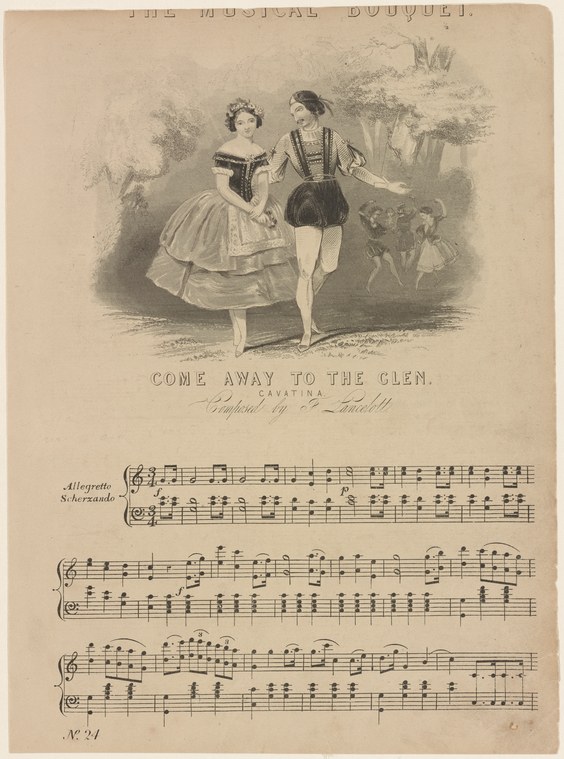
The musical bouquet. Come away to the glen. Cavatina. Composed by F. Lancelott
Unknown artist
- Collection:
- Prints depicting dance
- Source:
- New York Public Library
- Rights:
- Public domain — free to use, share and adapt.
- Recorded as:
- Public Domain
This work documents how dance culture and theatrical culture overlapped in the 19th century: the same audiences, the same costumes, the same Romantic aesthetic of emotion and natural beauty. The image reveals the visual codes through which mid-Victorian audiences recognized and consumed theatrical narrative—before photography, such prints were primary visual documents of performance.
What you are looking at
A young couple stands in an Arcadian landscape framed by trees. The woman wears a voluminous white ball gown with a fitted bodice and off-shoulder neckline; her dark hair is styled fashionably atop her head. The man wears a dark velvet tunic with short breeches and pale stockings—a Romantic-era costume suggestive of a pastoral or operatic character. They stand close together in a moment of courtship or romantic encounter. In the background, barely sketched, other figures appear to be dancing or in motion among the trees. The composition is intimate despite the landscape setting: the principals occupy the foreground while the scene recedes behind them into soft, atmospheric shading. The overall mood is one of yearning, characteristic of early 19th-century theatrical sentiment.
The dancing
The two figures stand nearly upright, at ease rather than in a formal dance frame. The woman's weight appears centered; her posture is graceful but relaxed. The man faces her at three-quarter angle, his body open toward her with a courteous, deferential bearing. Neither figure displays active footwork or a partnered dance hold. Their positioning suggests conversation or a moment of emotional exchange rather than the execution of a structured dance step. The background figures are too indistinct to assess their movement quality.
The dance depicted
This is a theatrical illustration for a vocal composition—a cavatina (a songform popular in 19th-century Italian opera). The title 'Come Away to the Glen' and the pastoral setting suggest a scene from a romantic operetta or melodrama of the 1840s–1860s. The figures are not dancing in a technical sense but are positioned as characters within a narrative moment. The female and male costumes—her ball gown, his Romantic doublet and breeches—belong to the theatrical vocabulary of the period rather than to ballroom or folk dance. This appears to document a moment of sung drama rather than choreography.
How it was made
This is a lithograph or engraved print, likely colored by hand or printed in tones. The fine linear work in the background landscape, the delicate modeling of the figures' faces and fabrics, and the softly graded atmospheric perspective are characteristic of mid-19th-century theatrical sheet music illustration. Such prints were distributed as covers for published vocal scores; they served simultaneously as advertisement and as an aid to performers and amateurs in visualizing the dramatic context of the piece. The technique allowed rapid reproduction and wide circulation among middle-class households with access to pianos.
About this work
This is a theatrical illustration printed as a cover for a published cavatina (a lyric solo or duet from an opera or operetta) composed by F. Lancelott and titled 'Come Away to the Glen.' The image captures two figures in a moment of romantic encounter within a Romantic-era theatrical frame: a woman in a white ball gown and a man in dark velvet pastoral costume, set in a soft, tree-framed landscape. Rather than documenting a dance proper, the image illustrates the emotional and narrative context of a vocal number—the type of theatrical genre that drew its audiences from the same social milieu as ballroom dancers and opera patrons.
The work belongs to a vast category of 19th-century popular prints designed to circulate sheet music and shape the visual culture of domestic music-making. It is evidence of how dance and theater, music and visual art, were integrated in the consumption habits and aesthetic tastes of Victorian audiences. The figure of the couple in romantic encounter became a standard compositional formula for theatrical sheet music of this era.
How to look at it
Attend to the relationship between the two figures: they are not dancing together but are frozen in a moment of emotional intensity—a gaze, a near-approach, the pause before or after speech or song. The artist has chosen a moment of stillness and charged proximity rather than movement. This convention—the theatrical 'tableau'—was central to 19th-century operatic staging, where the chorus and principals often held posed arrangements while singing. The soft, atmospheric landscape behind them is a visual analogue to the sentimental lyric: nature romanticized and idealized as a backdrop for human feeling.
The artist
The artist is not recorded. The work is attributed only to the composer, F. Lancelott, whose other works (if any) do not appear in standard dance or music reference sources. This may indicate a minor or amateur composer, or one working within a local or provincial musical tradition. Sheet music covers of this period were frequently illustrated by staff artists or minor practitioners of commercial lithography whose names were not preserved.
The period
The work dates to the mid-19th century, a period in which theatrical music and social dance were in creative dialogue. The cavatina form was popularized through Italian opera (Rossini, Bellini, Donizetti) and adapted into English operettas and drawing-room songs. The costume vocabulary visible here—the woman's white ball gown, the man's velvet doublet—drew on Romantic-era theatrical convention, which in turn influenced ballroom and fancy-dress aesthetics. The pastoral setting and the theme of romantic encounter reflect the literary and visual Romanticism that dominated European arts from roughly 1820 to 1870.
Where it lives
The work is part of the New York Public Library's prints collection documenting dance imagery. It is catalogued as a piece of theatrical sheet music cover art, indicating it was originally distributed as a functional object—the physical wrapper around a published vocal score for amateur or professional performers.
Questions about this work
Is this a dance?
Not technically. The two figures are posed in a theatrical tableau—a moment of dramatic or emotional heightening—rather than executing a choreographed dance. The work illustrates a scene from a vocal composition (a cavatina) and is evidence of how theatrical performance and social dance shared aesthetics and audiences in the 19th century, even when not literally depicting movement.
Who was F. Lancelott?
The catalogue record does not identify the composer beyond the name. Lancelott may have been a professional or amateur composer working in Britain or Europe in the mid-19th century, but no further biographical information is available in the NYPL record.
What is a cavatina?
A cavatina is a brief, lyrical vocal solo or duet popular in 18th- and 19th-century opera and operetta. Unlike an aria, a cavatina is simpler in form and typically expresses a single emotional state. The title 'Come Away to the Glen' suggests a Romantic-era cavatina with a pastoral or sentimental theme.
Why does this look like a dance image if it is not a dance?
The image depicts two figures in formal costume in a moment of heightened emotion, which is part of the visual vocabulary shared by theatrical dance, ballet, and operatic performance. All three forms drew on similar costume traditions, ideals of grace and beauty, and narrative themes of love and desire. This print demonstrates how these forms were visually and culturally intertwined.
More dance artwork





