49 works in this view — arrow keys or swipe to move between them.
Dance in Art
Folk and ethnic costumes
Unknown artist
- Collection:
- Prints depicting dance
- Source:
- New York Public Library
- Rights:
- Public domain — free to use, share and adapt.
- Recorded as:
- Public Domain
This work matters as evidence of how European artists and publishers understood non-European dress and movement in the early 19th century—not as living practice but as static, observable costume types. For dance historians, it documents the visual conventions by which metropolitan audiences encountered the bodies and garments of people from colonized or trading regions, and how those conventions typically froze movement into display.
What you are looking at
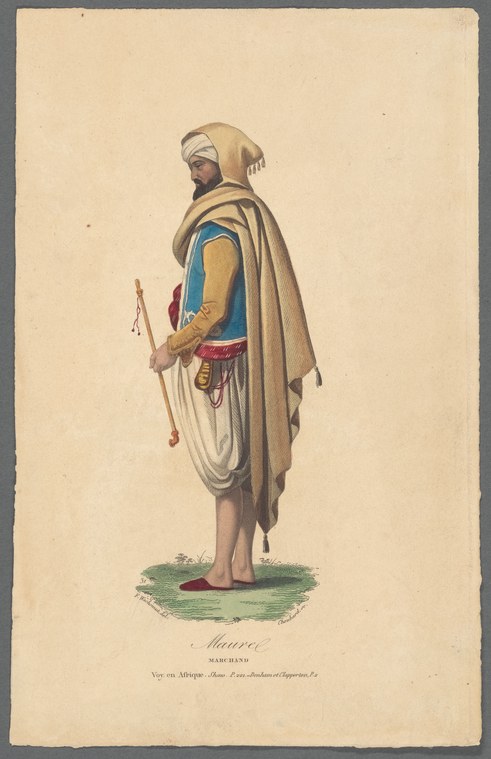
A single figure stands in three-quarter view against a plain buff background, dressed in North African dress from the early 19th century. The man wears a white linen head wrapping (tagelmust) wound around the head and across the lower face, leaving the eyes visible. His upper body is bare except for a blue sleeveless garment or tunic. At his waist he wears a deep crimson or magenta fabric, possibly a wrap or belt arrangement, and his lower legs are bare to the ankle. His right arm hangs naturally at his side holding what appears to be a thin wooden staff or walking stick; his left arm is bent and raised, the hand resting near his shoulder in a relaxed, contemplative pose. The figure stands barefoot on a small patch of green ground. The print is delicately hand-colored, with careful attention to the warm and cool tones of the fabrics.
The dancing
The single figure is stationary and posed rather than captured mid-movement. The raised left arm and bent elbow create a moment of pause or reflection rather than active dance. The posture is upright and dignified, with the body weight distributed evenly on both legs. There is no dynamic weight shift, no extension of limbs, no indication of rapid movement or partnering. The overall impression is of a standing figure allowing us to observe the details of dress and bearing rather than demonstrating movement vocabulary.
The dance depicted
This appears to be a costume study or ethnographic illustration rather than a depiction of dance. While the figure's raised arm and the presence of a staff might suggest connection to dance or ceremonial movement traditions of North Africa or the Sahel region, the static, posed quality of the figure argues against active choreography. The inscription reads 'Maure, Marchand' (Moor, Merchant), identifying the subject as a Moorish trader rather than a dancer. The image documents dress and bearing of a particular region and social role rather than capturing dance in performance.
How it was made
This is a hand-colored engraving or aquatint, characteristic of early 19th-century ethnographic illustration. The fine line work of the printed base layer is visible beneath careful watercolor or gouache tinting applied by hand. The technique allowed for precise rendering of fabric detail, texture, and color gradation—note the subtle modeling of the wrapped head covering and the careful differentiation between the matte finish of the linen and the sheen suggested on the blue tunic. Such prints circulated widely in Europe as part of costume books and ethnographic portfolios, reaching educated audiences interested in colonization, trade, and the 'exotic' peoples of Africa and the Mediterranean.
About this work
This is an early 19th-century hand-colored engraving documenting the dress and appearance of a Moorish merchant. The work belongs to a large European tradition of ethnographic costume illustration—the visual counterpart to travel narratives and colonial documentation. While the figure's pose includes a raised arm that might evoke ceremonial or gestural traditions, the inscription and overall framing present this as a costume study and social documentation rather than a record of dance. The New York Public Library's classification as 'Folk and ethnic costumes' within their dance collection reflects the broad 19th-century understanding of folk culture as a unified field that encompassed costume, music, and movement together.
How to look at it
Look at the pose as a deliberate compositional choice: the figure is turned to show both the profile and front of the costume, the arm is raised not to show motion but to reveal the silhouette of the garment and the musculature beneath it. The small patch of ground beneath the feet anchors the figure without suggesting narrative or place. The artist has chosen the moment of stillness to allow the viewer to study the form and drape of the clothing. This convention—the standing figure displayed against a neutral ground—comes from centuries of European fashion illustration and anatomical drawing, adapted here to present non-European dress as an object of study.
The artist
The artist is not recorded in the catalogue. The style and technique are consistent with the hand-colored engraving practices of French and English costume-book publishers working c. 1800–1830, when such ethnographic costume series were commercially successful and widely distributed. The inscription in French suggests a Parisian or broader European publication rather than a regional work.
The period
Early 19th-century Europe saw an explosion of ethnographic and costume literature driven by expanding colonial trade, Napoleonic wars in North Africa, and orientalist fashion in art and design. Publishers in Paris, London, and other capitals produced illustrated costume books that presented colonized peoples as fixed types—merchant, warrior, dancer, musician—often with minimal contextual information. This image participates in that apparatus: it documents the merchant class of North Africa for a European audience with little regard for individual identity or regional variation. Simultaneously, European ballroom and theatrical dance was dominated by romantic ballet and social dances like the waltz and quadrille; non-European movement forms were largely invisible in high culture except as 'exotic' spectacle.
Where it lives
The work is held in the New York Public Library's collection of prints depicting dance and folk culture. It is catalogued as 'Folk and ethnic costumes' and appears to be part of a larger series or publication documenting North African and Mediterranean dress types, though the full publication details are not recorded.
Questions about this work
Is this a dance image?
It is borderline. While the raised arm and staff might suggest ceremonial or movement traditions, the figure is clearly posed for costume documentation rather than captured mid-performance. The inscription identifies the subject as a merchant, not a dancer. It belongs in a dance collection because 19th-century European audiences understood folk costume, music, and dance as a unified ethnographic category—but it is documentation of dress rather than depiction of active dance.
Who is the artist?
The artist is not recorded. The style and technique are consistent with early 19th-century French or English hand-colored engraving practices, but without a signature or title page, we cannot identify the specific publication or artist.
What does 'Maure, Marchand' mean?
It means 'Moor, Merchant.' In early 19th-century European terminology, 'Moor' typically referred to North African Muslims, and the inscription identifies this figure as a merchant or trader of that region.
Why is this in a dance collection?
The NYPL's classification reflects the 19th-century understanding of 'folk culture' as encompassing costume, music, and movement as an integrated whole. Early ethnographic collections often grouped these together. By modern standards, this would be classified as a costume or ethnographic study rather than active dance documentation.
More dance artwork





