49 works in this view — arrow keys or swipe to move between them.
Dance in Art
Folk and ethnic costumes
Unknown artist
- Collection:
- Prints depicting dance
- Source:
- New York Public Library
- Rights:
- Public domain — free to use, share and adapt.
- Recorded as:
- Public Domain
The print preserves visual evidence of Ottoman court ritual and the European imagination of Eastern ceremony at a moment when such imagery was rare and influential. For historians of dress, pageantry, and intercultural encounter, it documents how movement and adornment conveyed power and status in Ottoman culture as seen through a European lens.
What you are looking at
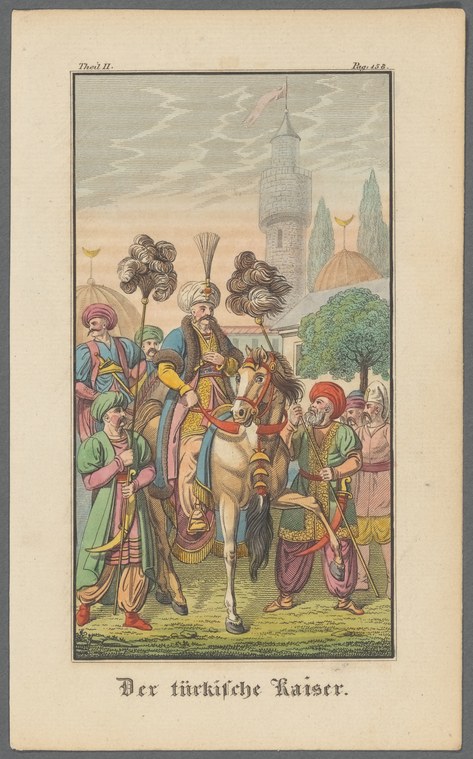
A processional scene set before a walled city with minarets and domes, rendered in hand-colored engraving. A mounted figure in rich Ottoman dress—turban, jeweled robes, long beard—dominates the center, attended by courtiers and officials in layered silks and elaborate headgear. The mounted figure holds aloft ornamental plumes or ostrich fans. To the left, a figure in green and pink silks carries a large plumed fan; to the right, attendants in red and yellow gesture and gesture toward the procession. The ground is sparse and flat; the architectural backdrop is rendered in fine parallel lines typical of Northern European engraving technique. The title at bottom reads "Der türkische Kaiser" (The Turkish Emperor).
The dancing
The composition is hierarchical rather than balletic: the mounted emperor is the focal point, with attendants arranged asymmetrically around him in poses of deference and service rather than synchronized movement. Their arms are raised and extended in gestures of presentation and attention rather than in formal dance positions. No pair work or hold is evident; the figures are individuated, standing or moving in relation to the central authority rather than to each other.
The dance depicted
This is not a dance scene but a courtly procession or ceremonial display depicting Ottoman imperial power. While the image records movement and gesture, it documents ritual and pageantry rather than a recognizable dance form. The plumes and ornamental objects may relate to ceremonial display practices in Ottoman court culture, but the engraving is ethnographic or heraldic in intent rather than a record of choreography.
How it was made
Hand-colored engraving on laid paper, recognizable by the fine parallel line work creating tone and the characteristic biting of the burin into the plate. The coloring—applied by hand after printing—is bright and opaque, typical of 16th or 17th century Northern European production for popular and courtly audiences. The technique allowed for multiple impressions and dissemination, making this a print for circulation and collection rather than a unique artwork.
About this work
This is a Northern European engraving depicting an Ottoman imperial procession, part of a tradition of exotic costume and ceremonial prints that circulated in the Renaissance and early modern period. The work documents courtly ritual, military hierarchy, and the visual markers of Ottoman power as understood by European printmakers. It belongs in a dance gallery not because it records dance but because it preserves the movement, costume, and bodily comportment of a ceremonial culture—the way bodies were arranged, ornamented, and displayed in a non-European court.
How to look at it
Attend to the hierarchical arrangement of figures around the mounted emperor: the asymmetry of the composition and the careful gradation of dress and ornament by rank. Note how the plumes and fans function as insignia of office and as kinetic elements that break the static formality of the procession. The European engraver has rendered Ottoman silhouette—the turbans, the cut of the robes, the length of the beards—with precision, suggesting either direct observation or detailed report from merchants or diplomats.
The period
This engraving belongs to a flourishing 16th and 17th century European market for exotic costume and "manners and customs" prints. Such works satisfied courtly curiosity about distant empires and were collected as visual encyclopedias of the known world. Ottoman imagery was particularly sought after following increased trade and diplomatic contact in the Mediterranean. The print reflects the aesthetic and ethnographic interests of its Northern European (likely Flemish or German) workshop.
Where it lives
From the New York Public Library's Prints collection depicting dance and related ceremonial practices. The work is catalogued as a folk and ethnic costume print, part of a larger holding of engraved costume and custom studies.
Questions about this work
Is this actually a dance?
No. This is a ceremonial procession or imperial display. The figures are arranged in ritual hierarchy rather than in choreographed movement or partnered dance. However, the work documents the movement, costume, and bodily comportment of Ottoman court ceremony, which has value for historians of performance and ritual.
Why would a dance gallery include this?
The gallery collects images that preserve how bodies moved, were dressed, and were arranged in contexts beyond concert dance—courtly ceremony, carnival, military display, and religious ritual. This print is evidence of how the body was deployed in Ottoman imperial performance.
What does the engraving technique tell us?
Hand-colored engravings like this were reproducible, affordable, and widely circulated among collectors and merchants. Multiple impressions could be made from a single plate, allowing the image to reach audiences across Europe. This particular print likely served curiosity about distant empires among educated patrons.
Who made this and when?
The artist and precise date are not recorded, but the style and technique suggest a Northern European (Flemish or German) workshop in the 16th or 17th century. The work belongs to a well-documented tradition of exotic costume prints that flourished in that period.
More dance artwork





