49 works in this view — arrow keys or swipe to move between them.
Dance in Art
August Bournonville
Unknown artist
- Collection:
- Prints depicting dance
- Source:
- New York Public Library
- Rights:
- Public domain — free to use, share and adapt.
- Recorded as:
- Public Domain
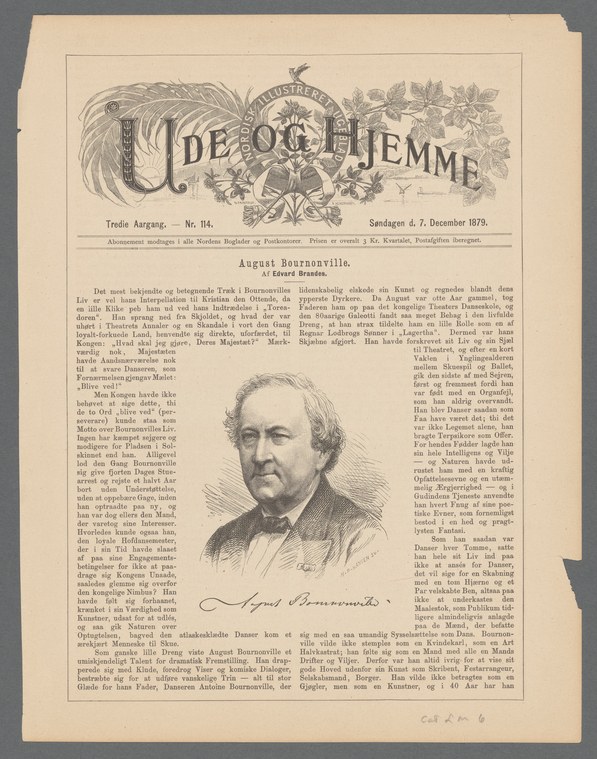
For anyone studying the Bournonville Method or the history of Danish ballet, this contemporary engraving preserves a documented likeness of Bournonville at the end of his life, in the year of his death—a significant moment for the ballet world. The periodical publication signals that Bournonville was recognized as a figure of cultural importance beyond the ballet theatre itself, worthy of illustrated biography in the press.
What you are looking at
This is a portrait engraving of August Bournonville, the legendary Danish ballet master, printed in the Danish illustrated periodical Ugeske Illustreret on 4–7 December 1879. Bournonville, shown in three-quarter profile facing left, wears formal 19th-century dress: a dark jacket with lapels and a white shirt with bow tie. His hair is gray and receding; his expression is stern and focused. The portrait is framed by decorative botanical elements—wheat stalks and flowering branches in the upper corners—typical of periodical illustration of the era. Below the portrait runs a substantial column of Danish text, indicating this is a biographical or commemorative feature rather than a simple portrait. The engraving style is precise and linear, with fine cross-hatching establishing tone and modeling of the face.
The dancing
This is a portrait rather than a depiction of dancing bodies in motion. Bournonville is seated and shown from the shoulders up. His posture is upright and dignified; his gaze is direct. There is no active dance gesture or choreographic content visible. The work documents the appearance of an individual rather than the execution of dance.
The dance depicted
This is not a dance scene but a portrait of August Bournonville (1805–1879), the dominant figure in 19th-century Danish ballet and the creator of the Bournonville Method. Bournonville was a dancer, choreographer, and ballet master at the Royal Danish Ballet from 1829 until his death, and is remembered as the architect of a distinctive Romantic ballet style emphasizing fast footwork, soft épaulement, and a grounded, energetic quality distinct from Italian and Russian schools. The engraving commemorates him as a historical figure rather than showing his work in practice.
How it was made
This is a wood engraving or steel engraving, printed as part of the Danish weekly illustrated periodical Ugeske Illustreret. The precision of the line work and the fine cross-hatching used to model the face are characteristic of 19th-century periodical illustration, where engravings were preferred for their reproductive clarity and ability to circulate alongside text. The technique allowed the periodical to reach a middle-class readership with both news and cultural commentary.
About this work
This engraving is a portrait of August Bournonville, printed in a Danish periodical in 1879, the year of his death. It documents one of the most influential figures in ballet history at a moment of commemoration. The work appears in a gallery of dance not because it depicts dancing, but because it preserves the likeness and historical moment of a choreographer whose method and aesthetic shaped theatrical ballet across generations. Bournonville's influence on technique, style, and the production of Romantic ballet makes the preservation of his image a legitimate record of dance history.
How to look at it
Observe the formal, dignified presentation: Bournonville is rendered as a figure of authority and cultural weight, not as a performer in action. The precise engraving technique emphasizes clarity and legibility—the portrait was designed to be read quickly by periodical readers. Notice the framing botanical ornaments, which lend a sense of classical dignity to what is otherwise a straightforward portrait. The accompanying text, though in Danish, anchors this as a biographical moment rather than a publicity image.
The artist
The engraver is not recorded. The work was produced by the editorial staff of Ugeske Illustreret, one of Denmark's leading illustrated periodicals in the mid-to-late 19th century. Such publications employed staff engravers and illustrators to produce portraits and news images, usually from photographic sources or written descriptions. The quality of the engraving suggests a competent, professional hand working within the conventions of periodical portraiture.
The period
This engraving was made in 1879, late in the 19th century, as Bournonville neared the end of his long career. By this date, Romantic ballet had evolved into Neoclassical and early modern forms in Western Europe, but Bournonville's Danish school remained distinct and influential. The periodical portrait reflects the era's appetite for illustrated biographical documentation of notable cultural figures. In dance history, 1879 marks a transition: the generation of Romantic ballet choreographers was passing, and newer aesthetics were emerging, yet Bournonville's method would prove enduring.
Where it lives
This engraving comes from the New York Public Library's collection of prints depicting dance. It was published in Ugeske Illustreret, a Danish periodical, Issue 114, dated 4–7 December 1879. The work circulated as part of mass media rather than as a fine art print or exhibition piece.
Questions about this work
Who was August Bournonville?
August Bournonville (1805–1879) was a Danish dancer, choreographer, and ballet master who led the Royal Danish Ballet from 1829 until his death. He is celebrated as the creator of the Bournonville Method, a distinctive approach to ballet technique emphasizing fast, precise footwork, soft upper-body carriage, and a grounded quality that contrasts with Italian and Russian schools. His ballets, including La Sylphide and Napoli, remain central to the Danish ballet repertoire.
Why is a portrait included in a dance gallery?
Portraiture of major choreographers and dancers is part of dance history documentation. Bournonville's influence on ballet technique and aesthetics was so significant that his likeness carries historical weight. This particular engraving, made at the moment of his death, commemorates a pivotal figure and shows how 19th-century periodical media recognized him as culturally important.
What is the text under the portrait?
The text is in Danish. The periodical Ugeske Illustreret published illustrated biographical features on notable Danes, and Bournonville's entry includes substantial text accompanying his portrait. While the full content requires Danish-language expertise to translate, the layout signals a serious biographical or commemorative article rather than a simple portrait reproduction.
More dance artwork





