49 works in this view — arrow keys or swipe to move between them.
Dance in Art
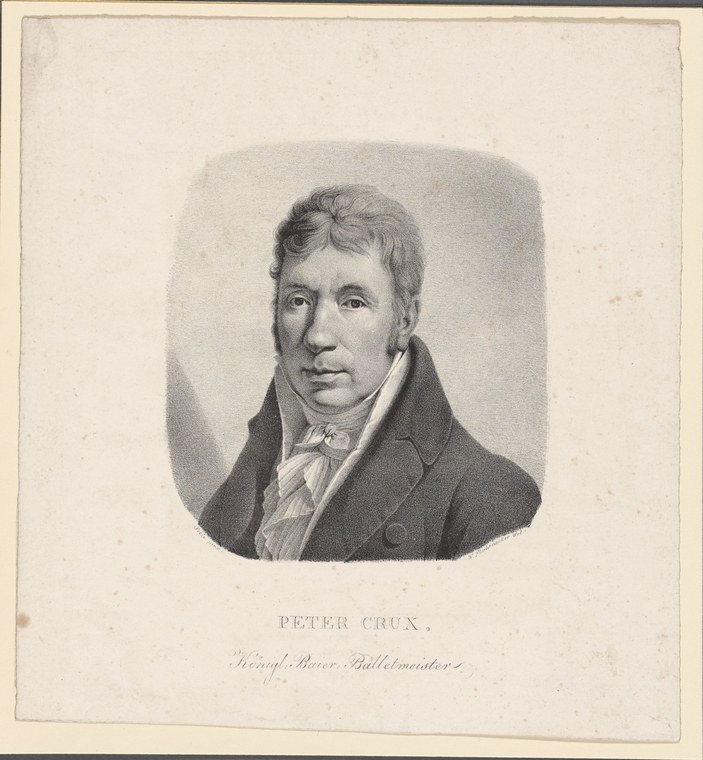
Peter Crux, Königl. Baier. Balletmeister
Unknown artist
- Collection:
- Prints depicting dance
- Source:
- New York Public Library
- Rights:
- Public domain — free to use, share and adapt.
- Recorded as:
- Public Domain
Ballet masters were the carriers of technique, repertory, and style in the era before film and notation. A portrait with a formal institutional title is evidence of how these positions were legitimized and publicized. Crux's position in Bavaria demonstrates how ballet had established itself across the German-speaking lands by this period.
What you are looking at
A portrait bust of a man in early 19th-century dress, rendered as a stipple or finely-worked engraving. The figure is shown from the shoulders up, turned slightly to the viewer's left, wearing a dark coat with a high collar and a white shirt front with a small bow tie. His hair is dark and swept back from his forehead in the style of the period. The background is a soft, even tone created by fine parallel lines, with the portrait itself occupying an oval vignette that fades into the pale paper at the edges. Below the image, in italics, runs the inscription "PETER CRUX," followed by "Königl. Baier. Balletmeister"—Royal Bavarian Ballet Master.
The dancing
The subject is a single figure, a head-and-shoulders portrait with a composed, frontal gaze. His expression is neutral and dignified. There is no visible movement, costume detail, or pose that would indicate dance practice; this is a formal identification portrait of the type used for theatrical programs or biographical reference.
The dance depicted
Peter Crux is identified by inscription as a Royal Bavarian Ballet Master (Königl. Baier. Balletmeister), indicating a position of professional standing in the Munich court ballet during the early 19th century. The portrait itself contains no evidence of the dances he taught or performed—it is a professional credential in portraiture form, designed to establish his authority and identity rather than to depict choreography or movement. Such prints were commonly circulated among theater-goers and in company documents.
How it was made
This is an engraving, most likely a stipple engraving, a technique that builds tone through fine dots rather than lines. The regular, even stippling in the background and the soft modelling of the face are characteristic of the method. Stipple engraving was labor-intensive but produced a refined finish suitable for portraits of persons of standing, and was commonly distributed as a printed sheet or incorporated into theater programs and librettos. The technique allowed for wide circulation and modest cost compared to mezzotint.
About this work
This is a formal engraved portrait of Peter Crux, identified as Royal Bavarian Ballet Master. It belongs in a dance archive not as a record of dance itself—the image shows only a face and torso—but as evidence of the institutional structure of European ballet in the early 1800s and of the professional identity and recognition granted to ballet masters of the period. The inscription confirms his position and Germanizes the practice of ballet mastery outside the French and Italian centers. Such portraits were working documents as much as tributes: they appeared in programs, collections of theatrical biographies, and archives, establishing the official lineage and credibility of a ballet institution.
How to look at it
This is not a portrait designed to convey movement or dance skill. Instead, attend to what the inscription and the formal presentation tell you: the authority of the costume, the dignity of the pose, the professionalism of the engraving technique itself. The portrait is a document of institutional status. The neat inscription in italic type is as much a part of the work as the face—it is a certified identity, a credential in print.
The artist
The artist is not recorded. The engraving is competent and refined, suggesting a professional workshop familiar with portrait work for the theater world. Stipple-engraved theatrical portraits of this caliber were often unsigned or carried only a publisher's mark.
The period
The early 19th century saw the establishment of national ballet institutions and the professionalization of ballet mastery across Europe. Munich's court ballet was one of several regional centers where such positions carried official weight and were documented through portraiture. This was the era of the rise of Romantic ballet (roughly 1830–1850), and ballet masters like Crux were the immediate predecessors and contemporaries of the great choreographers of that movement. The stipple-engraving technique was at the height of its refinement and popular use for theatrical portraiture during this period.
Where it lives
Held in the New York Public Library's collection of prints depicting dance. The work is part of a larger archival body of theatrical and dance-related portraiture, chiefly 19th-century European prints and engravings. Such collections were built to document the history of performance and the individuals who shaped it.
Questions about this work
Why would a ballet master's portrait belong in a dance archive if it doesn't show dancing?
Ballet masters were the guardians of technique and choreography. A formal portrait with institutional credentials is evidence of how the profession was structured, recognized, and passed down. It documents the person, not the dance itself, but it is essential to understanding how ballet institutions functioned and who held power within them.
What was a Royal Bavarian Ballet Master?
A ballet master was a senior performer and teacher who choreographed ballets, trained dancers, and maintained the company's repertory. In a court institution like Munich, the position was official and prestigious. Crux would have been responsible for the technical and artistic standards of the ducal ballet.
Why was this portrait made as a stipple engraving?
Stipple engraving was the finest and most widely used technique for theatrical portraiture in the early 19th century. It was refined enough to convey likeness and dignity, yet could be printed in quantity and distributed in programs, collections, or sold separately. It was a professional credential in image form.
More dance artwork





