49 works in this view — arrow keys or swipe to move between them.
Dance in Art
Fanny Elssler
Unknown artist
- Collection:
- Prints depicting dance
- Source:
- New York Public Library
- Rights:
- Public domain — free to use, share and adapt.
- Recorded as:
- Public Domain
Fanny Elssler was a pivotal figure in Romantic ballet whose technical gifts and dramatic range rivalled those of her great contemporary Marie Taglioni; this engraving, whoever it depicts, is part of the visual apparatus through which her fame was disseminated and her legacy preserved. The discrepancy between inscription and image also illustrates the challenges of attribution and verification in archival dance materials, a core concern for historians working with theatrical ephemera.
What you are looking at
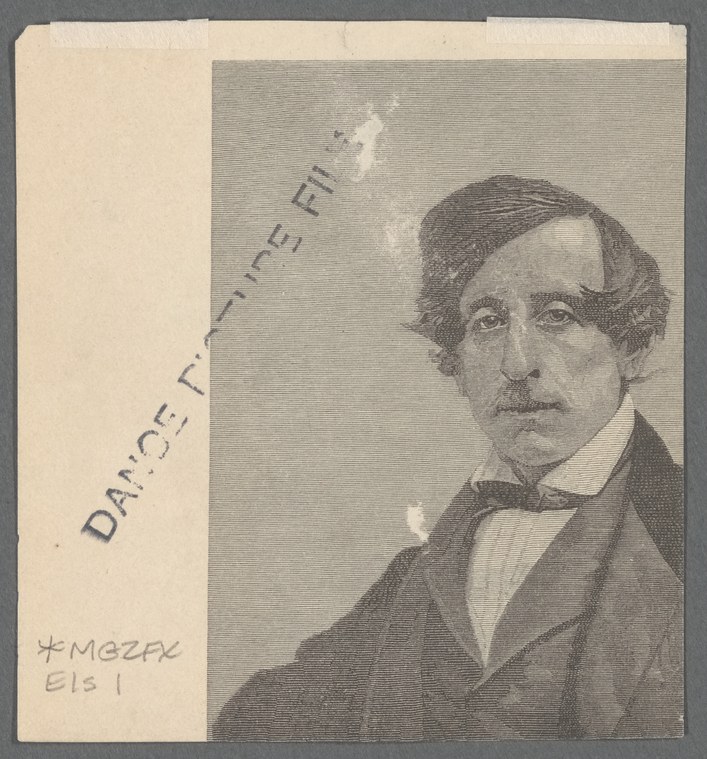
This is a portrait engraving of a man in early-to-mid 19th-century dress, presented in three-quarter view against a plain background. He wears a dark coat with a white collar and bow tie, his hair swept back from his face in the style of the 1830s–1840s. The figure is rendered in fine parallel lines characteristic of steel engraving, with careful attention to the modelling of the face and the fabric of the garment. The inscription "FANNY ELSSLER" runs diagonally across the upper portion of the image, and there is a catalogue mark at the lower left. The image is a formal commemorative print rather than a dance action scene.
The dancing
The figure is shown in a static, frontal pose typical of 19th-century theatrical portraiture—no dance position or movement is depicted. The body is upright and still, the arms at rest. This is a portrait of a person, not a representation of dance itself.
The dance depicted
The inscription identifies this as "Fanny Elssler," the celebrated Austrian ballerina of the Romantic era (1810–1884), who was renowned for her technically brilliant and dramatically expressive performances, particularly in works like La Cachucha and Esmeralda. However, the engraving shows not Elssler herself in action, but a male figure in contemporary dress. This is either a misidentification in the inscription, an engraving of a male dancer or choreographer associated with Elssler's career (such as a partner or impresario), or the inscription refers to a work or collection rather than the subject of the portrait. Without additional documentation, the dance identity cannot be securely established from the image alone.
How it was made
This is a steel or copper engraving, identifiable by the fine parallel hatching lines, uniform tonal gradation, and the crisp definition of edges throughout. Steel engraving was the standard reproductive medium for theatrical portraits in the 19th century, allowing for long print runs and wide distribution. The technique was labour-intensive and relatively expensive, indicating this was produced for a market of educated patrons interested in theatrical celebrities.
About this work
This engraving is a theatrical portrait from the 19th century, inscribed with the name of Fanny Elssler, one of the greatest ballet dancers of the Romantic era. The image itself depicts a man in early 19th-century dress in a formal, static pose—not a dance scene. It belongs in a gallery of dance imagery because the inscription connects it to a major figure in ballet history, yet it presents a puzzle: the mismatch between the male subject and the female dancer's name raises questions about attribution, inscription accuracy, or the nature of theatrical documentation and circulation in this period. For historians and dancers, it exemplifies how dance was commemorated and marketed to the public through prints and engravings, even when the actual image may not depict the moment of performance.
How to look at it
The viewer should note the formal, dignified presentation—this is not a dynamic or action-based image but a statement of presence and identity. The careful rendering of the face and the period accuracy of the dress are central; they indicate that this was a portrait meant to be recognisable to contemporary audiences. The inscription should be read as the primary text; the discrepancy between it and the subject merits investigation.
The artist
The artist is not recorded. The engraving was created during the height of the theatrical print trade in the 1830s–1840s, when publishers across Europe produced and circulated portraits of celebrated dancers, singers, and actors to feed public fascination with theatrical personalities. These prints were often sold singly, in portfolios, or as insertions in periodicals.
The period
This engraving dates to the Romantic era in ballet (approximately 1830–1850), when the ballerina emerged as the central figure in ballet spectacle, ethereal and technically accomplished roles like Sylphide and Giselle defined the aesthetic, and the star system created celebrity dancers whose likenesses were mass-produced and widely collected. Theatrical portraiture in engraving was at its height; the reproduction of famous dancers' images was a significant commercial enterprise.
Where it lives
This engraving is held in the New York Public Library's collection of prints depicting dance. It is catalogued with minimal metadata, and the inscription, artist, date, and printing details are not fully documented in the record provided.
Questions about this work
Is this actually Fanny Elssler?
The inscription names her, but the portrait depicts a man in period dress, not the dancer in action. The work may commemorate Elssler's era or circle, or there may be an error in the inscription or attribution. Without additional archival evidence, the true identity of the subject cannot be confirmed from the image alone.
Why is there no dance in this image?
This is a portrait print, not a scene of performance. In the 19th century, famous dancers were celebrated through formal portraiture as much as through action scenes. Prints like this were sold to the public as souvenirs and collectibles, serving a commemorative rather than documentary function.
What was Fanny Elssler famous for?
Elssler (1810–1884) was an Austrian ballerina celebrated for her technical brilliance, dramatic expressiveness, and mastery of character dances. She was known for roles in works like La Cachucha and Esmeralda, and she was the great rival of Marie Taglioni in the Romantic ballet era.
More dance artwork





