49 works in this view — arrow keys or swipe to move between them.
Dance in Art
American fashion plates
Unknown artist
- Collection:
- Prints depicting dance
- Source:
- New York Public Library
- Rights:
- Public domain — free to use, share and adapt.
- Recorded as:
- Public Domain
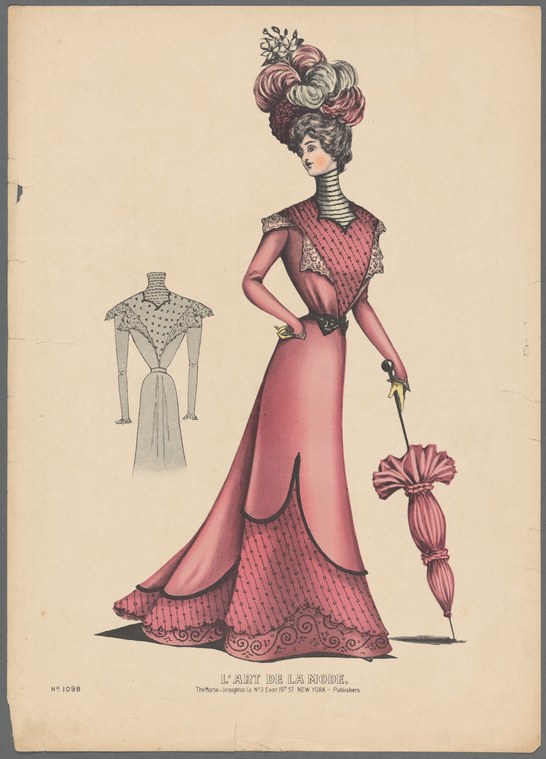
Fashion plates are crucial evidence for understanding how bodies were clothed, corseted, and held in a particular historical moment, and how those constraints shaped posture and movement. For historians of dance, this image documents the silhouette and restrictive understructure within which early-twentieth-century women danced, even if it does not itself depict dancing.
What you are looking at
A single fashionably dressed woman stands in three-quarter profile against a cream background, wearing an elaborate pink gown with a high waistline and a flowing trained skirt. Her posture is upright and elegant, with one arm akimbo and the other holding a decorative fan tied with ribbon. Her hair is built into an elaborate pompadour crowned with feathers and ornamental pins, and she wears a high boned collar. To the left, a technical fashion plate shows the construction of a fitted bodice with short sleeves, rendered in outline. The woman occupies most of the frame, presented as a model of early-twentieth-century fashion rather than as a dancer in motion. The image is hand-coloured, with careful attention to the subtle gradations of pink silk and the delicate patterning of the garment's lower portion.
The dancing
The single figure is static and posed rather than captured mid-movement. Her weight appears to rest evenly on both legs, with no indication of a dance position or hold. The arm akimbo and the relaxed placement of the fan-holding arm are attitudes of fashionable repose rather than dance technique. There is no evidence of a partner, weight transfer, or footwork typical of any ballroom or theatrical dance.
The dance depicted
This is not a depiction of dance in motion. It is a fashion plate—a commercial illustration intended to display garment construction and current fashion to potential customers or seamstresses. While the catalogue record is filed under 'Prints depicting dance,' the image contains no choreographic content, no partner relationship, no moment of movement, and no reference to any dance style or technique. The upright posture and formal presentation resemble the deportment taught in finishing schools and society dancing, but the image documents fashion, not dance.
How it was made
This is a hand-coloured lithograph or engraving, a mass-produced commercial print. The French title and publisher information (visible at bottom) indicate a fashion periodical, likely from a publication such as *L'Art de la Mode* or a similar Parisian fashion journal. The precision of the outline drawing, the inclusion of a technical flat of the bodice construction, and the careful hand-colouring are all standard to the fashion plate tradition. Such prints circulated widely among dressmakers, milliners, and affluent women, serving as both inspiration and instruction.
About this work
This is a fashion plate from an early-twentieth-century Parisian periodical, rendered in hand-coloured lithography. It documents an elegant day or afternoon dress, showing both the finished garment on a posed model and the structural pattern of the bodice separately. The work exemplifies the fashion plate as a hybrid image—part art, part commercial document, part instruction manual. While the catalogue places it among dance imagery, it is fundamentally a garment illustration, though the upright posture and refined deportment reflect the finishing-school aesthetics and ballroom comportment of the Edwardian era.
How to look at it
Examine the construction lines and the separate bodice plate on the left: they reveal the boning, seaming, and fit that shaped the wearer's torso. Notice the height of the waistline, the narrowness at the hip, and the way the skirt trails behind. The woman's posture—shoulders back, spine straight, chin held level—reflects the postural ideal demanded by the corsetry beneath. This is not a moment of movement but a moment of display; the body is presented as an object of fashion consumption rather than as a mover.
The artist
Not recorded. The style and publication context suggest a professional fashion illustrator working for a Parisian periodical in the 1900s–1910s, a period when fashion journalism and lithographic reproduction had become a significant commercial sector.
The period
This plate dates to the Edwardian era (c. 1900–1915), a period of significant shift in women's fashion and deportment. The high waistline and trained skirt shown here represent the transition between the exaggerated S-bend corset silhouette of the 1890s and the more vertical, columnar fashions that would emerge after 1910. Women's ballroom dancing during this period took place within these garments, which demanded an upright carriage and restricted the range of movement possible in the lower body. The same years saw the rise of new social dances such as the one-step and the tango, which required more mobility than previous ballroom forms—creating visible tension between fashion and the emerging demands of modern dance.
Where it lives
Held by the New York Public Library in a collection of historical prints depicting dance. The image is catalogued as 'American fashion plates,' though the French title and publication information indicate a Parisian source.
Questions about this work
Is this a dance image?
No, it is a fashion plate—a commercial illustration designed to display garment construction and style. It was not created to document dance or choreography. However, it is valuable for historians of dance because it shows the silhouette and corsetry within which early-twentieth-century dancers moved, and reveals how fashion and the body's potential for movement were related.
Why is a fashion plate in a dance collection?
Fashion plates and dance are closely linked in the early twentieth century. The garments shown constrained and enabled particular kinds of movement. Collectors of dance imagery often include fashion and theatrical costume plates because they document the visual conditions under which dancers performed and learned to move.
What can I learn from this about early 1900s fashion?
The high waistline, trained skirt, fitted bodice, and upright carriage shown here are characteristic of Edwardian dress (c. 1900–1915). The separate bodice plate reveals the internal structure—boning, seaming, and fit—that modern garment makers would have used to reproduce the style. The hand-colouring and lithographic technique indicate it was a commercial publication, likely from a Parisian fashion journal distributed to seamstresses and affluent consumers.
More dance artwork





