49 works in this view — arrow keys or swipe to move between them.
Dance in Art
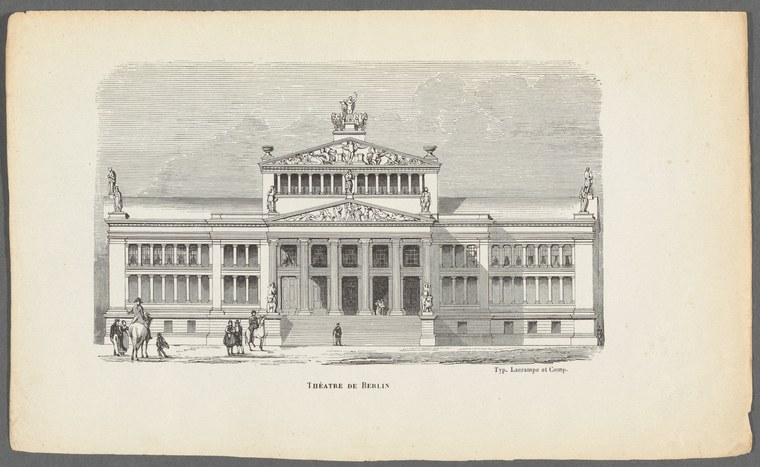
Théatre de Berlin
Unknown artist
- Collection:
- Prints depicting dance
- Source:
- New York Public Library
- Rights:
- Public domain — free to use, share and adapt.
- Recorded as:
- Public Domain
For dance historians and researchers, architectural prints of theatres are primary documents of the physical conditions under which performance took place—the sight lines, stage depth, acoustic properties, and social hierarchy encoded in the building's design. This image records the Theatre de Berlin as a monument to the cultural status of dance and drama in 19th-century Europe, showing how the built environment shaped what audiences saw and how performers worked.
What you are looking at
This is an architectural elevation drawing of the Theatre de Berlin, rendered as a finely detailed engraving. The building presents a symmetrical neoclassical facade with two stories of regularly spaced rectangular windows, each framed in recessed panels. Atop the main structure sits a smaller ornamental pavilion with Corinthian columns and a domed crown, topped with a sculptural finial. Classical statuary — male and female figures in contrapposto stance — flank the corners and pediment of the building. A handful of pedestrians and horse-drawn carriages occupy the plaza in front, rendered in much smaller scale, establishing the grandeur of the structure. The sky above is indicated by fine cross-hatching. The engraving is executed with careful parallel lines and stippling to suggest volume and shadow, characteristic of 19th-century architectural prints.
The dancing
The human figures depicted are not dancers but rather architectural staff and civic pedestrians in the plaza. The few figures visible in the foreground—rendered quite small—wear contemporary 19th-century dress and stand or walk in ordinary postures. The larger sculpted figures on the building itself are in classical contrapposto positions: standing figures in draped robes with weight distributed on one leg, arms at various rests or gestures of bearing. None of these figures are engaged in dance movement or hold.
The dance depicted
This work does not depict dance. It is an architectural rendering of a theatre building. While the venue is designed for theatrical performance, the engraving shows only the exterior structure and its sculptural ornament—no performance, dancers, or choreography is represented. The building itself is the subject.
How it was made
This is a wood or steel engraving, identifiable by the fine parallel hatching lines, precise linear perspective, and tonal gradation achieved through lineweight variation rather than solid shading. The technique allowed for mass circulation via printing press and was the standard medium for architectural documentation and promotion throughout the 19th century. Such prints would have been disseminated to potential patrons, architects, and the public press to advertise the opening or prestige of a new civic building.
About this work
This is an architectural elevation of the Theatre de Berlin rendered as a fine engraving, likely from the 19th century. The work documents a neoclassical civic building designed for theatrical performance and is held in the New York Public Library's collection of prints. It belongs in LODance not as a record of dance itself but as evidence of the architecture, patronage, and civic prominence of theatrical institutions during a period when ballet and opera were central to urban cultural identity. The building's grand scale, sculptural ornament, and formal symmetry communicate the importance accorded to theatre as a social and aesthetic institution.
How to look at it
Examine the symmetry and hierarchy of the design: the progression from the large rectangular volumes of the lower storeys to the more ornate and elevated pavilion, suggesting a tiered social space for different classes of spectators. Note the sculptural figures at the corners and roofline—their bearing and drapery reference classical antiquity, a common strategy for lending authority to theatrical institutions. The small human and animal figures in the plaza provide scale and suggest the building's dominance in civic space. The precision of the engraving technique—every window distinct, every cornice articulate—emphasises the building as a work of craft and reason, not mere decoration.
The period
This engraving dates to an era of rapid theatre construction across Europe, driven by industrialisation, urban growth, and the consolidation of ballet and opera as prestigious civic arts. Neoclassical architectural vocabulary—favoured for public buildings from the late 18th century onward—signalled reason, order, and cultural refinement. By the 19th century, theatres were designed as monumental public institutions, often funded by city governments or aristocratic patrons. The classical statuary adorning the façade alluded to ancient drama and legitimated the theatre as a keeper of high culture. Such buildings were intended to attract the educated classes and validate the expense and labour of the performers within.
Where it lives
Held in the New York Public Library's collection of prints depicting dance, this engraving is catalogued by subject rather than by artist or commissioner. It is a printed secondary source documenting the architectural context of performance rather than a first-hand artistic record of choreography or dancers.
Questions about this work
Why is a building included in a dance archive?
Theatres are inseparable from the history of dance. The design of a building—its stage depth, wing space, sightlines, and acoustic properties—directly shaped what dancers could do and how audiences experienced performance. Architectural prints are primary documents of the material conditions of dance-making in a given period and place.
Can I tell what kind of dance was performed in this theatre from the building alone?
No. The neoclassical style and civic prominence of this building suggests it hosted opera and ballet—the prestigious, state-sponsored genres of 19th-century Europe—but the building itself does not represent choreography, dancers, or specific performance styles. Other sources would be needed to document what was actually performed here.
Who is the artist and when was this made?
The artist's name is not recorded in the catalogue. The style, technique, and architectural vocabulary suggest a 19th-century engraving, but the exact date and commissionner remain unknown. It is likely a promotional or documentary print issued around the time of the theatre's opening or renovation.
More dance artwork





