49 works in this view — arrow keys or swipe to move between them.
Dance in Art
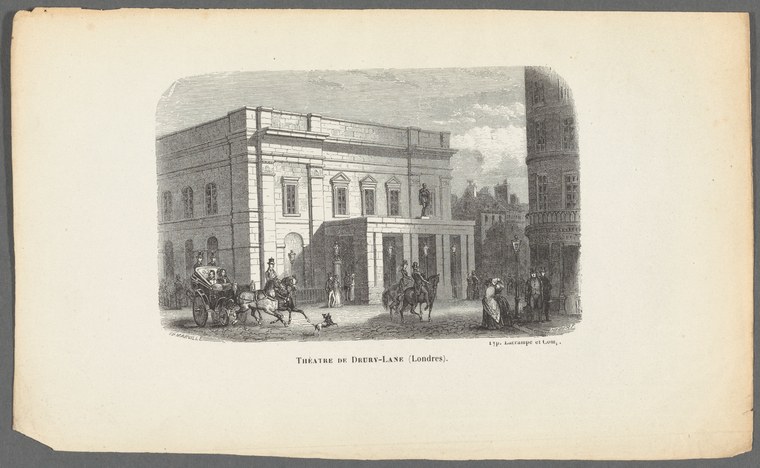
Théatre de Drury-Lane (Londres)
Unknown artist
- Collection:
- Prints depicting dance
- Source:
- New York Public Library
- Rights:
- Public domain — free to use, share and adapt.
- Recorded as:
- Public Domain
Drury Lane Theatre was a defining venue for dance in the nineteenth century, hosting the great Romantic ballerinas and innovative choreography. This image places that artistic achievement in its urban and social context, showing the building's public face and the crowds it drew. Understanding the architecture and geography of theaters where dance was made is essential to understanding dance history.
What you are looking at
This is an engraved architectural view of the Theatre Royal, Drury Lane in London, rendered in the mid-nineteenth-century style. The building occupies the center of the composition, a substantial four-story structure with a rusticated ground floor and regularly spaced arched windows. A columned portico marks the entrance, toward which several figures and horse-drawn carriages are directed. The street before it bustles with pedestrian and vehicular traffic: smartly dressed men and women in top hats and bonnets circulate; a carriage with horses and driver approaches the entrance; various street figures populate the foreground. The sky above is atmospheric, with smoke rising from chimneys visible in the background cityscape. The engraving technique has rendered fine architectural detail and created a lively sense of urban activity and commercial bustle around one of London's most prestigious entertainment venues.
The dancing
The figures are rendered in the scale and style typical of architectural engravings, where people serve primarily to indicate the building's grandeur and the vitality of the street. No coherent dance formation is visible. The figures are dressed in early Victorian costume—top hats, long skirts, tailcoats—and are engaged in the ordinary activities of urban pedestrians: walking, standing, boarding carriages. Their postures are upright and formal, typical of the period's social deportment. No dance-specific holds, frames, or movement vocabularies are evident in their positioning.
The dance depicted
This image does not depict dance. It is an architectural and social topography of a famous theatre building at street level. The figures shown are members of the public arriving at or departing from the venue, not performers. While Drury Lane was indeed a major center for theatrical performance—including dance, pantomime, and ballet—this engraving documents the building's exterior presence and the theater-going public rather than the art form practiced within.
How it was made
This is a wood engraving or steel engraving, a common reproductive medium for architectural and topographical prints in the nineteenth century. The fine parallel hatching visible in the sky and shading, the crisp linear definition of architectural elements, and the characteristic white-line style are consistent with engraved illustration. Such prints were produced for publication in newspapers, periodicals, and topographical books, allowing wide circulation to a middle-class audience interested in London's public monuments and commercial life. The technique enabled accurate architectural representation and readable urban narrative.
About this work
This is a documentary engraving of the Theatre Royal, Drury Lane, one of the most historically significant theatrical buildings in the English-speaking world. The image records the building's external form and its place in London's urban geography during the nineteenth century. Drury Lane was celebrated for its ballet and dance programming—it hosted leading dancers and choreographers of the Romantic era—and this engraving belongs in a dance archive as evidence of the physical venue, the urban context, and the social world in which London's theatrical dance life unfolded. The building itself is a historical actor in the story of dance.
How to look at it
Attend to the building's scale and its architectural vocabulary of classical order—the portico, the regular fenestration, the rustication—which advertised theatrical legitimacy and civic importance. Notice the animated street life: the social ritual of theater-going, the mixed crowds, the commercial energy. The composition presents the theater not as an isolated monument but as an integrated part of London's social and commercial fabric. The engraving tradition itself—its clarity, its documentary ambition, its circulation in prints—was the means by which Victorian audiences learned the appearance of venues they might never visit in person.
The artist
The engraver is not recorded. This print was produced in the standard topographical tradition of the nineteenth century, when illustrated views of London's major buildings were a staple of periodical publication and book illustration. Such prints typically combined architectural accuracy with a lively sense of street life and social activity, appealing to readers' civic pride and curiosity about urban development.
The period
This engraving dates to the height of the Romantic era in ballet and the apex of theatrical entertainment in Victorian London. Drury Lane, along with the King's Theatre in the Haymarket, dominated London's dance programming in the 1830s–1850s. The theater's external grandeur, captured here, reflected the prestige and commercial success of dance as a theatrical art form. The crowds shown in the street were arriving to see the leading dancers of the age—Marie Taglioni, Fanny Elssler, and their successors—whose performances defined a generation's understanding of feminine grace and technical virtuosity.
Where it lives
This engraving is held in the New York Public Library's collection of prints depicting dance. It is cataloged as an architectural topographical view rather than a dance documentation, reflecting the library's understanding of the work as a building record.
Questions about this work
Does this image show dancers?
No. This is an architectural engraving of the theater building and the street before it. The figures are members of the public arriving for performances, not performers. Dance happened inside Drury Lane; this image documents the outside.
Why is this in a dance collection?
Drury Lane Theatre was one of the most important venues for dance in the nineteenth century, home to celebrated Romantic ballerinas and innovative choreography. The building itself is part of dance history. Understanding the physical spaces where dance was made helps us understand the art form's social role and prestige.
When was this building active as a dance venue?
Drury Lane hosted major dance and ballet programming throughout the nineteenth century, with its greatest prominence in the 1830s–1850s during the Romantic era. The building survives and remains in use today.
More dance artwork





