49 works in this view — arrow keys or swipe to move between them.
Dance in Art
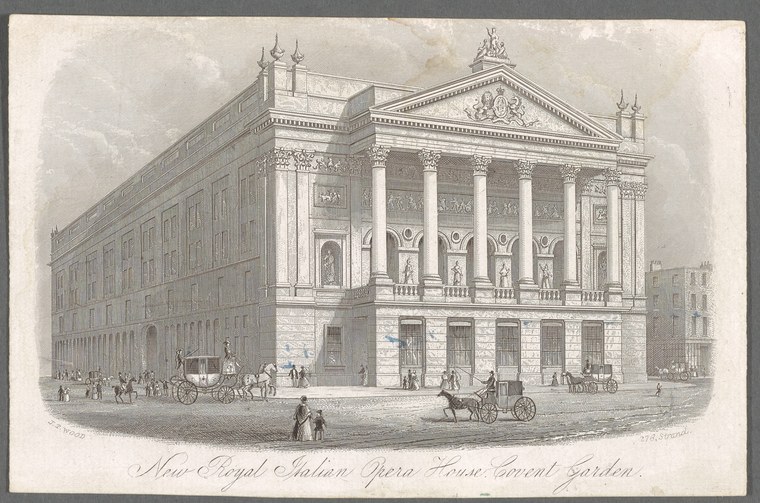
New Royal Italian Opera House Covent Garden
Unknown artist
- Collection:
- Prints depicting dance
- Source:
- New York Public Library
- Rights:
- Public domain — free to use, share and adapt.
- Recorded as:
- Public Domain
For historians of 19th-century dance, this image documents one of London's principal venues for theatrical dance and opera—the physical and social setting that constrained and enabled performance. The building's prominence and architecture reflect the cultural status dance and opera had achieved by the Victorian period, and its public position in Covent Garden speaks to how dance was integrated into urban civic life.
What you are looking at
This is an architectural engraving of the New Royal Italian Opera House at Covent Garden, a grand Italianate building with a rusticated stone façade and prominent columned portico. The structure dominates the composition, occupying the center and right two-thirds of the image. The main front presents six tall Corinthian columns beneath a triangular pediment with sculptural detail; the ground floor opens with arched doorways. A balustrade runs along the roofline, punctuated by decorative urns and finials. To the left, the adjoining building's classical façade recedes into shadow. The street before the opera house teems with life: horse-drawn carriages move across the plaza, well-dressed pedestrians in top hats and long coats congregate near the entrances, and a lamplighter or vendor stands in the foreground. The sky is rendered in fine stippling, giving depth to the scene. The engraving captures the building as a civic monument in active urban use, not an isolated architectural study.
The dancing
The human figures are small and subordinate to the architecture, rendered in the topographic manner typical of 19th-century urban engravings. They stand, walk, and gesture naturally in street dress of the period—men in frock coats and top hats, women in long skirts. No formal dance postures are evident; these are civilians and staff moving through the public space. The figures serve to give scale and vitality to the architectural subject rather than to document movement or choreography.
The dance depicted
This engraving does not depict dance in progress. It is a representation of the opera house building itself, the venue where dance and opera would have been performed. The image documents the architecture and social use of the space rather than any particular dance or performance. The work belongs in a dance collection because it records an important venue for theatrical dance in 19th-century London, but the image itself shows no dancers or dancing.
How it was made
This is a steel or copper engraving, a technique allowing fine linear detail and broad circulation as a print. The delicate cross-hatching and stippling, particularly visible in the sky and stonework, are characteristic of mid-to-late 19th-century engraving practice. The technique was ideal for architectural documentation and commercial reproduction—this image would have been published in newspapers, journals, or architectural volumes to publicize the new building. The hand-coloring visible in some impressions (sky tones here) was often added after printing.
About this work
This is a documentary architectural engraving of the New Royal Italian Opera House at Covent Garden, a major London performance venue of the 19th century. The image records not a dance event but the building in which dance was performed—an important context for understanding where and how theatrical dance circulated in the period. The work belongs in a dance collection as evidence of the theatrical infrastructure that shaped what kinds of dance could be staged, where, and for whom. The inscription and style suggest publication in the mid-Victorian era, when the opera house was a symbol of metropolitan cultural ambition.
How to look at it
This engraving rewards attention to architectural detail: the proportions of the classical order, the rustication of the ground story, the sculptural program of the pediment. But also note the human scale—the tiny figures in the plaza give the building's grandeur its meaning. The composition is frontal and symmetrical, a convention of architectural documentation that emphasizes legibility and monumentality. The inclusion of street life (carriages, pedestrians, vendors) grounds this temple of art in the everyday city.
The artist
The artist is not recorded. The engraving's style, technique, and finish suggest it was produced by a commercial urban topographer or architectural publisher, likely active in London in the mid-19th century. Such engravings were typically collaborative: an artist would make a drawing, a professional engraver would cut the plate, and the publisher would issue and distribute it. The work is anonymous by the conventions of the trade.
The period
The New Royal Italian Opera House was built in the 1850s–1860s, a period of Victorian expansion and investment in public cultural institutions. Opera and ballet were at the height of their popularity in London; the arrival of dancers from Europe, particularly Italian and French ballerinas, made the opera house a center of theatrical dance. The Romantic ballet—with its emphasis on the corps de ballet, pointe work, and ethereal feminine beauty—dominated the stage. This engraving was likely produced to promote the new building in the press and to capitalize on public interest in a major civic amenity.
Where it lives
This work is held by the New York Public Library in a collection of prints depicting dance. It is catalogued by institution and title rather than by artist or date, reflecting the anonymous, commercial origins of such engravings. The NYPL's inclusion of architectural and venue imagery in its dance collection reflects a broad curatorial understanding of dance history as embedded in institutions, spaces, and urban practice.
Questions about this work
Is there actually any dance in this image?
No. This is an engraving of the opera house building itself, not a performance. However, it is a crucial document for dance history because it shows the venue where theatrical dance was staged in 19th-century London. Understanding the architecture, location, and public status of the opera house helps historians understand the conditions under which Victorian dance took place.
Why would a dance collection include a building?
Dance does not happen in a vacuum—it happens in specific spaces designed and financed for performance. This engraving documents one of the principal theaters for dance in London at the moment when Romantic ballet was at its peak. For historians, such images are as important as images of dancers themselves, because they reveal the infrastructure and cultural investment that supported dance.
When was the New Royal Italian Opera House built?
The record does not provide a specific date for either the building or the engraving. Based on style and nomenclature, the building is likely from the mid-Victorian era (1850s–1870s). The engraving was probably made shortly after the building opened, to publicize it.
More dance artwork





