49 works in this view — arrow keys or swipe to move between them.
Dance in Art
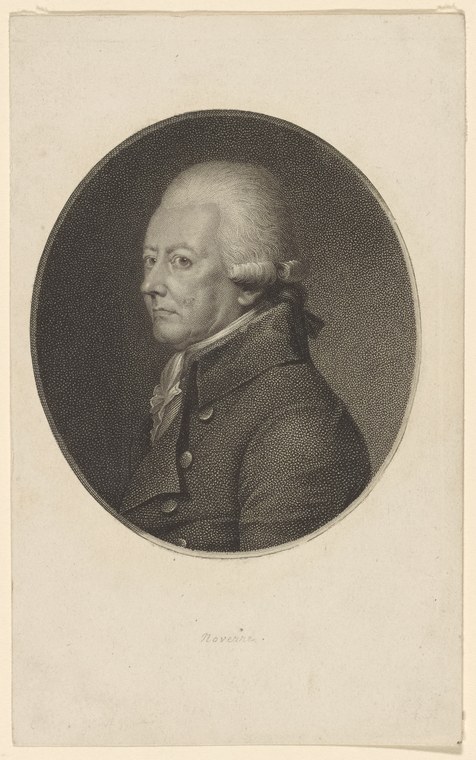
Noverre (in pencil)
Unknown artist
- Collection:
- Prints depicting dance
- Source:
- New York Public Library
- Rights:
- Public domain — free to use, share and adapt.
- Recorded as:
- Public Domain
Noverre's treatise *Lettres sur la danse* became the manifesto for Romantic ballet and modern choreography. Any serious study of how dance became a medium for narrative and emotion must reckon with his ideas. This portrait is a historical record of the man whose writings made ballet matter as art.
What you are looking at
A man in 18th-century dress is shown in profile against a dark background, his head and shoulders visible within an oval frame. He wears a dark coat with a high collar and visible buttons, and his hair is styled in the fashion of the period—pulled back and possibly powdered. His expression is serious and contemplative. The composition is formal and restrained, typical of portrait engravings. The name 'Noverre' is inscribed in pencil below the oval frame, identifying the subject. The work appears to be a reproductive engraving, probably from the late 18th or early 19th century, created some years after the subject's lifetime based on the style of the bust and rendering technique.
The dancing
A single male figure is depicted from the shoulders up, turned three-quarters to the viewer's right. His bearing is upright and dignified. No active dance movement is depicted; this is a portrait of repose rather than action. The formal pose and refined dress suggest a subject of social prominence and intellectual standing.
The dance depicted
This is a portrait of Jean-Georges Noverre (1727–1810), the most influential dance theorist and reformer of the 18th century. Noverre authored *Lettres sur la danse* (1760), which revolutionized ballet by arguing for expressiveness, pantomime, and natural movement over technical display. He served as ballet master at major European courts and theatres, including the court of Louis XVI. This engraving does not depict Noverre dancing, but rather commemorates him as a theorist and master—a representation of his intellectual legacy rather than his physical practice. The portrait format acknowledges his status as a founding figure of modern ballet aesthetics.
How it was made
This is an engraving, likely a steel or copper-plate engraving created in the late 18th or 19th century. The fine parallel hatching visible in the background and modeling of the face are characteristic of formal portrait engravings intended for publication and circulation. The oval format and restrained composition suggest this was part of a series of biographical or commemorative prints. Engravings of this type were affordable and widely distributed, making them the primary means by which a known figure's likeness reached the public.
About this work
This is a portrait engraving of Jean-Georges Noverre, the 18th-century ballet master and theorist whose writings fundamentally shaped the development of ballet as a dramatic art form. Rather than depicting him dancing, the portrait honors him as an intellectual and reformer. The work belongs in a dance archive not because it shows dance in action, but because it documents one of the most important figures in the history of choreography and dance theory. Noverre's conviction that ballet should tell stories through expressive gesture and pantomime—rather than serving as a vehicle for technical virtuosity alone—made him the intellectual founder of modern ballet.
How to look at it
Look at the facing direction and the set of the jaw: the portrait is composed to suggest both intellectual authority and emotional reserve. The viewer is not invited into intimate rapport but rather into formal recognition of status. This is a commemorative portrait in the neoclassical tradition, where the subject's character is conveyed through dignity and restraint rather than animation. The oval format was a mark of prestige, commonly used for portraits of celebrated artists and statesmen.
The period
In the mid-18th century, ballet was transitioning from court spectacle to theatrical drama. Noverre emerged during this shift as the theorist and practitioner who gave voice to what many sensed was necessary: the integration of pantomime, plot, and human emotion into dance. His career spanned the courts of Stuttgart, Vienna, and France, where he was master of the Paris Opéra Ballet under Louis XVI. By the time this engraving was made—likely in the decades after his death in 1810—Noverre's ideas had become canonical. The Romantic ballet movement of the early 19th century validated his arguments for expression over mechanics, making him a historical rather than contemporary figure at the moment of this portrait's creation.
Where it lives
This engraving is held in the New York Public Library's collection of prints depicting dance. It is likely one of many biographical prints created in the 19th century to document the lives and likenesses of celebrated dancers, choreographers, and ballet masters.
Questions about this work
Who was Noverre and why is he important to dance history?
Jean-Georges Noverre (1727–1810) was a French ballet master and theorist who authored *Lettres sur la danse* (1760), a manifesto arguing that ballet should be dramatic and expressive rather than merely technical. His ideas were revolutionary: he advocated for ballet d'action, in which movement and pantomime told stories and conveyed emotion. Noverre served as master of ballet at major European courts and was instrumental in transforming ballet from court entertainment into a narrative art form. His theories became foundational to Romantic ballet and remain influential today.
Why is this a portrait rather than a depiction of Noverre dancing?
By the time this engraving was made, Noverre was celebrated primarily as a theorist and reformer rather than as a virtuoso dancer. His legacy was his ideas and his influence on the next generation of choreographers and dancers. A commemorative portrait honors this intellectual contribution. The formal, dignified pose reflects how 18th and 19th-century culture represented great thinkers and artists.
What did Noverre mean by 'ballet d'action'?
Ballet d'action was Noverre's vision of ballet as a coherent dramatic narrative told through choreography and pantomime, rather than a series of technical display pieces. He believed dancers should express human emotion and tell stories through movement, and that plot and character should be central to ballet composition. This contrasted with earlier ballet, which often prioritized technical display and court spectacle over narrative sense.
More dance artwork





