49 works in this view — arrow keys or swipe to move between them.
Dance in Art
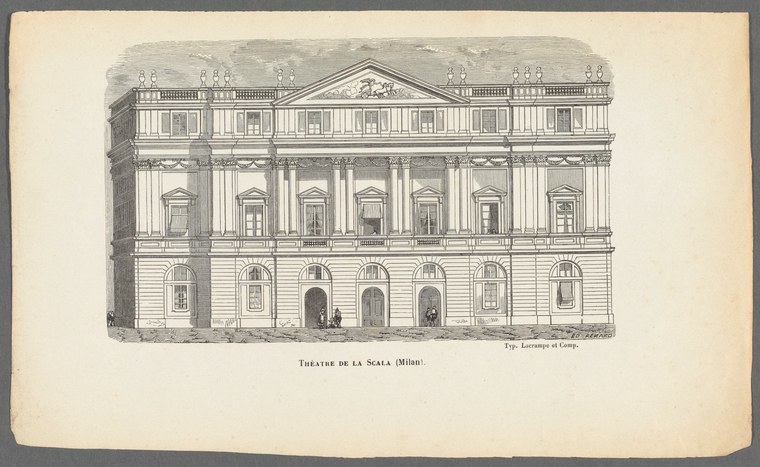
Théatre de la Scala (Milan)
Unknown artist
- Collection:
- Prints depicting dance
- Source:
- New York Public Library
- Rights:
- Public domain — free to use, share and adapt.
- Recorded as:
- Public Domain
The Scala is inseparable from the history of European ballet and opera, and this architectural print documents one of dance's most important historical venues. For historians, the image provides evidence of the building's appearance and prestige at a moment when it was already a destination for dancers and musicians across Europe.
What you are looking at
This is an architectural engraving of the Teatro alla Scala in Milan, rendered in fine lines and cross-hatching typical of 18th- or 19th-century print work. The building's façade dominates the composition: a grand neoclassical structure of three stories with a columned portico, pediment, and rusticated ground level pierced by large arched openings. The upper levels feature rows of rectangular windows arranged with mathematical precision beneath an ornamental attic story and balustrade. Small human figures appear at street level near the entrance arches, their scale emphasizing the building's monumental proportions. The engraving is tightly composed, showing the theatre as a civic monument rather than as a venue of performance or spectacle. No dancers or choreographed movement is visible; the image functions as architectural documentation rather than a record of theatrical event.
The dancing
The small human figures visible at ground level near the entrance are rendered schematically and serve as scale markers rather than as subjects of study. They show no distinctive posture, gesture, or grouping that suggests dance or performance. The work is not concerned with bodies or movement.
The dance depicted
This engraving does not depict dance. It documents the Teatro alla Scala as a building. While the Scala became one of Europe's most celebrated opera and ballet venues, this print shows only the architecture—the exterior shell that would have housed those performances. No choreography, dancers, musicians, or theatrical activity is represented.
How it was made
This is a line engraving, identified by its use of parallel lines and careful cross-hatching to build tone and volume across the architectural surfaces. The technique allowed precise rendering of architectural detail and suggested the building's materiality through controlled mark-making. Engravings of this type were the standard means of circulating images of important civic and cultural buildings in the 18th and 19th centuries, making them widely available to a print-collecting public and serving both documentary and promotional purposes.
About this work
This is an architectural print documenting the Teatro alla Scala in Milan, one of the world's most prestigious opera and ballet theatres. The engraving shows the building's neoclassical façade as a monument to civic grandeur, with no indication of the performances that took place within. While the Scala was the site of historic dance and opera productions, this image is a record of architecture, not performance.
The work belongs in a Dance in Art collection only as contextual documentation—a visual record of a venue central to the history of theatrical dance. It tells us how the building presented itself to the world, but nothing about the artists or choreography that made it a legendary stage.
How to look at it
Examine the engraver's rendering of the building's three stories and how architectural detail—the columns, arches, windows, and ornament—is conveyed through line work. Notice how the scale and prominence of the building is established partly through its own monumentality and partly through the tiny human figures at street level. The precision of the engraving technique itself is worth attention: the control of line and tone demonstrates the high skill required to translate architectural design into a reproducible print.
The period
The Teatro alla Scala opened in 1778 and quickly became the preeminent Italian opera house. During the late 18th and 19th centuries, architectural engravings of celebrated public buildings served both documentary and promotional functions, circulating images of civic pride and cultural achievement. The neoclassical style shown here—with its emphasis on proportion, symmetry, and classical orders—reflected the period's architectural ideals and its belief in rational, universal beauty.
Where it lives
This engraving comes from the New York Public Library's collection of prints depicting dance. While housed in a dance-related collection, the work functions as architectural documentation of a theatre rather than as a representation of dance itself.
Questions about this work
Why is an architectural print in a collection of dance imagery?
The Teatro alla Scala is one of the most historically significant venues for ballet and opera in Europe. This print documents the building that housed performances by legendary dancers and choreographers. While the image itself shows no dance, the venue is integral to dance history, and the print serves as a record of a place central to the art form's development.
When was the Scala built and was this engraving made at the same time?
The theatre opened in 1778, replacing an earlier opera house that burned down. This engraving's date is not recorded in the catalogue, but its style and technique suggest it was made sometime in the 18th or 19th century. Without additional information, it is not possible to determine precisely when the print was created or whether it documents the theatre as it appeared shortly after its opening or decades later.
What can we learn about the theatre's design from this image?
The engraving shows a large, formally planned neoclassical building with three stories, ordered fenestration, a columned portico, and a rusticated ground floor with large arches for public entrance. The design emphasizes monumentality and civic importance through symmetry and classical proportions. The building's size and architectural ambition signal its status as a major cultural institution.
More dance artwork





