49 works in this view — arrow keys or swipe to move between them.
Dance in Art
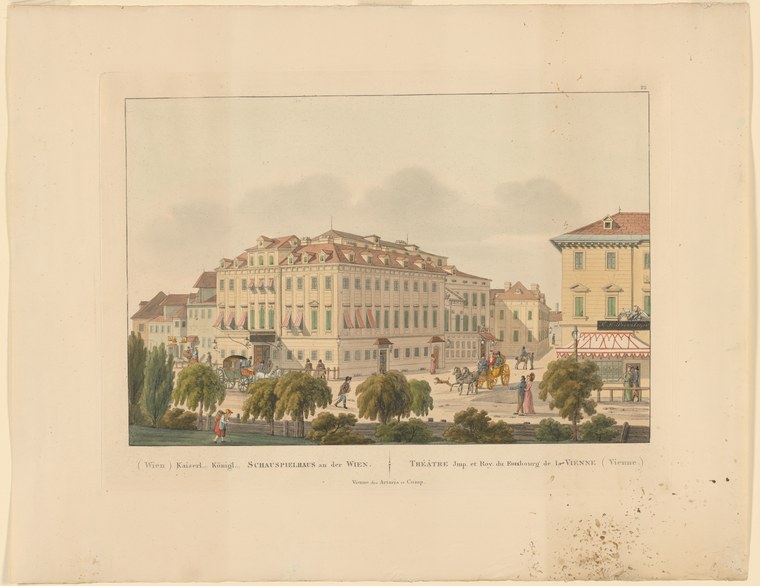
Schauspielhaus an der Wien
Unknown artist
- Collection:
- Prints depicting dance
- Source:
- New York Public Library
- Rights:
- Public domain — free to use, share and adapt.
- Recorded as:
- Public Domain
The Schauspielhaus an der Wien was one of the two or three most important venues for ballet and opera in early 19th-century Europe, and this print documents its physical presence and the fashionable public sphere around it during the Romantic era when Viennese audiences were seeing some of the most significant dance works of the period. For historians of dance and urban culture, the image is evidence of how theatre buildings functioned as anchors for the display and management of refined taste in society.
What you are looking at
A hand-colored engraving depicting a grand Viennese theatre building (the Schauspielhaus an der Wien) in an early 19th-century urban setting. The monumental neoclassical structure dominates the composition, its cream-colored façade articulated by multiple stories of tall sash windows and a mansard roof with dormer windows. The building sits beside willows and other trees on the river's edge; in the foreground, a fashionable crowd promenades along what appears to be a public square or embankment. The figures are rendered in miniature—gentlemen in dark coats and top hats, women in high-waisted Empire-line dresses with bonnets—creating a sense of theatrical pageantry in the urban space itself. The scene is bright and optimistic, with soft clouds and warm afternoon light, and includes the fine architectural detail typical of topographical prints of the period.
The dancing
The human figures are too small in scale to permit analysis of specific dance holds or footwork. They are shown standing, walking, or gathered in conversational groups—the posture is promenade rather than choreographed movement. A few figures appear to be in animated conversation; others stand in the classical contrapposto stance fashionable in the period. The composition treats the crowd as social ensemble rather than as individual dancers or pairs.
The dance depicted
This is not a dance scene in the strict sense, but rather a social gathering in an urban theatre precinct during the Viennese golden age of ballroom and theatrical dance. The image documents the fashionable world that attended performances and frequented the public spaces associated with major theatrical venues. The refined dress and composed demeanor suggest an aristocratic or wealthy mercantile audience of the sort who would have danced at balls in the salons of Vienna or attended the operatic and balletic productions staged inside such buildings.
How it was made
Hand-colored engraving on paper, typical of the topographical print tradition that flourished in German and Austrian lands from the late 18th through mid-19th centuries. The fine line work of the engraved building contrasts with the softer watercolor tinting applied to the sky, foliage, and costumes, creating a hybrid medium that combines the precision of intaglio with the warmth of wash. This technique was economical enough to produce for a broad educated market while maintaining the authority of an original print, and the hand-coloring allowed for individual variation and higher retail value.
About this work
This engraving is a documentary record of the Schauspielhaus an der Wien at the height of Vienna's dominance as a centre of European dance culture. The building itself—visible here in what appears to be the early decades of the 19th century—hosted the premieres and regular performances of the Romantic ballet that would define the century. The crowd depicted is the living audience for those performances, dressed in the neoclassical and Empire styles that dominated European fashion during the Napoleonic era and beyond. The image thus captures both a monument to theatrical dance and the refined social world that sustained it.
How to look at it
Attend to the scale relationship between the monumental building and the human figures—the architecture is the protagonist, and the crowd is rendered as subordinate detail, yet their fashionable dress and composed bearing are essential to the meaning. Notice the emphasis on the riverfront setting and trees: the theatre is shown as a public monument integrated into urban leisure space, not as an isolated palazzo. The soft coloring and balanced composition convey civic pride and optimism, the aesthetic equivalent of the confidence felt in Vienna's cultural authority.
The artist
The artist is not recorded. The print is characteristic of the Viennese topographical engraving tradition, produced by professional print sellers and distributors (often the same firms that published maps and architectural views) for the local and international market. The style and execution suggest a competent professional hand working in the early decades of the 19th century, possibly for a publisher like Artaria or similar Vienna-based firms that specialized in such views.
The period
Vienna in the early 19th century was the undisputed capital of ballroom dancing and a major centre for theatrical dance. The Congress of Vienna (1814–15) brought the crowned heads of Europe to the city and occasioned an explosion of balls and public celebrations. Simultaneously, the Schauspielhaus an der Wien (opened 1801) became a leading house for opera and ballet: Beethoven's Fidelio premiered there, and the theatre hosted performances by the leading dancers of the day. The Romantic ballet movement, which would transform European dance aesthetics mid-century, was emerging in Paris but had eager audiences in Vienna. The neoclassical and Empire fashions visible in the crowd reflect the cosmopolitanism and reform ideology of the period.
Where it lives
The work is part of a New York Public Library collection of prints depicting dance, suggesting it was acquired as documentary evidence of dance-related venues and urban culture rather than as a major artistic work in its own right. This is consistent with its function as a topographical print—ephemeral, widely distributed, and valued for information rather than originality.
Questions about this work
Is this an actual image of the Schauspielhaus an der Wien, or an imaginary reconstruction?
This is a topographical print of the actual building, made from observation or architectural drawings circulating in Vienna. The architectural detail is consistent with historical records of the theatre's façade and street elevation, though the artist may have idealized proportions or smoothed the composition for aesthetic balance. It is a reliable documentary source for the building's appearance in the early 19th century, but was also designed to be elegant and saleable, not merely literal.
Were the people shown in the foreground real people, or just generic figures?
The figures are generic types—fashionable Viennese society rendered in the conventional dress of the period—rather than portraits of specific individuals. Their presence establishes the social context of the theatre as a gathering place for the refined public. The artist's interest is in the crowd as an ensemble, a visual statement about who frequented such buildings and what they wore.
Why is this print relevant to a dance collection?
The Schauspielhaus an der Wien was a major venue for ballet and opera during the early Romantic period, hosting important premières and regular performances by leading European dancers. The print documents both the physical theatre and the fashionable audience that sustained professional dance in Vienna during a crucial period of artistic innovation.
More dance artwork





