49 works in this view — arrow keys or swipe to move between them.
Dance in Art
Amadis de Grece
Unknown artist
- Collection:
- Prints depicting dance
- Source:
- New York Public Library
- Rights:
- Public domain — free to use, share and adapt.
- Recorded as:
- Public Domain
This work matters because it reveals how early modern prints circulated narratives and theatrical concepts, and how engravers transformed literary romance into visual spectacle. For dance historians, it demonstrates that 'dance imagery' in historical art often includes tableaux vivants, allegorical gesture, and courtly display that do not conform to recognizable dance forms—yet were part of the same world of bodily expression and theatrical entertainment.
What you are looking at
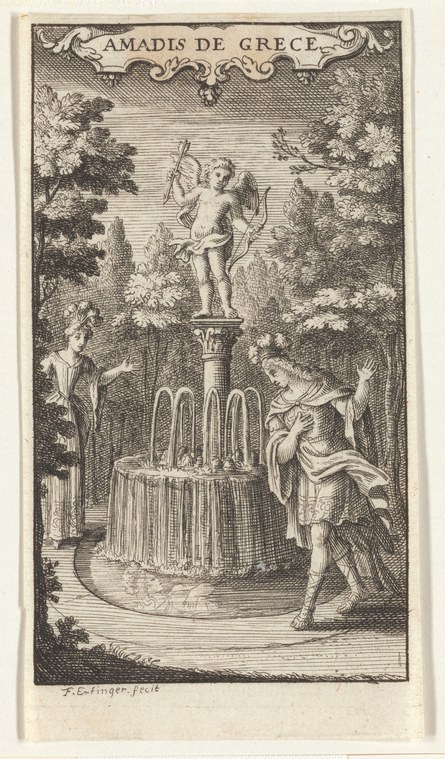
A winged putto (cherub) stands in classical contrapposto pose atop a tall pedestal in a wooded garden setting. The figure holds what appears to be a palm frond or staff in one hand and gestures expressively with the other, as if addressing an unseen audience. Two elegantly dressed figures—one in classical drapery on the left, one in flowing robes on the right—flank the pedestal at ground level, gazing upward at the central figure. The composition is rendered in fine engraved lines creating areas of shadow through parallel hatching; lush foliage frames the scene on either side, and the sky is filled with horizontal lines suggesting atmosphere. The entire scene has the character of an allegorical or theatrical tableau, possibly depicting a moment from a narrative or mythological episode.
The dancing
The putto stands in a relaxed contrapposto stance with weight shifted to one leg, the free leg slightly bent—a classical pose suggesting both ease and readiness. Both arms are raised; one extends forward in what could be a gesture of address or benediction, the other raised higher. The two human figures below adopt postures of attention or supplication, their bodies oriented toward the central figure. The composition creates a clear vertical hierarchy with the winged figure as focal point, elevated both physically and compositionally.
The dance depicted
This image does not depict recognizable social or theatrical dance. The putto's raised arms and contrapposto stance suggest classical artistic convention rather than a documented dance form. The scene appears allegorical or emblematic—possibly illustrating a moment from a mythological narrative or court entertainment—rather than documenting an actual dance. The title 'Amadis de Grece' suggests connection to the chivalric romance of Amadis, which was frequently adapted for theatrical and court entertainment, but the print shows a moment of gesture and tableau rather than the movement and momentum of dance.
How it was made
This is an engraving on paper, evident from the fine hatching and parallel lines that create tone and shadow throughout the composition. The signature 'Boetinger fecit' at lower left identifies the engraver. Engravings of this type—likely 17th or early 18th century—were produced for circulation as prints, making them accessible to a educated middle-class and court audience interested in theatrical narratives and allegorical imagery. The technique required precise control of line work and allowed for fine detail in drapery, foliage, and the human form.
About this work
This engraving depicts a classical allegorical scene titled 'Amadis de Grece,' most likely illustrating an episode from the chivalric romance or a theatrical adaptation of it. The work presents a moment of theatrical tableau rather than dance in the conventional sense—a putto elevated on a pedestal addresses or gestures toward two earthly figures in a garden setting. The engraver Boetinger rendered the scene with careful attention to classical proportion, drapery, and the effects of light through line work, producing a print intended for educated viewers familiar with romance narratives and court spectacle. While it portrays human figures in a moment of expressive gesture and interaction, it belongs more to the history of theatrical or allegorical art than to dance documentation.
How to look at it
Attend to the elevated position of the putto and the upward gaze of the earthly figures below: the composition enacts a hierarchy of the divine or allegorical over the mortal. The putto's raised arms and the elegantly draped folds of the other figures' garments show the engraver's training in classical art; these are poses and proportions derived from antique sculpture rather than observed life. The careful hatching and fine line work create a sense of dignity and formality appropriate to a noble narrative—this is courtly spectacle, rendered as high art.
The artist
The engraver Boetinger (signature reads 'Boetinger fecit') was likely a trained printmaker working in the 17th or early 18th century, though biographical details are limited. Engravings bearing similar signatures appear to document theatrical scenes and literary narratives, suggesting Boetinger specialized in prints after theatrical or allegorical compositions for educated patrons.
The period
The engraving dates to the period when chivalric romances like Amadis were being revived and adapted for court theatre and spectacular entertainments. In the 17th and early 18th centuries, such narratives were performed as ballets de cour, masques, and theatrical productions that combined dance, mime, music, and allegorical tableau. Prints like this one served to commemorate and circulate images of these ephemeral events, allowing those who had not attended—and those in distant locations—to appreciate the narrative and visual spectacle.
Where it lives
The work is held in the New York Public Library's collection of prints depicting dance, indicating it was catalogued as relevant to dance imagery, though the catalogue record itself is minimal. As an engraving, it was a reproducible print intended for distribution and collection by educated patrons.
Questions about this work
Is this actually a dance scene?
Not in the sense of choreographed or recognized dance forms. The scene depicts allegorical gesture and theatrical tableau—the putto's raised arms and expressive pose, and the upward orientation of the other figures. In early modern court entertainment, such moments of formal gesture and mythological display were often embedded in longer theatrical works that included dance, but this print captures a moment of stillness and address rather than movement.
What is 'Amadis de Grece'?
A chivalric romance from the 16th century that was wildly popular throughout Europe and frequently adapted for theatrical performance, including court ballets. The narrative involves the adventures of the knight Amadis, and episodes from it were transformed into spectacular visual entertainments combining dance, music, poetry, and allegorical imagery. This print likely commemorates a theatrical presentation of one such episode.
Who was Boetinger?
The engraver's full identity is not clearly established in available records, but the signature indicates the engraver trained in the formal technique of line engraving and worked on theatrical and narrative subjects. The quality of the line work and composition suggests professional training and access to court or educated patronage.
More dance artwork





