49 works in this view — arrow keys or swipe to move between them.
Dance in Art
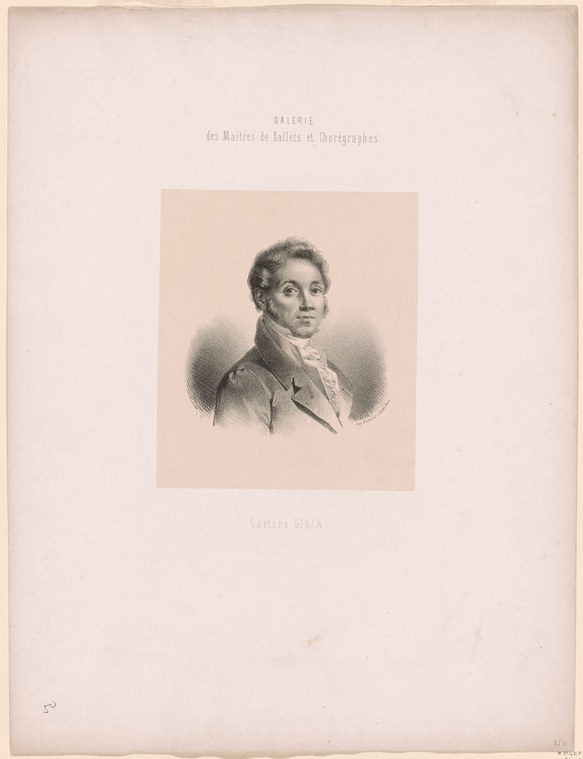
Gaetano Gioja
Unknown artist
- Collection:
- Prints depicting dance
- Source:
- New York Public Library
- Rights:
- Public domain — free to use, share and adapt.
- Recorded as:
- Public Domain
If Gioja was a notable dancer or choreographer of the early 19th century, this portrait serves as a historical record of his appearance and the visual conventions used to commemorate dance professionals in that era. However, the image itself contains no visual evidence of dance content, and any claim about his significance must rest on external knowledge about who he was.
What you are looking at
A three-quarter-length portrait of a man in early 19th-century dress, set against a plain background. He wears a dark coat over a white shirt with a high collar and a dark cravat or neck cloth, the standard dress of a gentleman from the Regency or early Victorian period. The figure is rendered in a refined stippled or dotted engraving technique that creates soft modeling in the face and shadows around the shoulders. His expression is composed and dignified, his gaze directed slightly away from the viewer. The composition is intimate and formal, emphasizing the sitter's refined appearance and social status. A thin ruled border frames the portrait, and text identifying the subject appears below.
The dancing
The man is shown in a static, frontal pose typical of formal portraiture rather than dance documentation. His shoulders are relaxed and square; his head is held upright with gentle contrapposto in the neck. There is no suggestion of movement, dance posture, or the kind of physical articulation that would indicate he is shown as a performer or in a moment of action. The hands are not visible in the frame.
The dance depicted
The portrait does not depict dance. It is a formal commemorative portrait of an individual, likely of significance in his time. Without additional context beyond the name 'Gaetano Gioja' printed below, the image alone provides no evidence of what his profession was, whether he was a dancer, choreographer, musician, or public figure of another kind. The pose and dress are consistent with how male professionals and gentlemen of the Regency era were portrayed, but nothing in the image itself identifies him as a dancer.
How it was made
This is a black and white engraving, most likely stipple engraving, a technique that uses small dots or flicks of the burin to build tone and create a soft, painterly effect. Stipple engraving was favored for refined portraiture in the late 18th and early 19th centuries because it could reproduce subtle gradations of light and shadow, and it required a high level of skill and craftsmanship. The technique suggests this was a work of some status, made for circulation among a cultivated audience—likely a print from a larger series or a standalone portrait published for collectors or to commemorate a person of public note.
About this work
This is a formal stipple-engraved portrait of a named individual, Gaetano Gioja, in the dress and style of the Regency or early 19th century. The work is held in a collection of prints depicting dance, but the image itself is a static portrait with no visible dance content or action. It belongs in a dance-focused collection only if Gioja was a known figure in dance history—a celebrated dancer, choreographer, or dance master—whose portrait would be valuable as a record of significant practitioners or personalities of the era. The absence of costume, pose, or setting that evokes performance means the dance connection must come from contextual knowledge about the sitter rather than from what the picture shows.
How to look at it
Attend to the extreme formality and stillness of the pose—this is portraiture designed to convey dignity and social standing, not performance or action. The refinement of the engraving technique, visible in the subtle modeling of the face and the delicate play of light and shadow, indicates this was a valued work made for a discerning audience. The printed name below anchors the image as a commemorative record of a specific, named individual.
The artist
The artist is not recorded in the catalogue. The quality of the stippling and the refinement of the engraving suggest a skilled professional hand, likely working in London or another major printing center in the early 19th century. Stipple engraving of this quality was associated with prestigious publishers and portrait engravers of the Regency period.
The period
In the early 19th century, stipple engraving was at the height of its refinement and was used to create prestigious portraits for the print market. This period saw a boom in published portraits of public figures—actors, musicians, dancers, and other celebrities of the stage—as prints became an affordable way for the public to own likenesses of performers they admired. The formal dress and restrained pose are typical of how male professionals wished to be commemorated, emphasizing gentility and status rather than the spectacle of performance.
Where it lives
The work is held in the New York Public Library's collection of prints depicting dance. It is mounted and framed as part of a larger series or collection, suggesting it was issued as a standalone print or as one of a numbered suite of portraits.
Questions about this work
Who was Gaetano Gioja?
The catalogue record does not provide biographical information. However, the surname and the inclusion of this portrait in a dance print collection suggest he may have been an Italian-born dancer or choreographer active in the early 19th century. External research would be needed to establish his role in dance history.
Why is a static portrait in a collection of dance imagery?
Formal portraits of dancers, choreographers, and other dance professionals were published and collected as records of significant figures in the dance world. They served a commemorative function and circulated among audiences interested in stage performers, much as printed portraits of actors and musicians did.
What technique was used to make this print?
This is a stipple engraving, a refined intaglio technique using small dots to build tone. It was highly valued for portraiture because it could achieve soft, painterly effects and was associated with high-quality, prestigious prints in the Regency and early Victorian periods.
More dance artwork





