49 works in this view — arrow keys or swipe to move between them.
Dance in Art
Fools, or jesters
Unknown artist
- Collection:
- Prints depicting dance
- Source:
- New York Public Library
- Rights:
- Public domain — free to use, share and adapt.
- Recorded as:
- Public Domain
This print documents a form of entertainment and physical performance that predates modern dance but belongs to the genealogy of theatrical movement. For historians of comedy, carnival, and folk performance, it shows how fools used their bodies, props, and costumes to create entertainment, and how that performance was recorded and circulated in print. The image also preserves the relationship between the fool and the musician—two essential roles in pre-modern entertainment.
What you are looking at
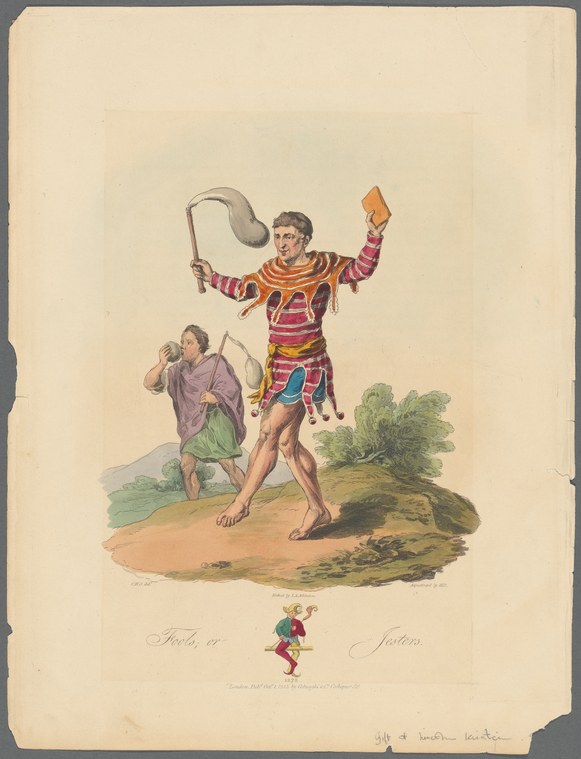
Two figures occupy a sunlit outdoor setting with rolling hills and distant greenery. The central figure is a male jester or fool, dressed in a vibrant patchwork costume of red, yellow, and blue horizontal stripes, with a matching striped tunic. He stands in a dynamic, energetic pose with one leg extended and his body in motion, his left arm raised high holding what appears to be a bladder or inflated sack (a traditional fool's prop), while his right arm is bent. His head is turned slightly, showing an animated expression. To his left stands a smaller figure, apparently a child or youth, also in motion and wearing a simpler pink or mauve tunic, playing a pipe or wind instrument. The composition captures a moment of theatrical performance or entertainment, with the fool as the dominant, active element.
The dancing
The fool's body is caught mid-movement in a posture of exuberant display rather than structured dance: weight appears shifted, one leg extended in a wide step or lunge, torso twisted, arms at different heights in a gesture of showmanship. The raised left arm holding the bladder creates an asymmetrical, attention-grabbing silhouette. The smaller figure beside him is also in motion, leaning forward slightly while playing the pipe, creating a subordinate but essential second element. Neither figure shows the formal hold or frame of courtly or balletic dance; this is gestural, improvisational performance.
The dance depicted
This is not a dance in the formal sense but a representation of a fool's or jester's performance—the kind of theatrical foolery, juggling, and physical comedy that entertained European audiences from the medieval period through at least the 18th century. The fool was a licensed performer of physical antics and satire, often accompanied by musicians as shown here. The inflated bladder on a stick (a slapstick predecessor) was a standard fool's prop used for comic effect. The companion figure playing a pipe suggests the performance was musical as well as physical. Fools' performances contained elements of mimicry, acrobatics, and rhythmic movement, but not what would be recognized as dance proper.
How it was made
This is a hand-colored engraving or etching, typical of 18th-century popular prints. The base image is finely engraved with attention to detail in the costume pattern and anatomical definition, while the coloring has been applied by hand in clear, bright pigments—evident in the sharply defined areas of red, yellow, blue, and pink. This technique allowed for relatively cheap mass production; the engraved plate could be printed many times and colored by workshop hands, making it accessible for popular consumption and collection. The print's small size and subject matter suggest it was circulated as an inexpensive broadside or part of a costume or character series.
About this work
This is a hand-colored engraving depicting a fool or jester in full performance, accompanied by a musician playing a pipe. The fool, in vivid striped costume, strikes a dynamic pose holding a bladder-and-stick prop, the signature instrument of his theatrical trade. The work dates from the 18th century and belongs to a visual tradition of documenting popular entertainers and stage characters. It is part of the NYPL's collection of prints depicting dance and performance.
The image preserves evidence of how fools operated within European performance culture: as unlicensed, improvisational entertainers whose physical comedy and satirical wit occupied a space between acrobatics, mime, and rhythmic movement. The fool's costume—exaggerated, striped, asymmetrical—was itself a form of visual entertainment, and the bladder prop signals the slapstick tradition that would influence comedic performance for centuries.
How to look at it
Notice the asymmetry and energy of the fool's pose: one leg extended, one arm high, his body twisted in a gesture of display rather than balance. This is not a stable position but a captured moment of motion—the kind of exaggerated, attention-seeking physical comedy that defined fool performance. The bladder on a stick is not incidental; it is his instrument, held aloft as both weapon and emblem. The small musician to his left grounds the composition: the fool performs, but he performs to music, and the hierarchy of the image (fool large and central, musician small and attendant) reflects their roles in the entertainment economy.
The period
The jester or fool was a licensed entertainer in European courts and popular culture from the Middle Ages through the 18th century. By the period this print was made, the fool had become partly a nostalgic or theatrical figure—preserved in plays, spectacles, and prints as a symbol of carnival liberty and licensed transgression. The engraved broadside was a standard medium for circulating images of actors, performers, and costume characters to a popular audience, often sold at fairs and markets. This print likely dates from the 18th century, when character prints and costume studies were popular collectibles among the urban middle classes.
Where it lives
This print is held in the NYPL's collection of prints depicting dance and performance. It is part of a larger body of 18th-century engraved character and costume prints, many now digitized and catalogued under broad subject headings.
Questions about this work
What is the bladder the fool is holding?
It is a fool's prop: a pig's bladder inflated and tied to a stick, used for comic effect. The fool would swat or wave it for physical humor and loud sound. It is a precursor to the slapstick (the wooden paddle that makes a loud crack) and signals the fool's role as a performer of physical comedy and satire.
Is this a dance?
Not a dance in the formal sense, but a performance of physical comedy and theatrical entertainment. However, it belongs in a collection of dance and performance because the fool's movement was rhythmic, gestural, and often accompanied by music—elements shared with dance proper. The boundary between fooling and dancing was porous in early modern popular entertainment.
When and where would you have seen a fool perform?
Fools were permanent fixtures in European courts from the medieval period through the 18th century, and also performed at fairs, markets, and in traveling troupes. By the 18th century, when this print was made, the fool was also a stock character in theater, pantomime, and comedic spectacle. This print may represent an actual performer or a generic 'fool' character for popular consumption.
What does the musician contribute?
The pipe player provides the musical accompaniment that structured and enlivened the fool's performance. In entertainment culture, the fool and the musician were complementary roles; the fool's movement and antics were given rhythm and continuity by live music, much as dancers depend on musicians today.
More dance artwork





