49 works in this view — arrow keys or swipe to move between them.
Dance in Art
Le Carnaval
Unknown artist
- Collection:
- Prints depicting dance
- Source:
- New York Public Library
- Rights:
- Public domain — free to use, share and adapt.
- Recorded as:
- Public Domain
For dance historians, this work is a rare visual document of how carnival—a foundational moment in the emergence of theatrical and social dance—was actually experienced and embodied in the early modern period. It captures the mingling of high and low, the dissolution of formal codes, and the improvisational physicality that characterized carnival culture and influenced later theatrical dance forms including opera-ballet and commedia dell'arte.
What you are looking at
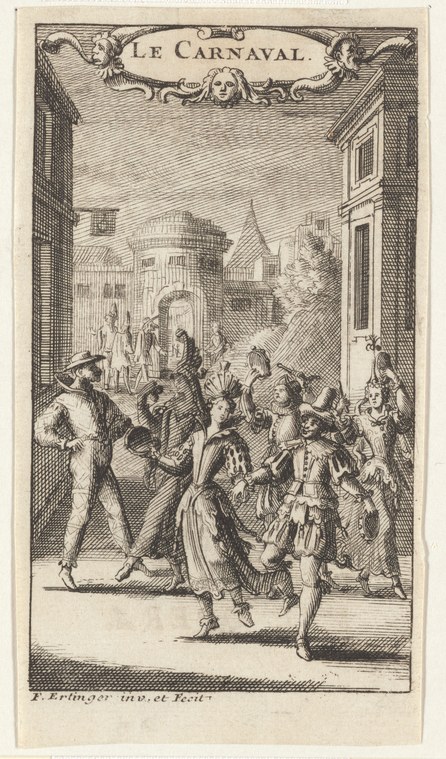
A crowded street carnival scene dominated by figures in elaborate costume and masks, rendered in a classical engraving style with cross-hatching and fine line work. The composition is framed by tall Renaissance-style buildings on either side, establishing a narrow urban street as the stage. In the foreground, multiple figures occupy the space: a man in a wide-brimmed hat and feathered costume strikes a theatrical pose on the left, while in the center and right, groups of masked and costumed revelers cluster together—some in aristocratic dress with plumed hats, others in more fantastical attire. The figures gesture animatedly, their bodies leaning toward one another in the jostle of carnival revelry. In the middle distance, a domed building suggests a Mediterranean or Italian setting, reinforcing the association with Venetian carnival tradition. The density of figures and the variety of poses suggest the chaos and mingling of social classes characteristic of carnival masquerade.
The dancing
The bodies are arranged in loose groupings rather than paired couples, and the gestures are emphatic and exaggerated—raised arms, turned heads, leaning torsos—suggesting pantomime and theatrical display rather than structured dance steps. Several figures lean toward neighbors in conversation or flirtation. The weight appears to be carried upright and forward, as if the figures are processing or parading rather than dancing in place. No visible hand-holds or closed positions; the contact is gestural and momentary. One man on the left strikes an almost balletic pose with extended leg and raised arms, though the context is comic rather than formal.
The dance depicted
This depicts carnival masquerade rather than a formal dance, though the theatrical movement and social mingling are characteristic of carnival street culture in Renaissance or early modern Venice and Italy. Carnival was a liminal period in which social hierarchies dissolved temporarily and masked figures engaged in improvised social performance and dance-like movement through urban spaces. The engraving captures the spirit of carnivalesque disorder and theatrical display rather than a specific choreographed dance form. The title *Le Carnaval* confirms this identification. Carnival dancing and movement were typically social, improvised, and mixed with pantomime and playacting—exactly what the image shows.
How it was made
This is an engraving, identified by the fine parallel lines (cross-hatching) creating tone and shadow, the crisp linear definition of forms, and the characteristic precision of the medium. Engravings of this style were typically executed on copper plates and printed on paper, allowing for multiple impressions and wide circulation. The technique permitted fine detail and nuance, making it ideal for depicting the elaborate costumes and expressive gestures of carnival figures. The style and execution suggest a northern European production (possibly French or Flemish given the signature cartouche at top and the classical architectural framing), dating likely to the 16th or 17th century, though the precise date is unknown.
About this work
This engraving documents carnival culture in Renaissance or early modern Europe, capturing a moment of masked street revelry in what appears to be an Italian city. The work belongs to a substantial tradition of carnival imagery produced for educated audiences who enjoyed prints depicting the licensed transgression and theatrical excess of the season. Such prints circulated widely among the European elite, serving as both documentary records and entertainment. The image shows us not formal dance but the kinetic sociability and performative display that accompanied carnival—the moment when ordinary urban space became a stage for masks, costume, and improvised movement.
How to look at it
Attend to the variety of body positions and the absence of synchronized movement—this is not a ballet or courtly dance but a crowd in motion. The theatrical poses and gestures suggest that the artist understood carnival movement as a form of playacting and pantomime rather than technical dance. Notice the careful rendering of costume and mask; the engraver has prioritized legibility of character and social type over anatomical precision. The architectural setting, carefully drawn in linear perspective, anchors the scene in a specific urban reality, reminding us that carnival was a street culture, not an indoor court performance.
The period
Carnival reached its peak as a cultural phenomenon during the 16th and 17th centuries in Venice and Italy, and prints depicting carnival scenes became a popular genre across northern Europe in the same period. The engraved print itself was the dominant medium for circulating imagery of social life, dance, and entertainment among educated audiences. Carnival's theatrical excess and temporary inversion of social order made it a compelling subject for printmakers, and such images often carried both documentary and satirical intent. The Renaissance fascination with classical architecture and theatrical display is evident in the composed framing of this street scene.
Where it lives
This engraving is held in the New York Public Library's collection of prints depicting dance and is catalogued under the title *Le Carnaval*. It is part of a broader collection of European Renaissance and early modern prints documenting social and theatrical life.
Questions about this work
Is this a dance or a party?
It is both. Carnival was a liminal space in which social hierarchies dissolved and movement—dancing, prancing, and theatrics—mixed freely with socializing. There is no formal choreography here, but the animated gestures and movement through space are characteristic of how people danced and moved during carnival season in early modern cities.
Where and when was this made?
The engraving appears to depict a Mediterranean or Italian city, likely Venice or another major carnival center, based on the architecture and the title. The style and technique suggest a production date in the 16th or 17th century, probably executed by a northern European printmaker producing work for wealthy collectors, though the artist and precise date are not recorded.
What do the costumes tell us?
The costumes and masks shown are characteristic of Venetian carnival: plumed hats, elaborate cloaks, and face masks that allowed social disguise and performance. The variety of costume types suggests social mixing—aristocrats, servants, and fantastical characters mingling together—which was one of carnival's defining features and attractions.
More dance artwork





