49 works in this view — arrow keys or swipe to move between them.
Dance in Art
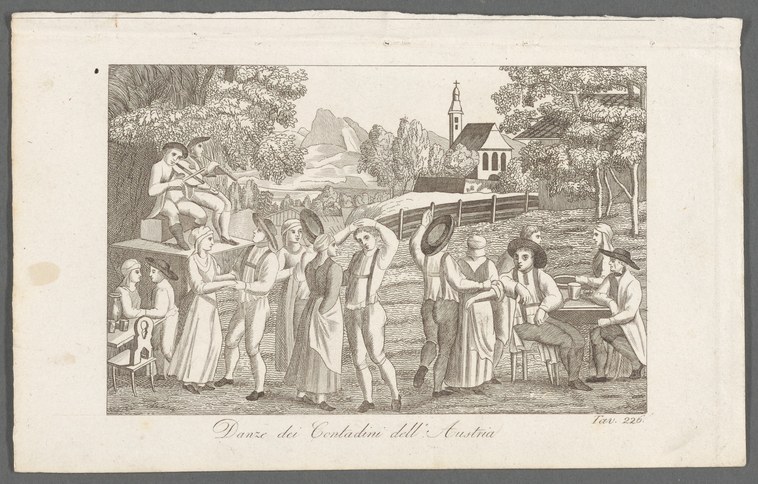
Danze dei contadini dell'Austria
Unknown artist
- Collection:
- Prints depicting dance
- Source:
- New York Public Library
- Rights:
- Public domain — free to use, share and adapt.
- Recorded as:
- Public Domain
This image preserves visual evidence of how Alpine folk dance was practiced and understood by 18th- and 19th-century European audiences, at a moment when such dances were beginning to be collected and codified. For dance historians, it offers rare contemporary documentation of peasant dance as a communal, outdoor, mixed-gender activity in its original regional setting, before standardization or theatrical adaptation.
What you are looking at
A lively outdoor scene of peasants dancing and socializing in an Alpine valley. In the foreground, couples and groups engage in folk dancing on level ground, their bodies animated in motion. The figures wear long dresses, breeches, and what appear to be traditional dress of the Austrian or Alpine region. To the left, cherubs or putti appear on a stone plinth or altar, overlooking the scene. The middle distance shows a wooden fence or railing, and the background recedes into forested hills with a church steeple visible on the right, establishing a rural, mountainous setting. The entire composition is rendered in fine engraved lines with careful attention to the play of light across fabrics and forms. The mood is festive and inclusive—multiple figures at different scales create depth, and the gathering suggests a community celebration or fair.
The dancing
The dancers move in open and closed formations typical of folk dance. Several figures appear to be in couple dances with partners; at least one pair shows the kind of facing or side-by-side alignment common to partner folk dances. Bodies are upright and energetic, with arms engaged in gestures—some raised, some at the sides or held with partners. The dancers' skirts are full and visible in the swing and movement of turning or stepping. The figures are distributed across the space rather than in formal line; some are actively dancing while others stand watching, gesturing, or preparing to join.
The dance depicted
This depicts peasant or folk dance of the Austrian or broader Alpine/Central European tradition, as the title explicitly states. The specific dances cannot be identified from the postures alone, but the setting, dress, and festive outdoor gathering are consistent with 18th- or 19th-century Alpine folk celebration—likely including social couple dances such as the Ländler or other regional polka-era dances, though the engraving's formal style may romanticize or generalize the actual practice. The presence of both dancing and spectating figures suggests this was communal recreation, likely tied to village festivals, fairs, or seasonal celebrations in rural Austria or neighboring regions.
How it was made
This is an engraving—line work executed with a burin on copper or steel plate, then printed. The technique required precise control and allowed for fine detail, as seen in the rendering of textile folds, facial expressions, and the atmospheric background. The formal, detailed style and the inscription in Italian indicate this was a finished print intended for circulation and collection, likely produced in the 18th century or later. Engravings of this subject matter and style were common in compilations of customs and folk practices, serving both as artistic works and as ethnographic or antiquarian documentation.
About this work
This engraving documents a moment of peasant festivity in the Alpine region, capturing folk dancers and their community at leisure. It belongs to a tradition of prints that recorded regional customs and social practices, serving simultaneously as art, travel record, and cultural archive. The work demonstrates how dance was understood and represented by educated European artists and audiences of the period—often with romantic idealization of rural life, yet containing genuine observation of dress, setting, and the inclusive, participatory nature of folk celebration.
How to look at it
Observe the range of motion captured: the full skirts caught in the swing of turning, the varied arm positions suggesting both restraint and expressiveness, the mix of couples dancing and individuals watching or preparing. Notice how the engraver has placed the cherubs at the top left—a classical framing device that elevates rustic celebration to a subject worthy of high art. The landscape background, though detailed, remains secondary to the human figures, emphasizing the social and physical act of dancing as the painting's true subject.
The period
This print dates from an era when European intellectuals and artists were developing new interest in folk customs, regional traditions, and the life of rural peoples. The Romantic movement's fascination with authenticity and the 'folk' drove collection and publication of such images. Simultaneously, the late 18th and 19th centuries saw the codification and popularization of dances like the Ländler, waltz, and polka—forms that originated in Alpine and Central European peasant practice but were rapidly being adopted and formalized in urban ballrooms. This print sits at the intersection: it shows the original context while being itself a product of educated interest in and appropriation of folk tradition.
Where it lives
Held in the New York Public Library's collection of prints depicting dance. The Italian inscription below the image—'Danze dei contadini dell'Austria' (Dances of the peasants of Austria)—suggests this print was either created by or circulated among Italian audiences, or reflects Italian classification practices. The catalogue reference 'Fol. 220' indicates it is part of a larger bound collection or series.
Dance in this work
Questions about this work
What dances are these people doing?
The specific dances cannot be precisely identified from the postures alone, but they are consistent with 18th- and 19th-century Alpine folk traditions such as the Ländler and related couple dances. The outdoor setting, festive gathering, and full regional dress suggest seasonal celebration or village fair. The formality of the engraving may have smoothed or idealized the actual movements.
Who made this print and when?
The artist is not recorded in the catalogue. The style, technique, and inscription suggest an 18th- or early 19th-century engraving, likely created or published in Italy or Central Europe. The Italian title indicates circulation in Italian collecting circles, but the date and maker remain unestablished.
Why would anyone collect pictures of peasant dances?
From the late 18th century onward, European Romantic thinkers and collectors became fascinated by regional folk traditions as repositories of authentic cultural identity and natural human expression. Prints like this served as both art and ethnographic documentation, allowing educated urban audiences to know—or imagine knowing—the life and customs of rural peoples.
More dance artwork





