49 works in this view — arrow keys or swipe to move between them.
Dance in Art
Folk and ethnic costumes
Unknown artist
- Collection:
- Prints depicting dance
- Source:
- New York Public Library
- Rights:
- Public domain — free to use, share and adapt.
- Recorded as:
- Public Domain
The image reveals the gap between costume and choreography: we learn what a courtier wore but not how he moved. This is the typical limitation of European ethnographic prints of the period—they documented dress and posture but missed or were uninterested in the kinetic knowledge of the culture they depicted. For scholars of how dance was understood (and misunderstood) through visual media, such images are valuable documents of European perspective and blindspot.
What you are looking at
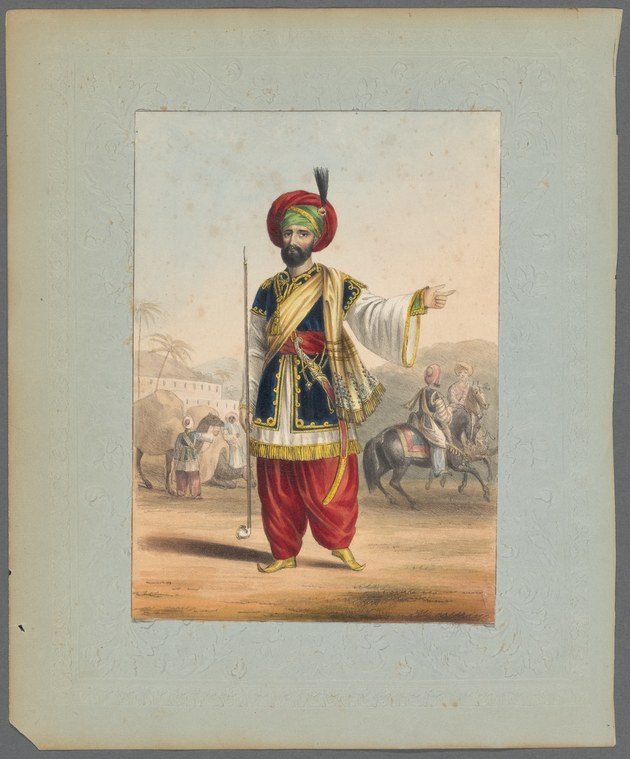
A single figure in elaborate South Asian court dress stands at the center of this hand-colored engraving, set against a dusty landscape with palm trees visible at left and a mounted figure with attendants in the middle distance at right. The man wears a red turban with a tall feather plume, a fitted yellow tunic with dark blue overjacket trimmed in gold, and full red trousers gathered at the ankles. He holds a long staff or spear in his left hand and extends his right arm in an open gesture, palm forward, in a posture of address or demonstration. His pose is frontal and formal, suggesting he is presented for inspection or documentation rather than engaged in active dance. The setting is sparse and schematic—the ground is rendered in warm ochre tones, and the figures in the background are small and incidental, establishing this as a portrait of costume and bearing rather than a narrative scene.
The dancing
The central figure stands in a formal, upright stance with weight evenly distributed and the body in profile-frontal orientation. His right arm is extended at approximately chest height, palm open and fingers relaxed—a gesture more consistent with formal presentation or classical mime than with active dance movement. His left hand grips the staff firmly. There is no visible flexion in the joints, no indication of bounce or weight transfer, and no evidence of dynamic weight shifts. The posture is static and ceremonial, designed to show the costume and the figure's rank or role rather than to capture movement.
The dance depicted
This is not a depiction of dance in motion. The figure is posed in a formal, heraldic stance that may represent a court attendant, nobleman, or official in ceremonial dress—possibly a Turkish, Persian, or North Indian functionary of the 18th or 19th century. While the elaborate costume and formal bearing speak to cultures with rich courtly dance traditions, the static presentation, frontal pose, and absence of any kinetic energy suggest this is a costume study or ethnographic illustration rather than a record of actual dance practice. The extended arm may reference a conventional gesture of authority or address used in court performance traditions, but the image is primarily documentary rather than kinetic.
How it was made
This is a hand-colored engraving, recognizable by the fine parallel line-work visible in the background and drapery, overlaid with watercolor or gouache pigment applied by hand after printing. The technique was standard for the reproduction of ethnographic and costume imagery in the 18th and 19th centuries, particularly for the popular 'Costumes of the World' series produced for European audiences. Hand-coloring allowed for accurate representation of textile and jewel tones while the engraved line provided crisp detail in features and ornament. This combination of techniques made such prints affordable and widely circulated among educated collectors, contributing to European ideas of 'the Orient' and non-European peoples.
About this work
This is an ethnographic costume study rendered as a hand-colored engraving, presenting a single figure in formal South Asian or Central Asian court dress. The figure is not dancing but standing in a static, ceremonial pose designed to display rank, costume, and bearing. The work belongs in a dance archive as a document of courtly dress and formal gesture in cultures with significant dance traditions, and as evidence of how 19th-century European printmakers chose to represent non-European bodies—as objects of visual study rather than as moving subjects. It is part of a widespread genre of costume prints that shaped European perception of global dance traditions without directly depicting dance itself.
How to look at it
Notice the pose: it is frontal and formal, designed for display, not movement. The extended right arm does not suggest an active gesture within dance but rather a conventional pose of address or authority—the kind of stance that would have been held for the duration of a sitting or standing portrait. Observe how the costume—the turban, the layered jacket, the gathered trousers, the jeweled belt—dominates the composition; the body is a hanger for cloth and ornament. The background is minimal and schematic, placing no emphasis on the setting or context where such dress would actually be worn or danced. This is a study in appearance, not in motion.
The period
This print belongs to the 19th-century boom in ethnographic imagery for European consumers. Following colonial expansion and the rise of international trade, European publishers produced thousands of hand-colored costume prints, often compiled into series with titles like 'Costumes of All Nations' or 'People of India.' These prints were sold as educational material, collected as curiosities, and displayed as evidence of European knowledge and dominion. They typically presented non-European peoples in static, isolated poses—removed from their social and kinetic contexts and arranged for the European eye. The formal, heraldic presentation of this figure is typical of the genre: the body is shown as an object of visual information, not as an agent of movement or social practice.
Where it lives
The work is held in the New York Public Library's Prints collection under the title 'Folk and ethnic costumes' with no recorded artist, date, or medium. It is part of a broad category of hand-colored ethnographic engravings produced for European circulation in the 19th century, likely part of a costume series now dispersed across museum collections.
Questions about this work
Is this a dancer?
The figure is posed in formal dress but is not shown dancing or moving. He stands in a static, ceremonial stance designed to display costume and bearing. He may be a courtier, official, or attendant in a culture with significant dance traditions, but this image documents his appearance, not his movement.
What culture does the costume represent?
The style suggests a Central Asian, Persian, or North Indian court tradition, judging from the turban style, the layered jacket, the gathered trousers, and the jewelry. However, without a dated or attributed record, the exact origin and period cannot be confirmed. Such prints often mixed or generalized costume details for European audiences.
Why was this print made?
It is part of the 19th-century European market for ethnographic imagery. Such prints were sold as educational material, collected as evidence of cultural knowledge, and displayed to show the range and 'exoticism' of non-European dress. They were made for European buyers, not for documentation within the culture depicted.
How does the gesture relate to dance?
The extended arm with open palm may reference a formal gesture from courtly performance traditions, but it is presented here as a static, heraldic pose rather than as a moment within movement. It shows the conventional bearing of a court figure, not an active step or frame from a dance.
More dance artwork





